

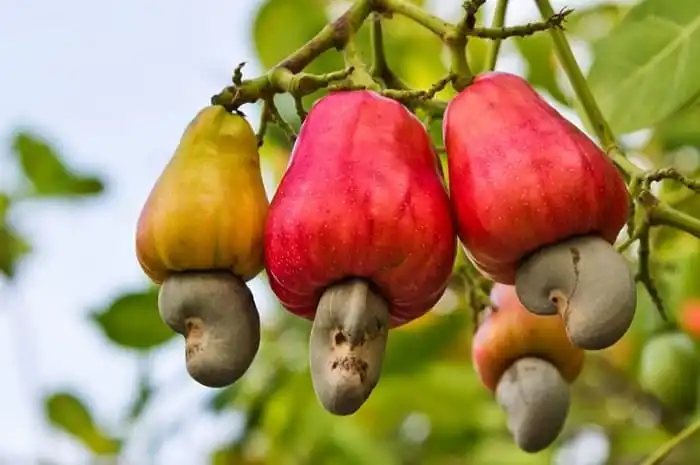

- Ghana Processes Less Than 6% of Cashew Harvest as Raw Exports Drain Industrial Value
Ghana is capturing only a fraction of the economic value generated by its cashew industry, processing less than 6.00% of domestic production locally even as output expands and the country strengthens its position as a regional export hub.
A new industry study estimates that only about 15,000 metric tonnes of raw cashew nuts were processed locally in 2025 out of total domestic production of roughly 262,000 metric tonnes.
That means more than 94.00% of Ghana’s locally produced cashew left the country in raw form, allowing most of the higher-value processing, manufacturing, employment and tax benefits to accrue in established processing centres such as Vietnam and India.
The imbalance highlights a broader weakness in Ghana’s industrialisation strategy: the country continues to expand agricultural production without building sufficient downstream capacity to convert raw output into higher-value products.
The consequences became particularly evident during the 2025 marketing season.
Farm-gate prices rose from about GH¢16.00 per kilogramme in January to GH¢20.00 in February before falling sharply to around GH¢7.00 by May.
The collapse exposed farmers to the volatility of international demand and demonstrated the risks associated with an industry that depends heavily on raw exports and has limited domestic processing capacity capable of absorbing excess supply.
Researchers argue that a stronger processing industry could help create an alternative market for farmers, improve price stability and reduce the sector’s exposure to fluctuations in overseas purchasing.
The problem is complicated further by Ghana’s role as a transit and export platform for cashew produced elsewhere in West Africa.
While domestic production was estimated at around 262,000 tonnes, total raw cashew exports reached approximately 444,000 tonnes in 2025.
The difference was largely accounted for by informal imports from Côte d’Ivoire, Mali and Burkina Faso that were routed through Ghana and exported through Tema Port.
That trading model has strengthened Ghana’s position as a regional logistics hub, but it has done far less to deepen domestic manufacturing.
In effect, Ghana has become efficient at moving raw cashew out of West Africa without becoming equally efficient at processing it.
The lost industrial opportunity is considerable.
According to the study, a modern cashew processing plant with annual capacity of about 20,000 metric tonnes could directly employ more than 600 workers while supporting additional jobs in logistics, engineering, packaging, maintenance and transport.
Scaling multiple facilities across the main producing regions could therefore turn cashew into a more significant industrial employment generator.
The constraint, however, is cost.
Establishing a modern processing facility in Ghana is estimated to require approximately US$9.20 million, compared with about US$5.30 million in Vietnam.
That represents a cost disadvantage of roughly 73.58% before processors even begin competing for raw nuts.
Domestic firms also face high electricity tariffs, expensive imported machinery and borrowing costs that can exceed 20.00%, weakening their ability to compete with processors operating in more supportive industrial environments.
These cost pressures help explain why Ghanaian processors struggle to buy raw cashew at prices competitive with exporters.
An exporter may be able to purchase nuts and quickly ship them to established Asian processors, while a local factory must absorb financing costs, energy expenses, labour, packaging, machinery depreciation and inventory risk.
The Association of Cashew Processors of Ghana is therefore urging government to place the sector within the country’s 24-Hour Economy and Accelerated Export Development agenda.
The group argues that Ghana already has the policy architecture needed to support local processing but requires stronger incentives and targeted implementation.
Rather than recommending an outright ban on raw cashew exports, the study proposes a more calibrated intervention.
Among the measures are a variable export levy on raw nuts, establishment of a Cashew Development Fund, tax incentives for local processors, improved access to affordable working capital and dedicated agro-industrial parks in Bono and Bono East.
A variable levy could help address the structural disadvantage facing local factories by making raw exports relatively less attractive when domestic processing capacity requires support.
The proceeds could potentially be channelled into sector development, although the effectiveness of such a mechanism would depend heavily on governance and how revenues are deployed.
Working capital is equally important.
Cashew processors must purchase substantial quantities of raw nuts during the harvesting season and hold inventory for processing over time.
At borrowing rates above 20.00%, financing those purchases can significantly raise production costs and weaken competitiveness.
The study also identifies value opportunities beyond edible kernels.
Cashew shells can be processed into Cashew Nut Shell Liquid, biofuel and biochar, creating additional revenue streams from what might otherwise be treated as waste.
Vietnam and India have developed commercial industries around such by-products, while Ghana has yet to exploit them at meaningful scale.
That matters because deeper processing improves the economics of the entire value chain.
A processor able to generate revenue from kernels, shell liquid and energy products can extract considerably more value from each tonne of raw nuts than a business focused solely on exporting unprocessed produce.
The central policy challenge is therefore no longer simply increasing cashew cultivation.
Ghana already produces meaningful volumes and has become an important regional trading centre.
The weakness lies in converting those volumes into domestic industrial activity.
Without reforms to reduce financing costs, improve energy competitiveness, expand processing infrastructure and create stronger incentives for value addition, rising production alone may continue to benefit overseas processors more than Ghanaian industry.
The cashew sector therefore illustrates a wider development dilemma facing the economy.
Ghana has repeatedly sought to industrialise while continuing to export large quantities of raw agricultural and mineral commodities.
The new study suggests that cashew offers a practical test of whether that model can change.
Processing even a materially larger share of the current 262,000-tonne domestic harvest could create jobs, diversify exports and retain more value within the economy.
Failing to do so would leave Ghana with the same structural outcome: producing the raw material while other countries capture most of the industrial reward.

