- Ghana Pulls Adamus Licences: ‘Illegal Mining’ Claims Trigger Lease Revocation
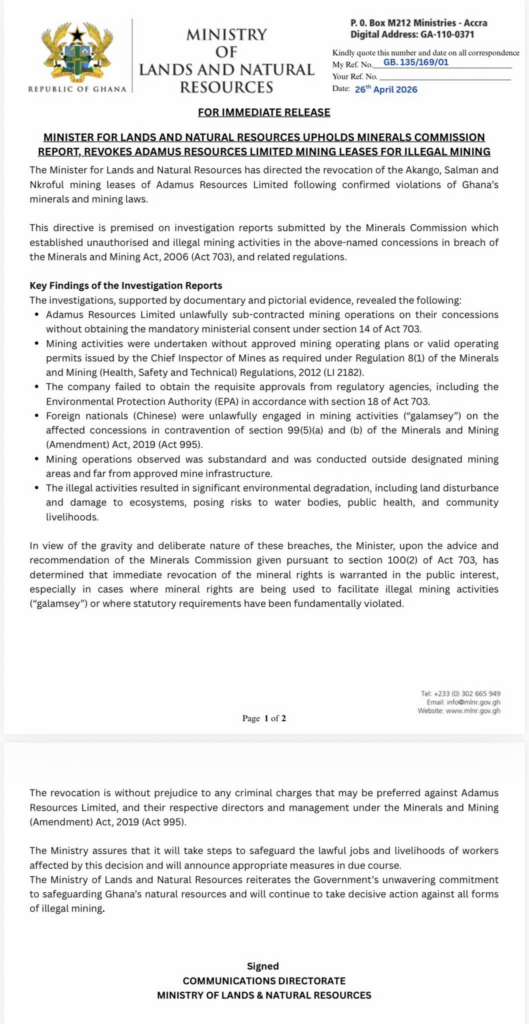
Ghana’s Ministry of Lands and Natural Resources has ordered the immediate revocation of three mining leases held by Adamus Resources Limited after an investigation by the Minerals Commission concluded that the company’s concessions had been used for unauthorised and illegal mining activities in breach of the country’s minerals and mining laws.
In a statement dated April 26, 2026, the ministry said the minister had directed the revocation of the Akango, Salman, and Nkroful mining leases, citing “confirmed violations of Ghana’s minerals and mining laws.” The decision, it added, was premised on investigation reports submitted by the Minerals Commission, which “established unauthorised and illegal mining activities” within the concessions, contrary to the Minerals and Mining Act, 2006 (Act 703) and related regulations.
The ministry’s action lands in the middle of an increasingly politicised national crackdown on illegal mining, where the government has sought to demonstrate that enforcement will extend beyond informal “galamsey” operators to include corporate permit holders, where regulators conclude that statutory controls have been sidestepped or abused.
According to the ministry, the investigation supported by documentary and pictorial evidence found that Adamus “unlawfully subcontracted mining operations” on its concessions without obtaining mandatory ministerial consent, as required under section 14 of Act 703.
Investigators also concluded that mining activity was undertaken without approved operating plans or valid operating permits issued by the Chief Inspector of Mines, as required under Regulation 8(1) of the Minerals and Mining (Health, Safety and Technical) Regulations, 2012 (LI 2182).
The statement further said the company failed to obtain approvals from other regulatory agencies, including the Environmental Protection Agency (EPA), in line with section 18 of Act 703 a gap that, if sustained, can widen the risk envelope around environmental compliance, tailings management, and operational safeguards.
One of the most politically sensitive findings involved foreign participation. The ministry said foreign nationals, identified as Chinese, were “unlawfully engaged in mining activities (‘galamsey’)” on the affected concessions, in contravention of section 99(5)(a) and (b) of the Minerals and Mining (Amendment) Act, 2019 (Act 995).
It also said the mining operations observed were “substantial” and were conducted outside designated mining areas and away from approved mine infrastructure, an allegation that, if sustained through enforcement proceedings, would go to the heart of how mineral rights are policed after issuance and whether leaseholders maintain effective operational control over their concessions.
The ministry linked the activity to “significant environmental degradation”, including land disturbance and damage to ecosystems, warning of risks to “water bodies, public health, and community livelihoods”.
The government framed the decision as an enforcement response to what it characterised as grave and deliberate statutory breaches. The minister, acting “upon the advice and recommendation of the Minerals Commission” under section 100(2) of Act 703, determined that immediate revocation was warranted “in the public interest”, particularly in cases where mineral rights are used to facilitate illegal mining or where statutory requirements have been “fundamentally violated”.
While the statement does not detail the timeline of the investigation or whether Adamus was granted an opportunity to respond before the revocation decision, the ministry’s language signals that the administration is prepared to use licensing sanctions, not only criminal enforcement, as a frontline tool in the illegal mining campaign.
Crucially, the ministry stressed that the revocation is “without prejudice” to any criminal charges that may be pursued against Adamus, its directors and management under Act 995. In other words, the loss of the leases does not close the door to potential prosecution if law enforcement agencies decide the facts meet the threshold for criminal liability.
At the same time, the ministry sought to pre-empt concerns about job losses and local economic disruption in affected districts, saying it would take steps to safeguard “the lawful jobs and livelihoods of workers” impacted by the decision and would announce “appropriate measures in due course”.
The statement closed by reiterating what it called the government’s “unwavering commitment” to safeguarding Ghana’s natural resources and pledged continued “decisive action against all forms of illegal mining”.