

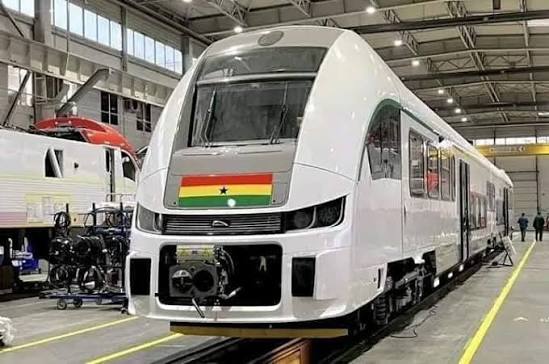

- Ghana Secures €20 Million EU Grant To Boost Tema–Mpakadan Rail Freight Capacity
Ghana has secured a €20 million grant from the European Union to modernise signalling on the Tema–Mpakadan standard-gauge railway, in a move expected to unlock freight capacity, improve safety and strengthen the country’s ambition of becoming a regional logistics hub.
The funding, equivalent to about US$21 million, has been awarded to the Ghana Railway Development Authority to finance the installation of the European Train Control System Level 1 on the corridor.
The digital signalling system will allow multiple trains to operate safely and efficiently on the line, removing one of the most significant constraints that has limited the railway’s full commercial use since it became operational.
Without a modern signalling system, train movements on the Tema–Mpakadan line have remained restricted, limiting service frequency, traffic coordination and the corridor’s ability to carry large volumes of freight.
The planned upgrade is expected to improve train control, enhance passenger and cargo safety, increase operational reliability and expand the railway’s carrying capacity.
For Ghana, the investment comes at a critical time. The country has spent heavily on transport infrastructure in recent years and is under pressure to ensure that those investments generate measurable economic returns.
The Tema–Mpakadan railway is one of the most strategically important transport projects in the country because of its connection to the Port of Tema and its potential to move cargo more efficiently into inland markets.
By improving the railway’s operational capacity, policymakers expect more freight to shift from road to rail. That could reduce pressure on highways, lower vehicle congestion, cut road maintenance costs and improve the efficiency of cargo movement from the port.
The project also fits into Ghana’s broader effort to support more sustainable logistics. Rail transport is generally more efficient for bulk freight than road haulage, particularly over long distances. If the Tema–Mpakadan corridor becomes fully functional for commercial freight, it could improve the competitiveness of Ghana’s logistics and transport sector.
The EU grant is also significant because it comes in the form of non-debt financing.
At a time when Ghana is still managing the consequences of its debt restructuring programme and implementing fiscal reforms, grant financing allows the country to upgrade critical infrastructure without adding to the sovereign debt burden.
That distinction matters for public finance. Infrastructure needs remain large, but Ghana’s fiscal space is still constrained. Concessional and grant-based support for commercially useful projects can therefore help the country continue investing in growth-enhancing infrastructure while maintaining debt discipline.
The Tema–Mpakadan line forms the first phase of the proposed Ghana–Burkina Faso railway corridor, a wider regional transport project designed to connect the Port of Tema to Burkina Faso and deepen trade links within West Africa.
If completed and efficiently operated, the corridor could support regional integration under the African Continental Free Trade Area by improving the movement of goods between coastal and landlocked markets.
For Burkina Faso and other inland economies, improved rail connectivity through Ghana could offer a more efficient route for imports and exports. For Ghana, it would strengthen the country’s position as a transit gateway and logistics hub for the sub-region.
The signalling upgrade is therefore more than a technical intervention. It is a key step in turning a major rail asset into a commercially viable transport corridor.
For the private sector, particularly shipping lines, freight forwarders, importers, exporters and logistics companies, reliability will be critical. Businesses will only shift cargo from road to rail if the railway offers predictable schedules, safe cargo handling, efficient coordination with the port and competitive pricing.
The installation of the European Train Control System Level 1 is expected to help create the foundation for that reliability.
The system should improve the management of train movements, reduce operational risks and support more regular services. That could make the railway more attractive for bulk cargo, containerised goods and other freight categories that currently depend heavily on road transport.
The investment also has implications for industrial policy.
Ghana’s long-term ambition to expand manufacturing, agro-processing, mining logistics and export-oriented production will depend partly on reducing transport bottlenecks. High logistics costs can weaken competitiveness, raise consumer prices and discourage investment in productive sectors.
An efficient rail corridor from Tema into the interior could support industrial parks, inland logistics terminals, warehousing, agriculture value chains and cross-border trade.
The EU’s support also reinforces its role as a strategic infrastructure partner for Ghana, particularly in projects linked to trade facilitation, green transport and regional integration.
For Ghanaian authorities, however, the key test will be implementation. The grant must translate into a functioning signalling system, trained operators, maintenance capacity and a clear operating model that supports both passenger and freight services.
Too often, infrastructure projects underperform because the supporting systems are not completed or because operational planning lags behind construction. The Tema–Mpakadan railway can avoid that outcome only if signalling, rolling stock, cargo handling, commercial agreements and maintenance systems are aligned.
The €20 million grant is therefore a welcome boost, but it is not the final destination.
The real value will come when the line begins moving freight at scale, reducing the burden on roads and providing businesses with a credible rail alternative.
For Ghana, the opportunity is clear: turn the Tema–Mpakadan line from an infrastructure project into a productive economic corridor.
If the signalling upgrade delivers as expected, it could mark an important step towards a more modern, safer and commercially viable railway network capable of supporting trade, industry and regional competitiveness.

