


- Ghana Secures International Certification for 6.57 million Carbon Credits After Nearly Two Decades of Forest Conservation
Ghana has secured international certification for 6.57 million forest carbon credits with a potential commercial value of approximately US$68 million, marking a significant breakthrough in the country’s efforts to convert forest conservation into a source of climate finance.
However, the government has yet to receive the expected proceeds, raising important questions about the timing of payments, the commercial value of the remaining credits and whether forest-dependent communities will receive their promised share of the revenue.
The credits were issued on November 12, 2026, by the Architecture for REDD+ Transactions (ART), an international carbon-crediting programme that independently verifies reductions in emissions from deforestation and forest degradation.
The development makes Ghana the first African country and third globally, after Guyana and Costa Rica, to receive credits under ART’s REDD+ Environmental Excellence Standard, known as TREES.
The achievement covers approximately 2.50 million hectares of forest landscapes and recognises verified emission reductions achieved between 2017 and 2021.
Each credit represents one tonne of carbon dioxide equivalent in certified emission reductions, meaning Ghana has secured recognition for approximately 6.57 million tonnes of avoided greenhouse gas emissions.
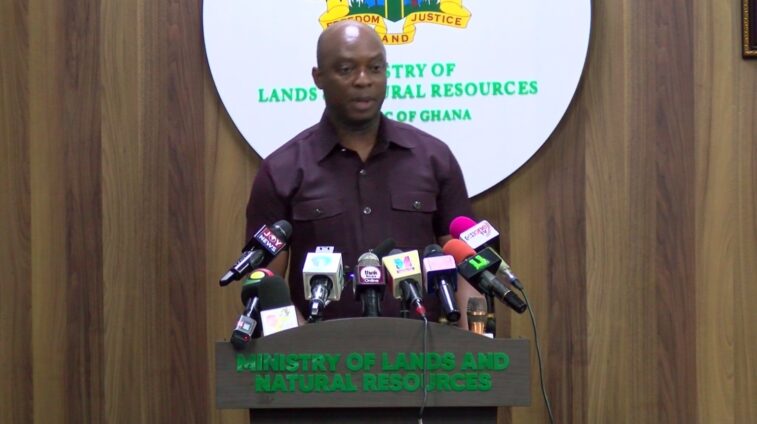
Speaking at a media engagement in Accra on Monday, November 23, Minister for Lands and Natural Resources Emmanuel Armah-Kofi Buah described the certification as the culmination of almost two decades of efforts to protect Ghana’s forest resources.
The Minister acknowledged the contributions of successive governments, the Forestry Commission and other stakeholders involved in strengthening forest monitoring and conservation.
“We have taken this journey since 2008. Successive Governments have contributed to making sure we continue to protect our forests.”
The statement underscores the length of time required to build the institutional systems needed to participate credibly in international forest carbon markets.
For Ghana, the certification represents an opportunity to attract foreign exchange from environmental conservation rather than relying exclusively on conventional commodity exports.
Nevertheless, the distinction between certified carbon credits and actual revenue remains critical.
Chief Executive of the Forestry Commission, Dr Hugh C. A. Brown, disclosed that international buyers, including members of the LEAF Coalition, have committed to purchasing approximately four million credits valued at US$43 million.
The remaining 2.50 million credits are available for additional transactions and could generate another US$25 million if buyers are secured at the anticipated prices.
Together, the committed and potential sales could produce approximately US$68 million.
However, the full amount is neither guaranteed nor already available to the government.
Dr Brown confirmed that Ghana had not yet received payment from the committed transactions, emphasising that certification represents an important step towards commercialisation rather than the completion of the revenue process.
Certification and commercial estimates as announced in November 2026. The projected US$68 million is not revenue already received.
The commercial implications are significant because forest carbon markets create a mechanism through which countries can receive financial rewards for demonstrable environmental outcomes.
Rather than being compensated simply for possessing forests, participating jurisdictions must establish that their activities have reduced emissions against an approved reference level.
The verification process requires credible forest monitoring, reliable carbon accounting, compliance with environmental and social safeguards, and independent assessment of reported results.
Ghana’s certification therefore reflects measurable conservation achievements supported by a substantial technical and institutional process.
The Forestry Commission explained that the emission reductions were independently assessed before the credits were issued.
Dr Brown stated, “these credits were not simply allocated to Ghana. They were earned through results that had to be achieved, measured, reported, independently validated, and verified.”
The certification also carries international significance because Ghana’s credits are the first issued under ART’s TREES Crediting Level approach and the first TREES credits to carry the Core Carbon Principles Approved label in the ART registry.
The designation is intended to provide additional assurance about the environmental integrity of carbon credits.
Such credibility could improve Ghana’s ability to attract international buyers in a market where concerns about the quality and reliability of carbon offsets have become increasingly important.
However, the economic significance of the development will ultimately depend on the country’s ability to secure commercially favourable agreements and ensure that the proceeds reach the institutions and communities responsible for conservation.
An approved benefit-sharing arrangement provides that 46.00% of the revenue will be allocated to forest-fringe communities, farmers and traditional authorities.
Government institutions, including the Forestry Commission, Metropolitan, Municipal and District Assemblies, COCOBOD and the Ghana National Fire Service, will receive 39.00%.
Environmental non-governmental organisations are allocated 2.00%, while the private sector will receive 3.00%.
The remaining 10.00% is earmarked for programme management, including monitoring, validation and verification costs.
If the entire projected US$68 million were realised and distributed using these percentages, forest communities, farmers and traditional authorities could collectively receive approximately US$31.28 million.
Government institutions would receive US$26.52 million, while programme management would account for US$6.80 million.
These are illustrative allocations based on the announced formula, rather than confirmed payments to beneficiaries.
The arrangement reflects the importance of local participation in forest conservation.
Farmers and communities living around forest reserves often face competing economic incentives, including agricultural expansion, timber extraction and other land-use activities.
Providing direct financial benefits for conservation could help make forest protection economically attractive.
However, the success of the model will depend on transparent distribution arrangements, accurate identification of beneficiaries and the extent to which payments support sustained conservation.
Ghana’s previous experience demonstrates the potential for such arrangements.
Under the Ghana Cocoa Forest REDD+ Programme, the country received approximately US$21.80 million in payments between 2023 and 2024.
The Forestry Commission says those resources supported forest protection, landscape restoration and community development initiatives, including farming inputs, boreholes, health facilities and educational infrastructure.
The experience provides a precedent for converting verified conservation outcomes into financial support for rural communities.
Nevertheless, the latest programme is considerably broader in its potential commercial value and will require effective oversight to ensure that benefits are distributed fairly.
The challenges are particularly important because Ghana’s forests remain exposed to substantial environmental pressures.
Illegal mining, illegal logging, wildfires and unsustainable agricultural expansion continue to threaten forest reserves and surrounding landscapes.
These activities have consequences beyond environmental degradation.
They could undermine Ghana’s ability to demonstrate additional emission reductions and therefore restrict future opportunities to generate carbon credits.
The next monitoring period will cover 2022 to 2026, with subsequent certification dependent on independently verified conservation results.
This creates a direct economic incentive for stronger forest protection.
Failure to address deforestation could reduce future credit issuance and undermine anticipated carbon-related revenue.
Conversely, sustained conservation and improved monitoring could strengthen Ghana’s position in international carbon markets.
The Food and Agriculture Organization of the United Nations has supported the Forestry Commission through its Accelerating Innovative Monitoring for Forests programme.
The assistance has included improvements in forest data collection, carbon accounting, satellite monitoring and quality assurance.
These capabilities are essential because international buyers require credible evidence that emission reductions are genuine, measurable and independently verified.
The central economic opportunity is that Ghana has established an internationally recognised financial value for verified forest conservation, but must now demonstrate that certification can translate into actual payments and lasting environmental protection.
The proposed US$68 million revenue opportunity is significant, particularly for communities whose livelihoods depend on forest resources.
However, its eventual contribution to Ghana’s economy will depend on completed transactions, buyer commitments, market prices and the credibility of future conservation outcomes.
For policymakers, the immediate priority is converting the initial purchase commitments into payments while establishing transparent mechanisms for distributing the proceeds.
For the Forestry Commission, the challenge is maintaining the environmental standards required to support further credit issuance.
And for local communities, the test will be whether participation in forest conservation generates tangible economic benefits.
Ghana’s entry into the international jurisdictional forest carbon market marks a potentially important development in the country’s climate-financing strategy.
Yet the long-term success of the initiative will not be measured solely by the number of carbon credits issued or the estimated value attached to them.
It will depend on how much revenue is actually mobilised, whether forest-dependent communities receive their allocated benefits and whether the financial incentives contribute to a sustained reduction in deforestation.
The milestone has established Ghana’s eligibility to participate in a potentially valuable market. Turning that opportunity into lasting economic and environmental gains is the next challenge.

