


- Ghana Turns to Meiji Partnership to Reshape Cocoa Economy Around Sustainability and Value Addition
Ghana has deepened its partnership with Japanese confectionery group Meiji Holdings Co Ltd as the government seeks to reposition the country’s cocoa industry around sustainability, farmer welfare and greater domestic value creation, moving beyond its traditional role as a supplier of raw beans.
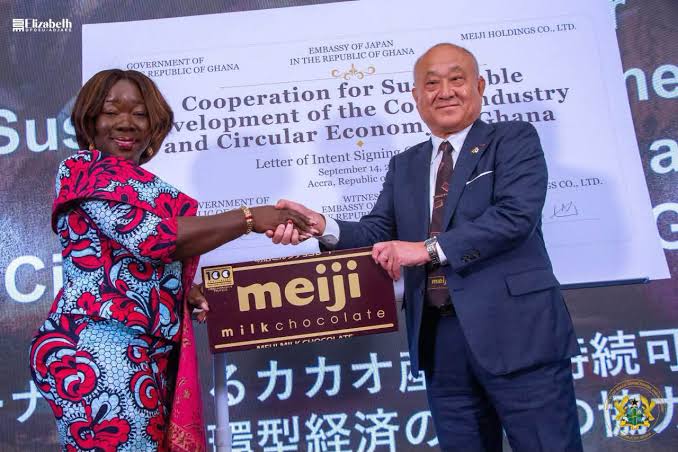
The government signed a Letter of Intent for Cooperation on the Sustainable Development of the Cocoa Industry and Circular Economy in Ghana with Meiji in Accra on September 14, extending a relationship that has linked Ghanaian cocoa with Japanese chocolate production for decades.
The agreement was signed by Trade, Agribusiness and Industry Minister Elizabeth Ofosu-Adjare on behalf of Ghana, while Japan’s Ambassador to Ghana, Hiroshi Yoshimoto, signed for the Japanese government. Meiji Holdings’ chief executive also initialled the agreement as part of activities marking the centenary of Meiji’s Milk Chocolate.
Ms Ofosu-Adjare said the partnership reflected Ghana’s determination to shift the cocoa sector from a raw commodity model towards one capable of generating greater economic value through domestic processing, environmental protection and industrial innovation.
“The agreement demonstrates Ghana’s commitment to transforming its cocoa sector from a raw commodity exporter to a value addition hub that prioritizes farmer welfare, environmental protection and industrial innovation,” she said.
The timing is significant because Ghana’s cocoa economy is confronting pressures that go beyond fluctuations in international prices.
The country remains dependent on cocoa for agricultural income, rural employment and foreign exchange, but production is increasingly threatened by ageing trees, disease, climate variability, illegal mining and relatively low productivity. The challenge is therefore not simply maintaining export volumes, but making cocoa farming economically attractive enough for producers to continue investing while increasing the amount of value retained locally.
That makes sustainability as much a financial question as an environmental one.
Debate across the global cocoa industry has increasingly focused on how value is distributed along the supply chain. Ghana Cocoa Marketing Company Managing Director Wisdom Kofi Dogbey has warned that farmers receive less than 10% of the profits generated across the international cocoa value chain.
“Put the money back into the farm,” Mr Dogbey told an international cocoa conference in Singapore, adding that “our adversary in this cycle is volatility, not each other.”
That context gives the Meiji agreement a more demanding economic test.
A sustainability partnership will achieve little if it merely creates additional certification and compliance costs without materially improving farmer incomes. The commercial objective must be to make Ghanaian cocoa farms more productive, resilient and profitable while protecting the environmental foundations on which future production depends.
Ghana has already begun strengthening the policy framework around that ambition.
The Ghana Cocoa Board Act, 2026, gives statutory backing to the government’s commitment that farmers should receive at least 70% of the world market price. President John Dramani Mahama has also said the legislation supports the government’s objective of processing at least 50% of Ghana’s cocoa beans domestically.
The Meiji partnership could therefore become an important private-sector complement to government policy.
For Meiji, dependable access to quality cocoa ultimately depends on the economic sustainability of farming communities. For Ghana, an international chocolate manufacturer can potentially create greater value as a long-term industrial and technology partner than simply as another buyer of raw beans.
That distinction matters because Ghana has historically occupied the lower end of the cocoa value chain, exporting beans while much of the processing, manufacturing, branding and marketing takes place elsewhere.
The government’s industrial strategy is attempting to alter that structure by expanding domestic processing and attracting investment around agricultural commodities.
The circular-economy element of the Meiji agreement adds another dimension.
Meiji presented 10,000 cacao bioplastic ballpoint pens produced from cocoa-related materials, illustrating how agricultural by-products could potentially be converted into commercial products rather than treated purely as waste.
For Ghana’s cocoa industry, that could eventually create additional markets for cocoa husks and processing residues and open opportunities around organic fertilisers, bio-based materials and other green products.
The economic logic is attractive: if processors can extract value not only from cocoa beans but also from by-products, the industry could generate additional income streams while improving resource efficiency.
But turning that concept into an industry will require considerably more than symbolic demonstrations.
Commercialisation will need investment, research, technology, reliable markets and clear arrangements around intellectual property. It will also require coordination among the Ministry of Trade, Agribusiness and Industry, Ghana Cocoa Board, environmental authorities, research institutions and private companies.
Chief of Staff Julius Debrah accordingly urged the relevant institutions to work closely together and maintain a focus on implementation.
That emphasis is particularly important because the Letter of Intent does not disclose a specific investment value, binding project commitments or implementation timetable. Its immediate significance lies in establishing a framework for deeper cooperation rather than announcing a large financial injection into the cocoa sector.
The next phase will therefore determine whether the agreement translates into programmes capable of improving productivity, traceability, climate resilience, domestic processing and farmer incomes.
The partnership also fits into a wider regional debate. Ghana and Côte d’Ivoire, which together account for about 60% of global cocoa production, have increasingly argued that the future of the industry requires greater price stability, environmental protection, industrialisation and cooperation on challenges such as climate change and illegal mining.
For Ghana, the economics are increasingly straightforward: the country needs a cocoa industry capable of rewarding farmers adequately, withstanding production shocks, financing itself more sustainably and retaining a larger share of value domestically. Japan and Meiji, meanwhile, need a dependable supply of quality cocoa produced under increasingly demanding environmental and social standards.
The opportunity lies in converting those overlapping interests into investment.
If the partnership succeeds, sustainability would become part of the commercial model rather than simply an external compliance requirement; farmers would be rewarded for sustainable production; cocoa waste could become an input into new industries; and more of the value created from Ghanaian cocoa would remain in Ghana.
The real test, however, will not be the signing ceremony. It will be whether cocoa farmers eventually see higher and more predictable incomes, healthier farms and stronger incentives to plant the next generation of trees.
For Ghana, the strategic question is no longer simply how much cocoa it can sell. It is how much value it can create and retain from every bean it produces.

