

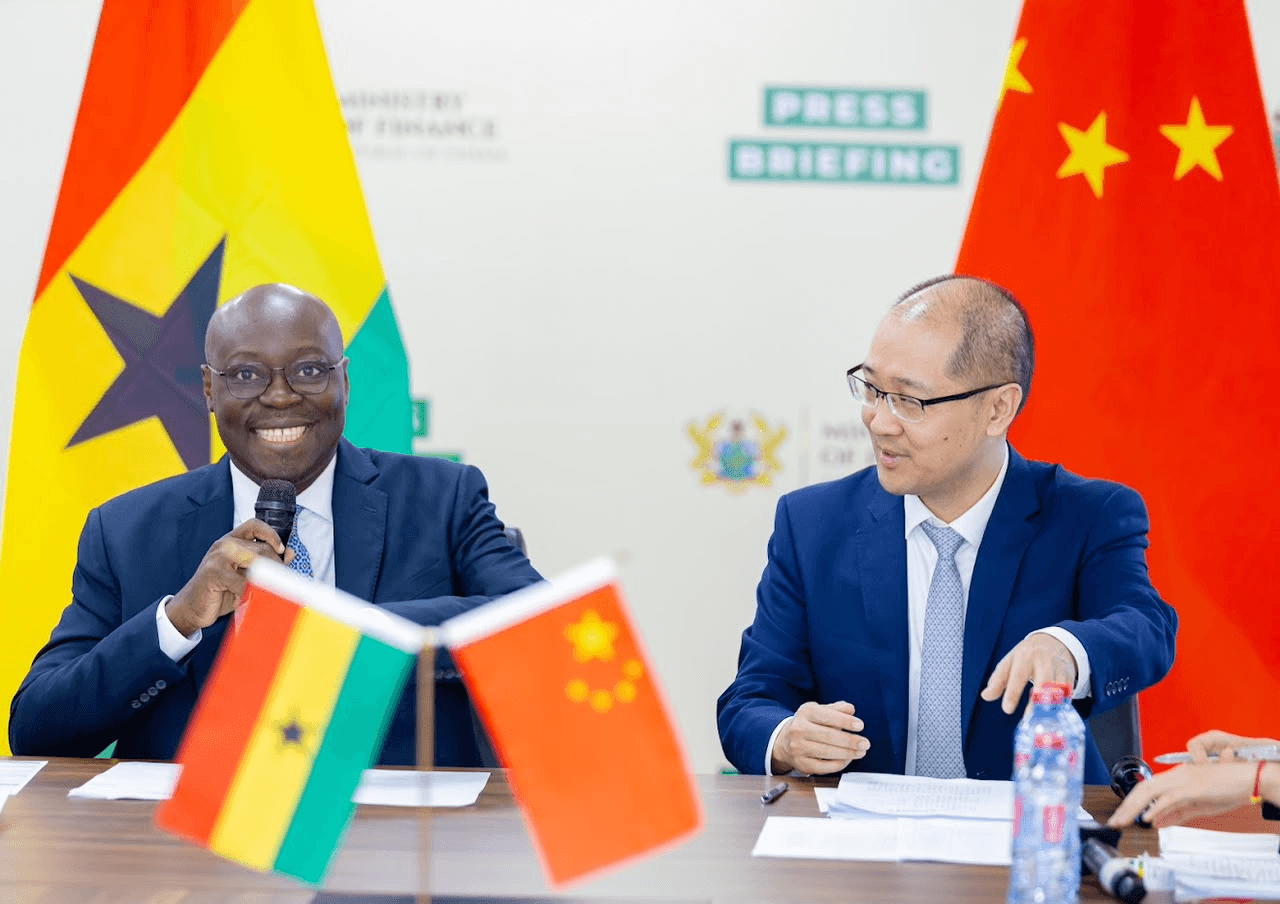

- Ghana Wants More Than Trade from China as Government Targets Technology Transfer and Local Production
Ghana is seeking to recast its economic relationship with China away from the traditional exchange of raw commodities for manufactured imports, as the government pushes for Chinese capital to finance domestic processing, industrial production and technology transfer.
Finance Minister Dr Cassiel Ato Forson said the scale of trade between the two countries was no longer sufficient as a measure of the relationship, arguing that Ghana needed to capture a larger share of the value generated from its natural resources before they left the country.
“China is now Ghana’s largest trading partner, but the structure must improve,” Dr Forson said at the opening of the Fifth Session of the Ghana–China Joint Commission on Economic, Trade and Technical Cooperation.
The statement goes to the heart of a longstanding weakness in Ghana’s external trade structure. A country can export large volumes of commodities and still capture relatively little of the value ultimately generated from them if the higher-margin activities processing, branding, manufacturing, logistics and technology take place elsewhere.
For Ghana, the ambition is therefore no longer simply to sell more to China. It is to change what is being sold, where it is processed and how much of the production chain remains inside the Ghanaian economy. At the centre of that strategy is a push for greater domestic processing of commodities such as cocoa.
Ghana is one of the world’s major cocoa-producing countries, but the largest share of value in the cocoa economy is created further downstream in processing, confectionery, branding and retail. That means a tonne of cocoa beans exported from Ghana can ultimately generate far more value once transformed into finished consumer products abroad.
“We seek investments that build processing plants and manufacturing lines, transfer technology, procure from Ghanaian businesses, train our people and create sustainable jobs,” he said.
That formulation is important because it establishes a much broader test for foreign direct investment. The amount of capital entering Ghana matters, but the more consequential question is what that capital leaves behind.
A foreign-owned factory that imports most of its inputs, employs relatively few local workers and retains little technical knowledge domestically may increase investment statistics without materially deepening Ghana’s productive capacity.
An investment that develops Ghanaian suppliers, trains engineers, introduces new production processes and connects local companies to export markets can have a much larger economic effect.
The government’s emerging position therefore appears to be that Chinese investment should increasingly be judged by the strength of those domestic linkages.
That represents a shift from a purely transactional trade relationship towards a more industrial one.
Ghana’s repeated exposure to foreign-exchange shortages and commodity-price shocks has demonstrated the limits of an economy that depends heavily on primary exports while importing large quantities of manufactured goods. When commodity prices weaken, export earnings can fall quickly.
When the cedi depreciates, the cost of imported machinery, intermediate goods and finished products rises. A larger base of manufactured and processed exports could help reduce that vulnerability by broadening Ghana’s sources of foreign exchange.
Processing cocoa domestically, for example, creates demand beyond the factory itself. Packaging companies, transport operators, laboratories, maintenance contractors, logistics firms, designers and exporters can all become part of the production chain.
That is where value addition begins to matter economically. The objective is not simply to replace one export category with another. It is to create more economic activity around the same underlying resource.
But the strategy will face a difficult competitiveness test. China is one of the most sophisticated manufacturing economies in the world. Ghanaian companies seeking to export processed products into that market will have to compete on price, quality, scale and reliability.
Preferential access or political goodwill can help open doors, but they cannot compensate indefinitely for high production costs.
Ghanaian manufacturers will therefore need reliable electricity, affordable financing, efficient ports, predictable regulation and internationally accepted quality standards if they are to compete successfully. That is especially important for smaller companies.
Large industrial investors may be able to finance machinery and working capital internally or through international lenders.
Domestic small and medium-sized enterprises often cannot. Without deliberate measures to expand access to finance, the local-supplier component of the government’s strategy could remain limited even if major Chinese investments arrive.
Governments frequently include technology transfer in investment agreements, but genuine transfer requires more than imported equipment. It requires Ghanaian workers and firms to acquire the knowledge necessary to operate, maintain, adapt and eventually reproduce productive systems themselves.
If Chinese companies establishing plants in Ghana source packaging, logistics, maintenance, engineering and other services locally, domestic firms gain experience and scale. If most inputs and technical services continue to be imported, the local multiplier will be much smaller.
That distinction is why Dr Forson’s emphasis on Ghanaian suppliers is important. The government appears to be arguing that the quality of investment matters as much as its quantity.
China, for its part, signalled its willingness to deepen the relationship.
Zhang Li, China’s Assistant Minister for Commerce, praised recent improvements in the Ghanaian economy and reaffirmed Beijing’s commitment to stronger economic and commercial cooperation.
He also indicated that China was prepared to support the government’s Big Push Programme and other priority initiatives.
The Big Push is intended to accelerate infrastructure development and unlock private-sector activity, and Chinese participation could bring financing, engineering expertise and implementation capacity.
But the economic impact will depend heavily on how such projects are financed and structured. Infrastructure financed on unsustainable terms can create fiscal pressure.
Infrastructure that lowers transport costs, improves logistics and supports industrial production can raise productivity for years.
The distinction is therefore not whether Ghana should accept Chinese participation in infrastructure. It is whether the resulting assets improve the competitiveness of the wider economy.
Ghana does not necessarily need less trade with China. It needs a different composition of trade.
A relationship dominated by exports of raw commodities and imports of finished manufactured goods leaves Ghana vulnerable to exactly the structural weaknesses the government says it wants to overcome.
A relationship increasingly built around domestic processing, industrial investment and export-oriented manufacturing could look very different. It could allow Ghana to use access to Chinese capital and markets to accelerate industrialisation rather than simply expand bilateral trade statistics.
Chinese investors will still make decisions based on commercial returns. Ghana will therefore have to demonstrate that producing locally is economically competitive. That means the country’s industrial policy cannot be separated from its energy policy, tax policy, trade infrastructure or financial system.
A factory does not become competitive merely because government wants local value addition. It becomes competitive when electricity is reliable, logistics are efficient, workers are productive and finance is available at a cost that allows the finished product to compete internationally.
The government will also need to avoid another familiar risk: creating local-processing requirements that simply increase costs without building viable industries.
Restricting raw commodity exports can encourage investment in processing, but if domestic plants remain uncompetitive, the result may be lower investment rather than industrialisation. The strongest policy approach is therefore likely to combine incentives with capability-building.
Ghana needs infrastructure, skills, finance, market access and regulation working in the same direction.
The Fifth Session of the Ghana–China Joint Commission consequently matters for reasons that extend beyond another bilateral meeting. It offers Ghana an opportunity to redefine what success looks like in one of its most important economic relationships.
The more meaningful measure going forward may be how many factories are built, how many Ghanaian suppliers enter production chains, how much technology is transferred and how many processed goods leave Ghanaian ports instead of raw commodities.
That would represent a more fundamental transformation. It would also force both countries to move beyond the comfortable logic of comparative advantage based purely on extraction.
It is to ensure that more of the value created from those resources is generated before they leave the country. If Chinese investment helps build that capacity, the relationship could become a much more powerful engine of industrial development.
If the structure remains unchanged, trade may continue to grow while Ghana’s underlying economic vulnerabilities remain intact.
The next phase of Ghana–China economic relations will not be judged simply by how much the two countries trade. It will be judged by how much of that trade helps Ghana build factories, acquire technology, create local supply chains and export more value rather than just more raw material.

