



Ghana’s Ambitious Six-Region Strategy Could Position it as West Africa’s Leading Natural Beverage Producer
Ghana has set in motion an ambitious industrialisation agenda aimed at positioning the country as Africa’s leading hub for tropical and functional wellness beverages. At the heart of this agenda is the Six-Region Tropical Beverages and Functional Drinks Industrialisation Plan (2025–2030), a comprehensive framework designed to convert Ghana’s diverse agro-ecological endowments into a regionally competitive value-added industry. With projected annual output exceeding US$900 million by 2029, the programme signals a decisive shift towards large-scale agro-processing at a time when regional and global demand for natural and functional drinks is expanding rapidly.
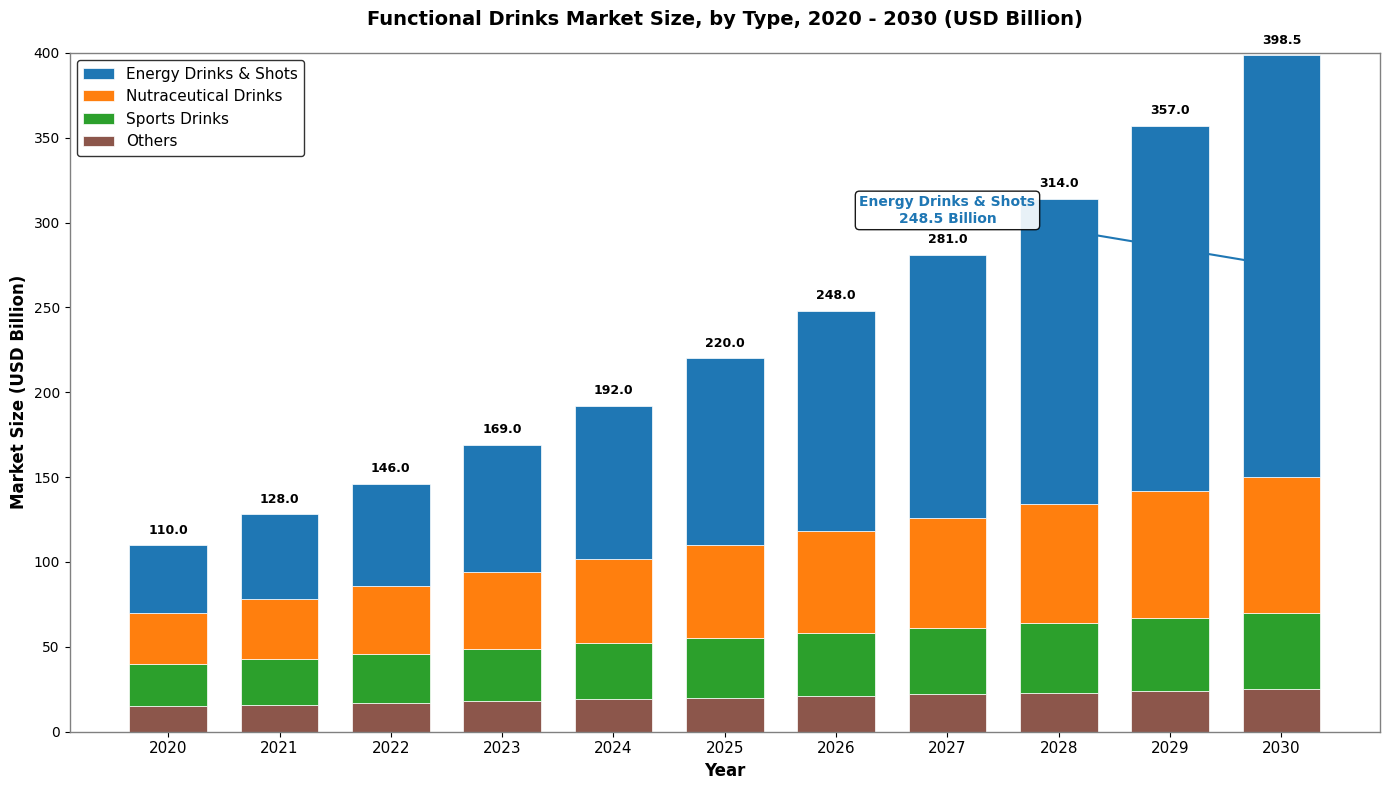
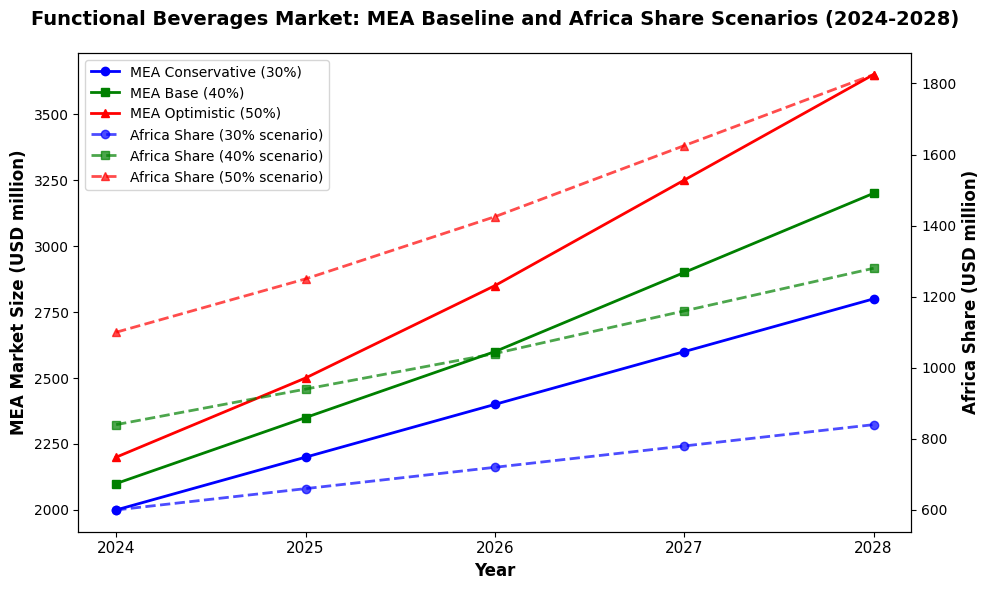
Current market conditions strongly support this direction. Across Africa, consumer interest in natural, health-enhancing and functional beverages continues to grow, driven by rising health awareness, urbanisation, the rise of formal retail channels/malls, and changing consumption habits among young and middle-income populations. The Middle East and Africa functional beverages market alone was valued at approximately US$6.76 billion in 2024 and is forecasted to grow at around 7.9% annually over the medium term. Under realistic scenario modelling, Africa’s share of this market could reach between US$2.7 billion and US$3.7 billion by 2028, depending on market share gains and the pace at which local industries formalise supply chains, expand processing capacity and improve distribution networks (Figure 1). These trends align strongly with Ghana’s competitive strengths in raw materials such as coconut, pineapple, citrus, baobab, moringa and hibiscus, all of which underpin fast-growing global beverage categories including coconut water, botanical infusions, probiotic blends and plant-based hydration products.
Figure 1. Middle East and Africa functional beverages market size (2018-2030)
Within this context, Ghana’s industrialisation plan seeks to respond to both domestic and export opportunities. The country currently imports hundreds of millions of dollars’ worth of processed juices and sugary drinks annually, creating a substantial outflow of foreign exchange. The new framework aims to reclaim 30-60 % of this import market within its first three years while simultaneously building the capacity to export to regional and international markets leveraging regional and continental trade pacts such as ETLS and AfCFTA. This dual approach, import substitution combined with export development, forms the strategic anchor of Ghana’s broader economic diversification efforts.
Operationally, the programme proposes the establishment of six agro-processing hubs across major agricultural belts, each aligned to regional comparative advantage. These hubs will process abundant local crops into high-margin products such as natural fruit juices, coconut water, ready-to-drink teas, fermented probiotic beverages, herbal infusions and other functional wellness drinks. The model draws inspiration from successful Ghanaian enterprises such as Ekumfi Fruits and Juices Limited and Central Citrus Processing Limited, which have demonstrated the viability of world-class tropical beverage processing in West Africa. Each facility is expected to operate at a capacity of 25 tonnes per hour on a continuous 24-hour cycle, equipped with ultra-high temperature processing, Tetra Pak lines, PET bottling systems and canning infrastructure. These will be complemented by research and development units focused on innovation and quality enhancement; however, rather than establishing entirely new R&D centres, I argued that the programme can and should leverage existing expertise within CSIR-Food Research Institute, Kwame Nkrumah University of Science and Technology, the University of Ghana, and other academic departments that have made significant contributions in food science and technology.
Government projections estimate that the six-hub system could generate between US$900 million and US$1.2 billion in annual output by 2029, with cumulative revenues from 2025-2030 amounting to US$2.7 billion to US$3.5 billion (Figure 2 below). In terms of employment, the initiative is expected to generate between 36,000 and 54,000 direct and indirect jobs across farming, processing, logistics, packaging and distribution. This labour demand could strengthen both rural agricultural employment and urban industrial workforce development, creating integrated value chains that link smallholders to modern processing facilities. The plan also provides a structural solution to persistent post-harvest losses, currently estimated at 15-30 % by siting processing plants close to production zones, thereby stabilising farm-gate prices, reducing waste, and improving supply-chain efficiency.
Figure 2. Middle East and Africa functional beverages market share projections (2024-2028)
Implementation will proceed in four phases. The Foundation Phase in 2025 involved site selection, zoning, out-grower/in-grower mobilisation and engineering design. This will be followed by the Construction and Expansion Phase (2026–2027), during which the six processing plants will be built, research partnerships formalised and cultivation expanded by 5,000 to 15,000 acres per region. The Scale-Up Phase (2027–2029) will see the transition to full-capacity, multi-shift operations alongside the introduction of value-added product lines and enhanced export orientation. Rather than constructing new export pathways, I propose we leverage established channels such as the Federation of Associations of Ghanaian Exporters (FAGE), the Association of Ghana Industries (AGI) and existing private-sector exporters to accelerate market entry. The final Consolidation Phase in 2030 will focus on securing global certifications and positioning Ghana as a continental leader in natural and functional beverage exports.
Ultimately, the success of this ambitious programme will depend on mobilising adequate financing, building robust out-grower/in-grower schemes, maintaining consistent quality standards and navigating international trade and regulatory environments. Nonetheless, the convergence of strong global demand for natural wellness drinks, Africa’s expanding market for functional beverages, and Ghana’s favourable agricultural resource base presents a compelling investment proposition. For domestic and international investors seeking exposure to high-growth agribusiness opportunities, Ghana’s Six-Region Tropical and Functional Beverages Industrialisation Plan stands out as a strategically sound and economically attractive pathway for long-term value creation.

