

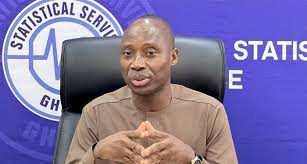

- Ghana’s Bribery Paradox: Fewer Pay Over the Year, Yet Officials’ Demands Surge to 69.40%
Ghana may have ended 2025 with fewer citizens paying bribes, smaller unofficial payments and millions more people interacting with public institutions. Yet beneath those encouraging numbers lies a far less comfortable reality: during the final six months of the year, the proportion of public officials directly requesting extra payments or gifts surged to nearly seven in every 10 encounters captured by the country’s latest governance survey.
That contradiction sits at the heart of the Ghana Statistical Service’s Governance Series Wave 3 and makes the report far more consequential than a conventional corruption scorecard.
The figures offer two versions of Ghana’s governance story, and both are true.
Viewed across the full year, the country appears to have made measurable progress. Viewed only through the second half of 2025, however, the data suggest that some of those gains were beginning to come under pressure.
The challenge for policymakers is deciding which signal matters more — and whether the deteriorating short-term indicators are merely statistical turbulence or an early warning that improvements in public-sector integrity could prove temporary.
The Governance Series tracks how citizens experience the state, particularly whether they are required or encouraged to make unofficial payments and whether they believe they have a meaningful voice in public decision-making. It is anchored in Sustainable Development Goal 16, including SDG 16.5.1 on bribery and SDG 16.7.2 on inclusive and responsive governance.
Wave 3 covered July to December 2025 and was conducted between February 26 and March 24, 2026. The study returned to the same panel of household heads originally drawn from Ghana’s 2021 Population and Housing Census, allowing the Statistical Service to compare changes over time rather than rely on entirely different samples. A total of 3,095 household heads were successfully interviewed.
The report describes governance in unusually practical terms. “Good governance is not an abstraction,” it says. “It is felt at the counter of a clinic, at a checkpoint on the road.”
That framing matters because the latest numbers suggest that Ghana’s biggest governance challenge may not always be found in major procurement scandals, politically exposed transactions or headline-grabbing corruption investigations. For millions of citizens, the more immediate test of the state comes when they require a licence, a police service, a hospital, a permit, water, electricity, documentation or some other public service — and encounter an official with discretion over whether that service moves quickly, slowly or at all.
In Wave 2, covering January to June 2025, 14.30% of household heads who had interacted with the state reported giving money or gifts to public officials. By Wave 3, covering July to December, that figure had climbed to 18.00%.
The population having contact with public officials, meanwhile, declined from 74.20% in Wave 2 to 69.60% in Wave 3. In absolute terms, the factsheet estimates that about 6.8 million people had contact with officials in Wave 2, compared with 6.4 million in Wave 3, while the number giving gifts rose from about 1.3 million to 1.7 million.
That alone would be concerning. But the most striking number is not the rise in people who actually paid. It is the rise in those who were asked.
Direct requests by public officials for additional payments or gifts increased from 50.90% in Wave 2 to 69.40% in Wave 3. That represents an 18.50 percentage-point increase in only six months.
The main report captures the shift starkly: “The pressure to pay is moving from the citizen’s hand to the official’s ask.”
It is perhaps the most important sentence in the 117-page document.
If bribery were primarily being driven by citizens voluntarily offering money to speed up services, the policy response would focus heavily on public education, sanctions and civic behaviour. But if increasingly the demand originates from officials themselves, the problem shifts more decisively towards institutional controls, supervision, enforcement, discretion and incentives inside the public service.
There is, however, a countervailing sign. Citizens appear slightly more willing to resist. The proportion refusing to make a requested unofficial payment increased from 3.00% to 4.90%. Yet even that improvement raises a harder question: what protection exists for a citizen who refuses an official controlling a service that person urgently needs?
Repeat payment fell dramatically. Among those who gave gifts or money, the proportion doing so five or more times plunged from 24.00% in Wave 2 to 3.70% in Wave 3. Meanwhile, those reporting that they paid once jumped from 38.80% to 70.80%.
In other words, bribery appears to have become more widespread but less repetitive.
That is better than citizens being trapped in continual unofficial payments, but it hardly amounts to victory. A public service system in which more people are required to make even one unofficial payment still imposes an invisible tax on households and businesses.
Most payments remained comparatively small. Wave 3 data show that 54.30% of payments were GHS100 or less, while 30.10% were between GHS101 and GHS500. But the share exceeding GHS1,000 increased from 6.60% to 9.10%. The broader report calculates that roughly 84.40% of monetary gifts were GHS500 or less.
Small payments can, paradoxically, be economically corrosive precisely because they become normalised. A GHS20, GHS50 or GHS100 unofficial charge may never trigger a high-profile anti-corruption investigation, yet when multiplied across thousands of transactions, it alters citizens’ expectations of the state and creates a parallel pricing system for services that should be governed by official fees.
Among people who said an official had requested money or a gift but they refused, 53.20% identified the Police Service. Within policing, the Motor Traffic and Transport Department remained the institution with the highest recorded proportion of gift-giving, increasing from 51.90% in Wave 2 to 54.60% in Wave 3.
That is especially significant because traffic policing is one of the state’s most frequent points of direct, discretionary contact with ordinary citizens. A motorist stopped on a road is dealing with an officer who possesses immediate enforcement authority and considerable discretion. Where institutional safeguards are weak, that combination creates precisely the environment in which informal payments can flourish.
Yet this is where Ghana’s governance picture becomes more complicated.
Annualise the data and compare the whole of 2025 with 2024, and the trajectory improves considerably.
Contact with public officials rose from 55.70% in 2024 to 71.90% in 2025 — equivalent to an increase from around 5.0 million adults to 6.6 million. Despite that surge in state-citizen interaction, gift-giving declined from 18.40% to 16.80%.
Normally, increased interaction creates more opportunities for corrupt transactions. Instead, Ghana recorded significantly more contact with public institutions while the proportion paying unofficial gifts declined.
The amount people paid also moved in a favourable direction over the annual horizon.
Payments of GHS100 or less increased from 40.90% in 2024 to 51.60% in 2025. Payments between GHS501 and GHS1,000 fell from 10.70% to 6.70%, while those above GHS1,000 declined sharply from 14.70% to 7.60%, according to the annualisation factsheet.
Even MTTD looks different when viewed annually. The proportion associated with gift-giving fell from 61.00% in 2024 to 53.60% in 2025.
This is precisely why the report warns against simplistic interpretation. Ghana can simultaneously have improved substantially against 2024 and deteriorated during the second half of 2025.
“The latest wave shows some pressures rising,” the report says, “but across the full year the direction of travel is toward more engagement, less bribery.”
The same tension emerges in citizens’ perceptions of political inclusion.
On an annual basis, the proportion saying they had no say at all in government decision-making dropped dramatically from 42.40% in 2024 to 29.70% in 2025. Those reporting no influence at all declined from 43.20% to 33.00%, while those saying they had a great deal of say increased from 2.50% to 5.90%.
That suggests a meaningful expansion in perceived political voice. But again, the latest six months flash a warning.
The proportion saying the political system gives ordinary citizens a say declined from 68.40% in Wave 2 to 64.40% in Wave 3. Those feeling completely excluded increased from 29.20% to 30.50%, while 33.90% said the political system gave them no influence at all, compared with 32.50% previously.
Among those aged 18 to 24, 39.70% said they had no say at all. For people aged 65 and above, the figure was 35.20%. Among unemployed respondents, 36.80% felt they had no influence, compared with 28.90% among employed citizens.
These are not merely perception statistics. They speak to the legitimacy of policymaking itself.
A government may enact reforms that are technically sound, fiscally responsible and developmentally necessary. But if younger citizens, unemployed people and vulnerable groups increasingly believe decisions are made without them, the state risks creating a gap between policy effectiveness and political legitimacy.
The report asks what citizens ultimately want and arrives at a strikingly ordinary answer: roads, water, clinics, schools and jobs coupled with a meaningful say in how they are delivered. That simplicity may be precisely why the findings deserve attention.
Governance debates often become abstract conversations about constitutional arrangements, institutional mandates and national anti-corruption strategies. But Wave 3 returns the debate to its most basic transaction: whether an ordinary citizen can approach the state, receive a public service fairly and walk away without being compelled to negotiate an unofficial price.
The policy prescriptions therefore follow directly from the evidence. The Statistical Service recommends concentrating anti-corruption efforts on institutions where citizens interact most frequently, especially the Police Service and MTTD; expanding digitisation and automation in licensing, permits, utilities and regulatory services; institutionalising corruption-risk assessments; enforcing codes of ethics; improving anti-corruption investigations and feedback; and expanding citizen engagement by government, the executive and legislature.
Every process moved from discretionary face-to-face interaction to a transparent digital platform potentially removes one opportunity for an unofficial negotiation. But technology alone is not enough. A corrupt manual process can become a corrupt digital process if approvals remain opaque, officials retain unchecked discretion or citizens have no credible avenue for redress.
It involves changing the probability that an official requesting an illegal payment will be detected, sanctioned and remembered by the system.
The report’s most consequential finding may therefore not be that Ghana’s bribery prevalence rose to 18.00% in Wave 3, nor even that official solicitation reached 69.40%.
It is that Ghana appears to have demonstrated during 2025 that improvement is possible — and then demonstrated during the final six months how quickly that improvement can begin to weaken.
The full-year numbers show fewer bribes, smaller payments, more contact with public institutions and significantly stronger citizen voice than in 2024.
The Wave 3 numbers show rising bribery, dramatically higher solicitation and renewed signs of political exclusion.
Neither cancels the other. Together, they produce a more demanding conclusion: Ghana may be moving in the right direction, but it has not yet built governance gains strong enough to survive without constant institutional pressure.
The report itself puts it more succinctly: “Governance gains are real but fragile.”
That should be the warning policymakers take from Wave 3.
The real test will not be whether Ghana can record another temporary decline in bribery. It will be whether a citizen approaching a police officer, public hospital, licensing authority, utility provider or government office increasingly believes that the official fee is the only price that must be paid and that his or her voice matters even after the transaction is complete.
Until that becomes the ordinary experience of dealing with the state, Ghana’s improving governance numbers will remain exactly what this report suggests they are: progress worth recognising, but progress still capable of slipping away.

