


- Ghana’s Gold Production Hits 5.94 Million Ounces as Small-Scale Mining Leads Output
Ghana’s mining industry recorded one of its strongest performances in recent history in 2025, with gold production reaching a historic high and fiscal contributions to the state rising to GHS 24.22 billion.
According to the Ghana Chamber of Mines, attributable gold production increased by 23.4 percent, rising from 4.82 million ounces in 2024 to 5.94 million ounces in 2025. The performance was driven largely by a sharp increase in small-scale mining output.
For the first time in more than a century, small-scale mining overtook large-scale mining as the largest contributor to Ghana’s gold production.
Small-scale output rose by 63.8 percent to 3.11 million ounces, accounting for 52.4 percent of total national gold output. Large-scale production, however, declined marginally by 2.98 percent to 2.83 million ounces, although Chamber member companies continued to account for 98 percent of large-scale production.
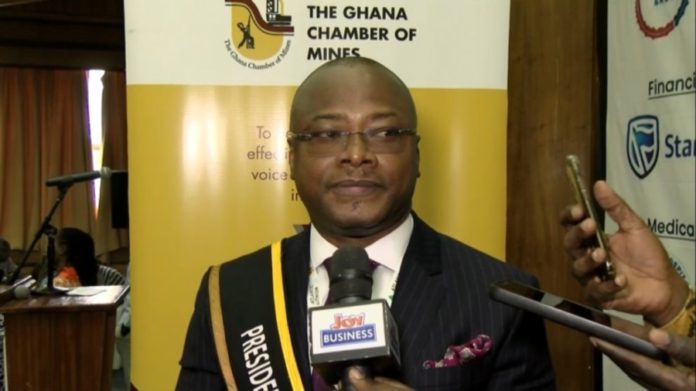
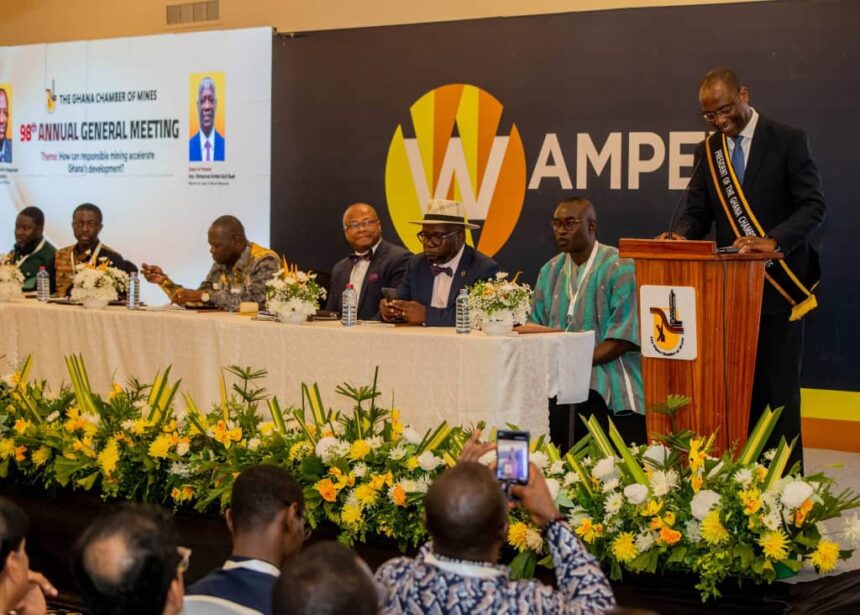
Addressing the Chamber’s 98th Annual General Meeting in Accra, outgoing President Michael Edem Akafia said the industry remained a critical pillar of Ghana’s economy, supporting export earnings, employment, foreign exchange accumulation and government revenue.
The sector’s tax contribution also rose strongly.
The mining and quarrying sector remained the largest contributor to direct domestic tax revenue collected by the Ghana Revenue Authority, generating GHS 23.11 billion in taxes in 2025, up from GHS 20.87 billion in 2024.
When dividends are included, total fiscal contribution rose to GHS 24.22 billion, representing a 10.6 percent increase over the previous year.
Mineral export earnings also surged, rising by nearly 78 percent from US$11.98 billion to US$21.36 billion. Minerals accounted for 68.2 percent of Ghana’s total merchandise exports, underlining the sector’s central role in foreign exchange inflows.
Mr Akafia said the gold mining subsector was the standout performer, expanding by 19.6 percent and increasing its share of national GDP from 7.97 percent to 9.98 percent.
“The gold mining sub-sector was the standout performer, driven largely by a near doubling of small-scale gold output. Gold’s contribution to GDP increased significantly, making it the largest sub-sector of the economy,” he said.
The strong performance comes at a time when Ghana is trying to retain more value from its mineral resources amid high global gold prices and renewed debate over mining lease renewals, royalties, local participation and the role of the state in strategic mineral assets.
But the Chamber warned that the sector’s record contribution should not obscure growing concerns over policy uncertainty and rising operational costs.
It cited revisions to the mining royalty regime, the ongoing review of the Minerals and Mining Act, and unresolved mining lease renewal discussions as key issues affecting investor confidence.
The Chamber also warned that Ghana’s effective mining tax burden, estimated between 54 percent and 58 percent, ranks among the highest globally and could weaken the country’s competitiveness, particularly in attracting fresh exploration and long-term mining investment.
Mr Akafia urged government to undertake a holistic review of the mining fiscal framework to ensure that reforms balance revenue mobilisation with investor confidence.
The call comes as government has taken a more assertive stance on mining governance, including tougher scrutiny of licence renewals and a stronger push to ensure that mining companies deliver clear benefits to the state and host communities.
The Chamber also renewed its call for at least 30 percent of mineral royalties to be returned directly to mining communities. It further advocated for the establishment of a Mineral Revenue Management Act to improve transparency and accountability in the use of mineral revenues.
Chief Executive Officer of the Chamber, Ing. Dr Kenneth Ashigbey, said the industry had shown resilience despite geopolitical tensions, inflationary pressures, supply-chain disruptions and climate-related obligations.
He noted that the Chamber’s engagement with government contributed to the reduction of the Growth and Sustainability Levy from 3 percent to 1 percent in 2026, with a commitment for the levy to be phased out by 2028.
Dr Ashigbey said the Chamber would continue to advocate stable policies, responsible mining practices and reforms that strengthen Ghana’s competitiveness as a leading mining destination.
“Together, we can continue to position Ghana’s mining industry as a driver of sustainable economic transformation, industrial growth, and shared prosperity. That is the responsibility before us, and it is the opportunity we must seize,” he said.
Looking ahead, the Chamber projects large-scale gold production to range between 3.2 million and 3.4 million ounces in 2026, while small-scale output is expected to remain strong at between 2.9 million and 3.5 million ounces.
The figures point to a mining sector at the centre of Ghana’s economic recovery story — generating record output, export earnings and tax revenue.
But they also raise a deeper policy question: how can Ghana capture more value from mining without weakening the investment conditions needed to sustain production?

