


- Ghana’s Gold Strategy Must Balance Revenue, Transparency And Environmental Protection — Christian Council
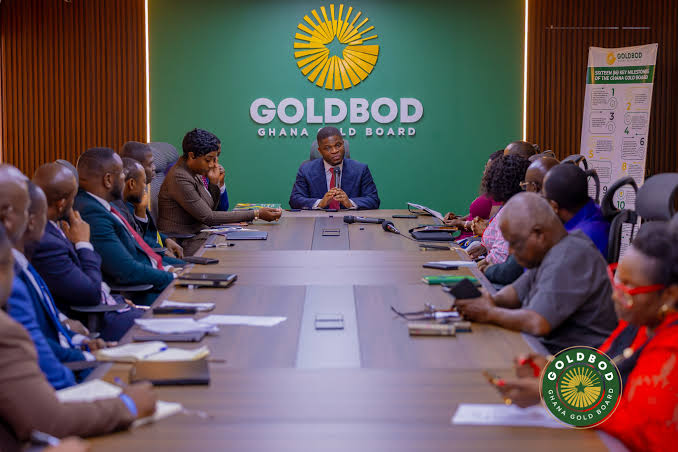
The Christian Council of Ghana has endorsed the Ghana Gold Board’s efforts to impose greater transparency and accountability on the country’s gold trade, lending institutional and moral support to a state-led strategy that increasingly places mineral resources at the centre of Ghana’s economic recovery. The endorsement came during a courtesy visit by a Council delegation to GoldBod, where both institutions discussed responsible resource governance and the need to ensure that Ghana captures more value from its mineral wealth. The engagement also highlighted the wider challenge of converting gold production into lasting economic gains while reducing the environmental and social costs associated with poorly regulated mining.
Dr Joyce Laco Steiner, Director of Programmes and Advocacy at the Christian Council, described Ghana’s mineral resources as a national endowment that should be managed with integrity, accountability and responsibility for both present and future generations. She stressed the need for government institutions, businesses, communities and civil society to work together so that natural resources contribute meaningfully to sustainable development. Her intervention places governance, rather than production alone, at the centre of the debate over Ghana’s gold economy.
GoldBod’s growing importance reflects the wider economic role assigned to it under the Ghana Gold Board Act, 2025, Act 1140. The institution has been given a strategic role in Ghana’s gold-trading architecture, including the mobilisation of foreign exchange and support for macroeconomic stability. In an economy that has repeatedly faced foreign-exchange shortages, debt-service pressures and volatility in the cedi, the capacity to channel gold exports through formal systems has become economically significant.
GoldBod Chief Executive Sammy Gyamfi told the delegation that the institution’s mandate includes generating foreign exchange and helping strengthen macroeconomic stability. That ambition points to a broader shift in economic policy, in which natural resources are increasingly viewed not merely as commodities for export but as instruments that can support monetary and external-sector resilience. The policy test, however, is whether the formalisation of gold trading can produce gains that are durable, transparent and widely shared.
The economics of Ghana’s gold sector also extend well beyond export receipts. Ghana has historically exported large quantities of gold while capturing less of the downstream value associated with refining, jewellery manufacturing, assay services, logistics and other activities linked to the commodity. GoldBod’s stated ambition to expand domestic refining and jewellery production therefore represents an attempt to retain a greater share of the value chain within the country.
If successful, a deeper domestic gold-processing industry could create skilled jobs, expand industrial capacity and generate additional tax revenues while building businesses capable of serving regional and international markets. It could also reduce Ghana’s role as predominantly a producer of raw or semi-processed gold and reposition the country as a more integrated participant in the global gold economy. The potential industrial benefit is therefore significant, but it depends on whether refining and jewellery activities can become commercially competitive rather than merely policy aspirations.
That opportunity comes with a demanding governance challenge. Gold is highly liquid and internationally tradable, while parts of Ghana’s artisanal and small-scale mining sector have historically been vulnerable to smuggling, under-declaration, illicit financial flows and environmental degradation. A more centralised trading system must therefore be assessed not simply by the quantity of gold it purchases or exports, but by the quality of its traceability, pricing systems, compliance controls and public accountability.
The Christian Council’s emphasis on integrity is particularly relevant in that context. Greater state involvement can strengthen oversight and formalisation, but it can also create concentration risks if transparency and independent accountability do not keep pace with the institution’s expanded powers. Public confidence in GoldBod will ultimately depend on whether miners, taxpayers, financial institutions, civil society and market participants can scrutinise how the system operates and how value is distributed.
Environmental sustainability presents another major test. Mr Gyamfi highlighted initiatives including the establishment of an international-standard fire assay laboratory, land reclamation efforts and the rehabilitation of water systems affected by mining activities. These measures address one of the most sensitive aspects of Ghana’s gold economy: the environmental damage associated with illegal and irresponsible mining.
The destruction of water bodies and degradation of agricultural land carry direct economic costs for communities and the state. Polluted rivers increase the burden of water treatment and threaten livelihoods, while damaged farmland can reduce agricultural productivity and require future public spending on restoration. GoldBod’s performance should therefore be measured against a broader balance sheet in which foreign-exchange earnings are weighed alongside clean water, productive land, public health and the long-term sustainability of mining communities.
The Christian Council’s intervention effectively places a social compact around GoldBod’s economic mandate. The message is that Ghana should not pursue higher gold revenues at any cost, and that increased production, formalisation and foreign-exchange earnings should be accompanied by stronger environmental standards, transparency and public accountability. That approach recognises that natural-resource policy becomes sustainable only when economic gains do not come at the expense of communities or future productive capacity.
For policymakers, the central challenge is now implementation. GoldBod has the potential to become an important pillar of Ghana’s commodity and foreign-exchange strategy, but its credibility will depend on whether increased state participation produces measurable benefits for the wider economy rather than simply changing who controls the gold trade. Transparent reporting, credible assay systems, mine-to-market traceability, effective enforcement against smuggling and clear evidence of benefits to mining communities will be essential tests of that mandate.
The Christian Council’s endorsement gives GoldBod a valuable vote of confidence, but it also raises the standard against which the institution should be judged. Ghana has produced gold for decades; the harder task is ensuring that mineral wealth creates durable prosperity through stronger institutions, higher domestic value addition and responsible environmental management. For GoldBod, the next phase will therefore be less about proving that Ghana can sell gold and more about demonstrating that the country can govern its gold economy effectively.

