

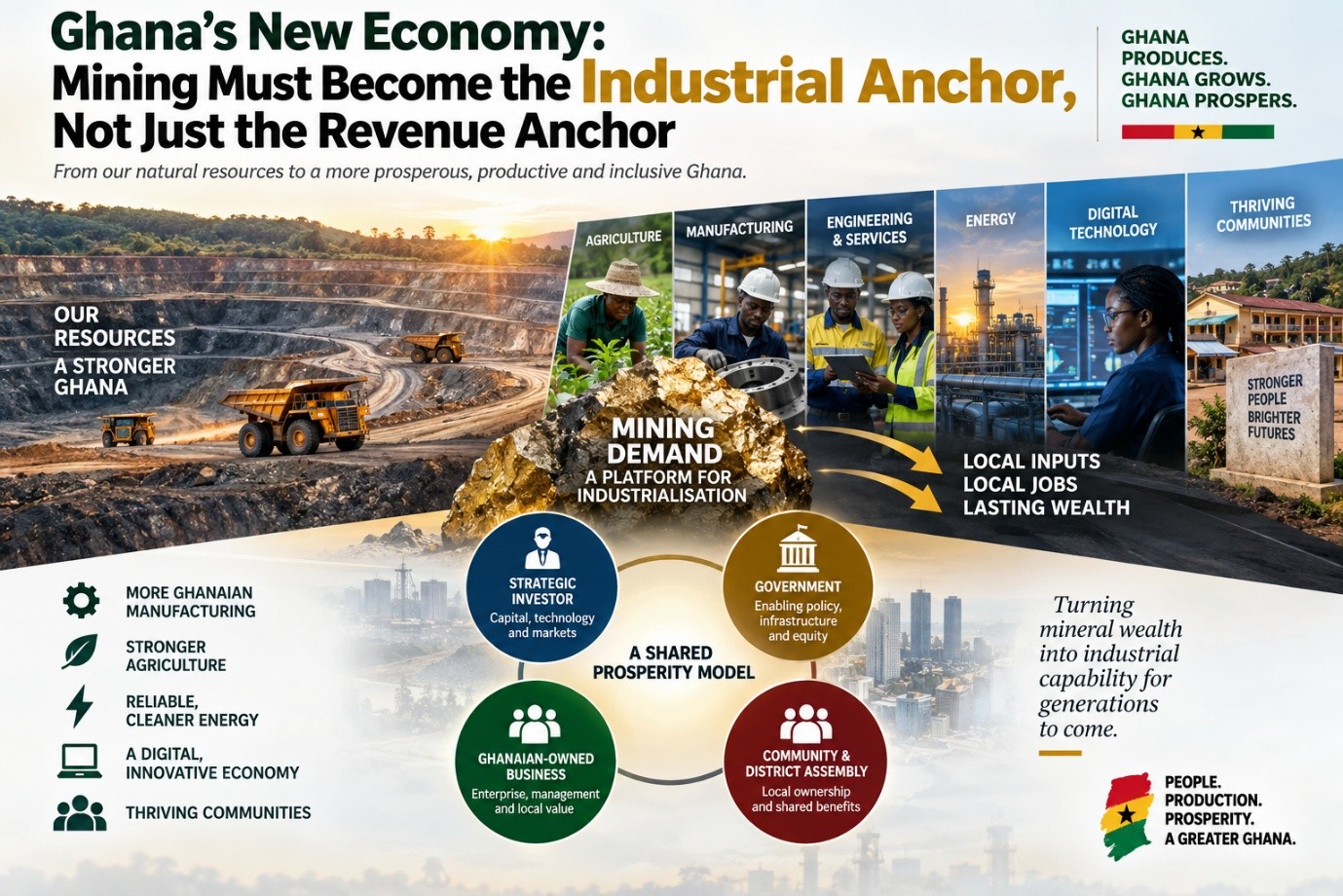

- Ghana’s New Economy: Why Mining Should Be the Anchor of Our New Economic Transformation
As the Minister for Finance engages key ministries on Ghana’s New Economy, the ambition is compelling: to build an economy that does not merely withstand shocks but creates wealth and grows on the strength of what Ghana produces.
The challenge is to translate this ambition into an industrial strategy. For decades, Ghana has measured mining largely through exports, taxes, royalties, foreign exchange and employment. These remain important. But if the New Economy is genuinely about production, we must ask a different question: how can the purchasing power of the mining industry be converted into factories, technologies, skills and Ghanaian-owned enterprises? This is where mining should become an anchor of Ghana’s economic transformation.
In 2025, producing member companies of the Ghana Chamber of Mines spent approximately US$4.2 billion on procurement, while their broader expenditure in Ghana was about US$7.14 billion. That is more than expenditure. It is industrial demand waiting to be organised.
Every mine purchases machinery, grinding media, activated carbon, chemicals, explosives, electrical equipment, pipes, protective clothing, engineering services, food, transport, software, energy and hundreds of other inputs.
The strategic question for the Minister for Finance should therefore be: of everything Ghana’s mining industry buys annually, what can Ghana competitively produce within the next five to ten years? Answering this could fundamentally change our industrial trajectory.
Consider activated carbon.
Ghana’s gold mines consume activated carbon, while the country produces coconuts whose shells can provide an important raw material for its manufacture. A deliberate industrial programme could connect coconut farmers to processors, manufacturers and mining companies.
The same principle can be explored for grinding media, industrial chemicals, cables, pumps, pipes, protective equipment, equipment components and engineering services. Mining should therefore cease being treated as an economic enclave. It should become a platform for industrialisation.
The Minister for Finance should champion a National Mining Industrial Linkages Programme, bringing together the ministries responsible for Finance, Lands and Natural Resources, Trade, Agriculture, Energy, Education and Digital Technology, alongside industry, universities, financial institutions and research organisations.
Its first assignment should be comprehensive mapping of the mining supply chain: what the industry purchases, what is imported, its annual value, what can currently be produced locally, and which products Ghana could competitively manufacture within three, five and ten years.
But localisation cannot be built on aspiration alone. It must be built on science. The Council for Scientific and Industrial Research (CSIR) should therefore be commissioned to lead applied research, working with universities, mining companies and manufacturers, to identify mining inputs that can be competitively produced from Ghanaian raw materials.
Can Ghana manufacture activated carbon from coconut shells at the quality and scale mines require? Which industrial chemicals can be produced locally? Which equipment components can Ghanaian engineering companies manufacture? Can mine waste and by-products become inputs for construction and other industries? These should become national research questions connected directly to commercial opportunities. Promising research must then move from laboratories into pilot plants and ultimately into commercial production.
But financing and ownership matter.
Ghana should consider a Shared-Equity Mining Industrialisation Model for strategic mining-input industries. Under such a model, a technically capable strategic investor could provide technology, capital and access to markets; Government could hold equity and provide enabling infrastructure and policy support; a credible Ghanaian-owned business could hold significant equity and lead local enterprise development; while the host community and District Assembly could jointly hold equity through an appropriate vehicle.
The percentages need not be predetermined. They should reflect the capital requirements, risks and commercial realities of each project. This would represent a significant shift from communities receiving only corporate social investments or statutory transfers to becoming owners of productive assets.
Imagine an activated-carbon factory located close to a coconut-producing area, supplying Ghana’s mines and eventually exporting across Africa. Farmers provide the raw material. A strategic investor brings technology. A Ghanaian company participates in ownership and management. Government facilitates infrastructure and investment. The community and Assembly own shares and benefit when the business succeeds. That is economic transformation.
The model could progressively be explored for selected chemicals, engineering components, mining consumables and other products where feasibility studies establish Ghana’s competitive advantage.
Government could complement this with a dedicated financing window through appropriate development-finance institutions to provide patient capital for machinery, certification, research and expansion. However, local content must never become a euphemism for expensive or inferior production.
The objective must be competitive Ghanaian production.
Mining companies compete globally and require reliable inputs meeting international standards for quality, safety, availability and price. Research, technology transfer, certification and economies of scale must therefore underpin localisation.
Mining demand can similarly stimulate agriculture, engineering, renewable energy and digital technology. Modern mines increasingly depend on automation, drones, sensors, artificial intelligence, cybersecurity and data analytics. Ghana should develop companies capable of solving these problems locally and exporting those solutions across Africa. Ghana can learn more about drone technology from Iran.
Ultimately, gold is finite. Mines eventually close.
Ghana’s mining legacy therefore cannot simply be ounces produced, taxes paid or royalties collected. The real test should be what productive capacity remains when mining ends.
Did mining help us build internationally competitive manufacturers? Did it create engineering and technology companies? Did communities become shareholders in productive enterprises? Did Ghanaian businesses that started by supplying Tarkwa, Obuasi and Ahafo eventually supply mines across Africa? That is how finite mineral wealth creates permanent economic capability.
The Minister for Finance’s vision of an economy that creates wealth and grows on the strength of what Ghana produces is therefore both timely and achievable.
But Ghana may not need to search far for the engine. The market already exists. The demand already exists. The infrastructure, expertise and global connections already exist.
Mining can provide the anchor. Manufacturing, agriculture, energy, technology and services can provide the linkages. Ghanaian enterprise can provide the growth. The opportunity before us is to connect them deliberately. Because the greatest value Ghana can extract from mining may ultimately not be what we take from beneath the ground. It may be everything we learn to produce above it.

