

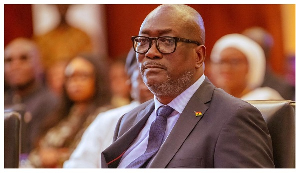

Ghana’s Oil Billions Have Produced Receipts, Not Development – Prempeh
Ghana’s petroleum revenues have generated thousands of expenditure records but few transformative national assets, raising questions about whether 15 years of oil production have meaningfully improved the country’s long-term development prospects.
That was the central concern emerging from the 15th-anniversary celebration of the Public Interest and Accountability Committee, where Professor H. Kwasi Prempeh, Executive Director of the Ghana Center for Democratic Development, and Professor Christian Agyare, Vice-Chancellor of the Kwame Nkrumah University of Science and Technology, called for a fundamental reset in petroleum revenue management.
Their messages converged around a difficult conclusion: transparency has improved since Ghana began commercial oil production, but transparency without disciplined investment, institutional consequences and measurable human-development outcomes cannot protect the public interest.
The anniversary, organised in collaboration with KNUST’s College of Engineering, was held under the theme, “PIAC at 15: Advancing Resource Governance through Transparency and Accountability for Sustainable Development.”
Prof. Prempeh focused on how governments have allocated petroleum revenues, arguing that the repeated distribution of oil money across hundreds of small projects has prevented Ghana from producing visible national infrastructure capable of carrying the legacy of its petroleum era.
“Rather than directing the oil money in the budget towards a focused set of priority national projects, successive budgets have dispersed it across hundreds of small uncoordinated items,” he said.
He described the practice as “thin spreading”: allocating limited petroleum revenues among numerous projects, constituencies and sectors without adequately financing any coherent set of national priorities.
This model may allow governments to show that many communities received something from petroleum revenue. It may also produce long lists of roads, schools, health facilities and other interventions in budget documents.
But the mere appearance of widespread distribution does not establish that the expenditure produced durable economic value.
“After 15 years and billions of dollars, few if any major national infrastructure projects have been built end-to-end with oil money,” Prof. Prempeh said.
“I think most of us would struggle to name a huge major national infrastructure project that stands in the name of the oil that we have gotten.”
His criticism is not an argument that every cedi of petroleum revenue should be concentrated in one region or spent on a single project. It is an argument for strategic concentration: selecting a limited number of properly appraised national investments, financing them sufficiently and completing them within reasonable schedules.
Fragmented expenditure can leave projects underfunded for years. Construction costs then rise, contractors abandon sites and governments introduce new projects before completing earlier ones.
The result is a cycle in which public money produces expenditure certificates and payment receipts without necessarily producing completed infrastructure or sustainable economic returns.
“Dispersing public funds this way produces receipts. But it does not produce development,” Prof. Prempeh said.
Prof. Agyare approached the problem from the perspective of human development and intergenerational responsibility.
“The possession of natural resources alone does not guarantee development. What matters is how these resources are managed, how revenues are utilised, and whether their benefits reach the people,” he said.
For the KNUST Vice-Chancellor, Ghana’s success should not be assessed by the number of barrels extracted, the amount of petroleum receipts collected or the volume of government expenditure attributed to oil.
It should be measured by improvements in education, healthcare, infrastructure, employment, productivity and living standards.
“The true value of a nation’s natural resources is measured not by what is extracted from the ground but what is built in the lives of its people,” he said.
The distinction is important because petroleum is a finite asset. Once extracted and sold, the resource cannot be replaced. If the resulting revenue finances consumption or incomplete projects, the country exchanges a permanent natural asset for a temporary fiscal benefit.
If the money finances education, research, productive infrastructure, technology and economic diversification, it can create assets and capabilities that continue generating value after oil production declines.
“The greatest legacy of natural resource wealth is not what one generation consumes, but what it builds for the generations that follow,” Prof. Agyare stated.
The speeches also exposed a gap between Ghana’s transparency architecture and its accountability mechanisms.
PIAC has spent 15 years monitoring petroleum receipts and expenditure, publishing reports and engaging communities. Its work has improved public access to information that might otherwise have remained within government institutions.
But producing reports is only the first stage of accountability. The more difficult test is whether public institutions correct the weaknesses that those reports identify.
Prof. Agyare commended PIAC’s contribution but urged authorities to implement its recommendations so that oversight would produce measurable development outcomes.
“As we celebrate this achievement, we must also encourage the effective implementation of its recommendations to ensure that oversight translates into tangible development outcomes,” he said.
Prof. Prempeh was more direct about the institutional weakness. He argued that Ghana had created a relatively credible system for reporting petroleum revenue irregularities without establishing equally effective means of compelling compliance.
“The Constitution creates a duty, clearly, but not the means to enforce it in our courts,” he said, referring to the trusteeship obligations attached to the management of natural resources.
He proposed that Parliament consider giving PIAC legal standing to initiate judicial proceedings where institutions fail to act on documented breaches of petroleum revenue management requirements.
Under such a model, the committee could potentially seek court orders compelling public institutions to comply with statutory obligations or recover revenues, including outstanding petroleum surface rentals.
The proposal would significantly strengthen PIAC’s mandate, moving it beyond monitoring, reporting and public education towards a more enforceable form of accountability.
However, that expansion would require careful legal design. PIAC’s investigative, advisory and possible enforcement roles would need to be clearly defined to avoid conflict with Parliament, the Auditor-General, the Attorney-General and other public accountability institutions.
The underlying principle remains persuasive: a watchdog whose findings can be ignored indefinitely risks becoming an observer of governance failures rather than an instrument for correcting them.
Prof. Prempeh also called for stronger legal protection for PIAC’s funding, arguing that unpredictable financing could weaken its independence and operational effectiveness.
“Financial autonomy is not a courtesy extended to a watchdog. It is a precondition for the watchdog to function effectively as one,” he said.
Oversight institutions dependent on annual discretionary allocations may face difficulties recruiting technical expertise, conducting field verification, sustaining public education and challenging the institutions responsible for releasing their funds.
The debate is becoming more urgent because Ghana’s petroleum opportunity may be narrowing.
Prof. Prempeh warned that domestic crude oil production had fallen substantially from its 2019 level, while the limited conclusion of new petroleum agreements had weakened expectations of a rapid production rebound.
At the same time, global energy-transition policies are accelerating investment in cleaner technologies and encouraging economies to reduce their dependence on hydrocarbons.
“The oil age will not end for lack of oil. There will still be plenty of oil when it ends. It will end because the world would have moved on before the last barrel is empty,” he cautioned.
For Ghana, this means the policy question is not simply how much oil remains underground. It is whether the country can convert its remaining period of petroleum production into productive assets before declining output and global market changes reduce fiscal receipts.
The answer requires more than transparency. Ghana must decide which investments petroleum revenues should finance, how projects will be selected, how completion will be guaranteed and what economic outcomes each intervention is expected to deliver.
Large projects are not automatically better projects. Concentrating expenditure can produce equally serious waste if procurement is weak, project selection is politically driven or implementation is poorly supervised.
A new approach must therefore combine concentration with rigorous appraisal, transparent procurement, realistic costing, clear completion timelines and independent monitoring.
Transport corridors, industrial infrastructure, research facilities, irrigation systems, energy networks and human-capital programmes could potentially generate lasting benefits. But their value would depend on whether they address binding development constraints and produce returns beyond their construction costs.
Prof. Prempeh attributed the persistence of fragmented spending partly to electoral incentives.
“My own judgment is that it persists because spreading small projects widely is politically easier and attractive than concentrating large ones. And that is a problem of politics,” he said.
A government may gain greater immediate political visibility by announcing projects across many constituencies than by directing several years of oil revenue towards one national investment. Yet national development often requires choices whose benefits extend beyond individual electoral cycles.
This is where Parliament, civil society, academia and citizens must demand a clearer connection between petroleum expenditure and measurable outcomes.
Prof. Agyare identified universities as important partners in this effort. Research institutions can evaluate project choices, strengthen professional capacity, support technological innovation and provide independent evidence on whether petroleum-funded programmes are delivering value.
He called for deeper cooperation among government, academia, industry and civil society, arguing that accountability should be treated as a mechanism for improving performance rather than an administrative burden.
The next chapter of PIAC’s work will consequently be judged by more than the number of reports it publishes. It will be assessed by whether its recommendations change budget decisions, trigger recoveries, strengthen institutions and improve project completion.
Ghana has achieved an important degree of petroleum revenue transparency. Citizens can increasingly see how much money has been received, how it has been distributed and where weaknesses exist.
But the ultimate promise of transparency is not disclosure for its own sake. It is the creation of consequences that improve conduct and protect public value.
Fifteen years into the petroleum era, Ghana must move from asking where the oil money went to determining what lasting national asset it created.
Without that shift, the country risks reaching the end of its petroleum opportunity with detailed accounts of expenditure, numerous unfinished projects and little capable of showing future generations what was built with their inheritance.

