


- Ghana’s Payment Revolution Has Yet to Deliver Credit Revolution – Deputy Governor
Ghana faces an estimated US$4.8 billion annual financing gap for small and medium-sized enterprises, exposing a striking disconnect between the rapid development of the country’s digital payments infrastructure and the ability of businesses to convert their transaction histories into affordable credit.
The Bank of Ghana is now pushing for a shift towards data-driven lending, open banking and cash-flow-based credit assessment, arguing that the enormous volume of information generated through mobile money and other electronic transactions could help lenders evaluate businesses that struggle to meet traditional collateral requirements.
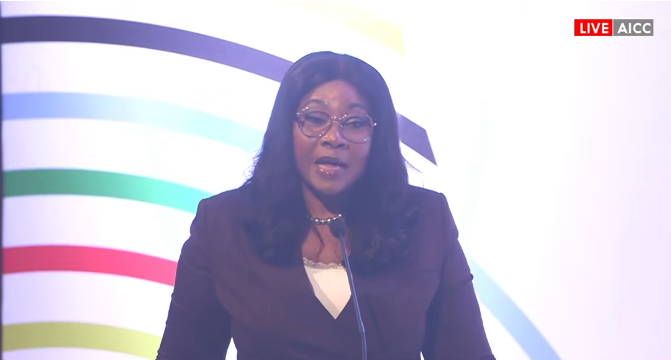
Matilda Asante-Asiedu, Second Deputy Governor of the Bank of Ghana, said the country had succeeded in building infrastructure that allows money to move rapidly across the economy, but the same technological progress had yet to transform access to business financing.
“We have built extraordinary payment rails, but we have not yet built equally extraordinary credit rails,” she said at the National ICT Week celebration at the University of Ghana, where she delivered the third Distinguished Digital Finance Lecture.
The distinction goes to the heart of Ghana’s financial inclusion challenge because a small business can receive payments almost instantly through mobile money and electronic channels, generating months or years of transaction records, yet still struggle to obtain working capital.
Conventional lending models continue to place significant weight on physical collateral such as land and buildings, leaving many viable businesses outside formal credit markets.
“The disconnect between transaction data and credit access, in my view, is the single largest unrealized opportunity in this room,” Ms Asante-Asiedu said. Her argument points towards a significant change in how lenders assess risk, replacing an excessive focus on what a borrower owns with a more detailed assessment of what the underlying business actually earns.
Mobile money and banking records can provide evidence of sales volumes, transaction frequency, cash-flow stability, seasonal patterns and whether revenues are expanding or contracting. “This is not just background information. It is a credit record. We have simply not built the habit of reading it as such,” Ms Asante-Asiedu said.
Such an approach could be particularly important for Ghana’s smaller businesses, many of which may have viable operations but lack sufficient property to secure conventional bank financing.
A company generating predictable monthly revenue can still represent a manageable credit risk even without substantial fixed assets, provided lenders have reliable data and appropriate models for assessing cash flows.
The scale of Ghana’s digital payments ecosystem demonstrates why the opportunity is significant. According to Ms Asante-Asiedu, mobile money platforms processed 954 million transactions worth approximately GH¢493 billion in June 2026 alone, while the country had about 84.6 million registered mobile money accounts, of which 26.4 million were active, supported by more than one million registered agents.
Those figures suggest Ghana’s digital finance challenge is increasingly shifting from access to utilisation. Consumers and businesses are already generating vast quantities of digital financial information, but that data has yet to be systematically converted into financial identities capable of supporting lending decisions.
For banks, greater use of transaction data could also change the economics of SME lending. Small loans have traditionally been expensive to originate because lenders must conduct documentation, verification and monitoring for relatively modest credit exposures, but automated analysis of cash flows could reduce assessment costs and shorten the time required to make lending decisions.
Ms Asante-Asiedu also challenged the financial sector to broaden its understanding of assets capable of supporting credit. Modern businesses increasingly derive value from contracts, receivables, purchase orders, customer relationships and predictable future income rather than exclusively from physical property, creating scope for lending models built around cash flows and enforceable commercial claims.
Confirmed purchase orders, export contracts and multi-year service agreements could therefore become more important in credit assessment under appropriate legal and risk-management frameworks.
Such a shift would be particularly valuable to businesses in technology, services and trade, where enterprise value may be substantial even though tangible assets remain limited.
The Bank of Ghana sees open banking and open finance as important parts of this transition. Customer-authorised sharing of financial data could allow lenders to build a more complete picture of business performance and enable firms with strong transaction histories to seek financing from competing institutions rather than remain dependent on the bank where they maintain their primary account.
Ms Asante-Asiedu cautioned, however, that the success of open banking should not be measured merely by the number of APIs or technological connections created. “The measure of success…should be how much credit” ultimately reaches businesses through the use of transaction data, she said, shifting the focus from technological infrastructure to measurable economic outcomes.
That approach could intensify competition across Ghana’s financial sector because fintech companies and banks would be able to develop credit products around customer-authorised data. Businesses with strong financial histories could potentially obtain better pricing as lenders compete to finance demonstrably healthy cash flows.
Greater data sharing will nevertheless introduce important risks around cybersecurity, consent, privacy, data governance and automated decision-making. The central bank will therefore have to balance the desire to expand data-driven lending with the need to ensure that businesses retain meaningful control over how their financial information is accessed and used.
The wider economic significance extends beyond financial inclusion. If part of the US$4.8 billion SME credit gap can be closed, additional capital could flow into inventory, machinery, technology, hiring and expansion, while domestic savings held across banks, pension schemes and investment institutions could be channelled more efficiently towards productive businesses.
Ghana’s digital finance transformation has so far been defined largely by how quickly and conveniently money can move. The next phase could prove considerably more consequential if those same payment records begin determining who can borrow and on what terms.
For Ghana’s SMEs, closing the financing gap may therefore depend less on discovering entirely new pools of money and more on changing how lenders define creditworthiness.
If transaction histories can be converted into credible financial identities, the hundreds of billions of cedis passing through Ghana’s digital ecosystem each month could become not only evidence of commerce already completed, but the foundation for the investment and growth that comes next.

