



Ghana’s Quiet Yield Productivity Ceiling we Still Refuse to Break
Ghana’s agricultural yield story over the past six decades is neither one of stagnation nor of dramatic revolution. It is a story of gradual productivity gains shaped decisively by policy regimes, macroeconomic reforms, and targeted input interventions. The data show that maize yields have moved from roughly 0.7–1.2 tonnes per hectare in the 1960s–70s to 2.67 t/ha in 2024 (Fig.1). Rice has risen from about 0.9–1.3 t/ha to 3.33 t/ha. Cassava has climbed from 8–12 t/ha to more than 24 t/ha, while yam increased from roughly 10–14 t/ha to nearly 19 t/ha. These improvements are real. But they have been incremental, and each wave of growth corresponds to distinct policy phases.
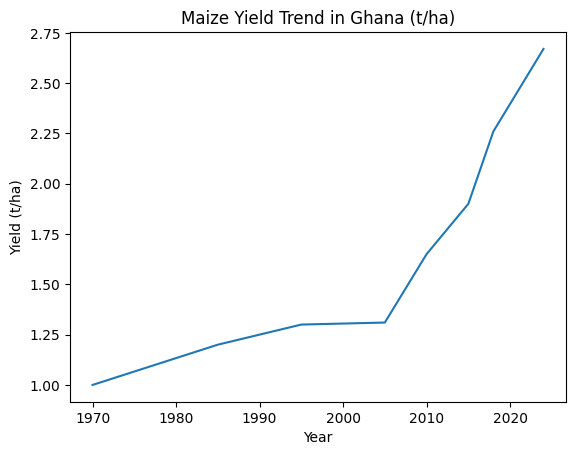
Fig. 1. Maize yield trends in Ghana across six decades (1960–2025). Data source: SRID, MoFA and FAOSTATs
The 1983 Structural Adjustment Programme marked the first major inflection point. Faced with macroeconomic collapse, Ghana liberalised input and output markets, devalued the local currency, and reduced state dominance in agricultural marketing. While the immediate effect constrained public extension services and subsidies, market liberalisation improved private fertiliser importation, and input distribution systems. Yield growth during the 1980s remained modest. For instance, maize rarely exceeded 1.4 t/ha but the institutional groundwork for private-sector-led input systems was laid during this period.
A more coherent agricultural modernisation agenda emerged with the launch of the Food and Agriculture Sector Development Policy (FASDEP I) in 2002 under the Ministry of Food and Agriculture. FASDEP I shifted the focus toward market-oriented agriculture, food security, and private sector participation. It strengthened seed system reform, encouraged technology dissemination, and improved alignment between research and extension. The results were not immediate leaps in yield, but the stagnation of the 1990s began to ease. By 2005, maize yields were 1.31 t/ha and rice 1.11 t/ha which were still low, but stabilising (Fig. 2).
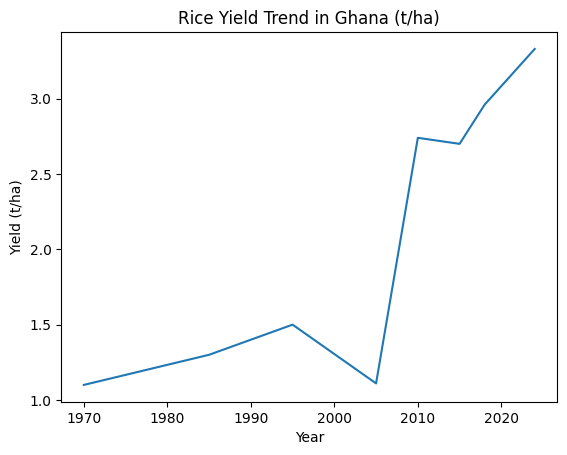
Fig. 2. Rice yield trends across 1960–2025 in Ghana. Data source: SRID, MoFA and FAOSTATs
FASDEP II in 2007 deepened the productivity emphasis. It explicitly targeted intensification, value chain development, irrigation expansion, and mechanisation services. This policy period coincided with measurable yield acceleration. Between 2005 and 2010, maize increased from 1.31-1.65 t/ha. Rice rose sharply to 2.74 t/ha, reflecting improvements in inland valley cultivation and varietal adoption. Cassava climbed to 15.33 t/ha (Fig.3). These gains suggest that when policy focus sharpened around productivity and value chains, farmers respond.
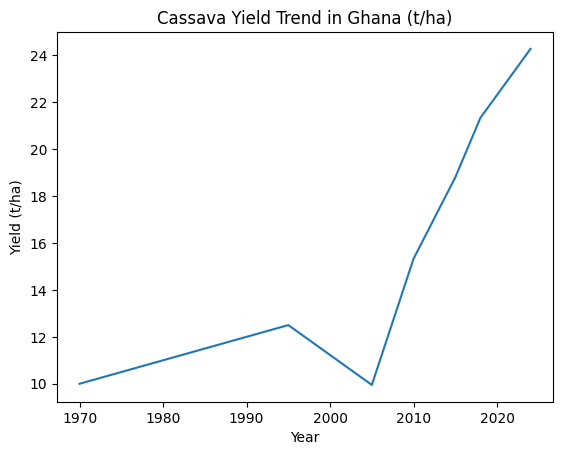
Fig. 3. Six decades (1960–2025) of cassava yield trends in Ghana. Data source: SRID, MoFA and FAOSTATs
The Agriculture Sector Medium-Term Investment Plan (METASIP), launched in 2012, operationalised FASDEP II’s ambitions. It emphasised coordinated investments, input subsidies, irrigation rehabilitation, and strengthened extension delivery. During the METASIP era (2012–2016), yields continued upward. Maize reached 1.9 t/ha by 2015, rice stabilised around 2.7 t/ha, and cassava neared 19 t/ha. Importantly, METASIP improved programme planning coherence and donor alignment, ensuring more predictable resource flows into the sector.
The most visible acceleration occurred after 2017 with the introduction of Planting for Food and Jobs (PFJ) policy programme. This programme scaled fertiliser subsidies, expanded improved seed distribution, and revitalised extension coverage nationwide. Input uptake increased significantly. Between 2015 and 2018, maize rose from roughly 1.9 to 2.26 t/ha. By 2024, it reached 2.67 t/ha. Rice climbed to 3.33 t/ha. Cassava surpassed 24 t/ha. While weather variability influenced year-to-year fluctuations, the broader trajectory reflects increased input intensity and farmer participation.
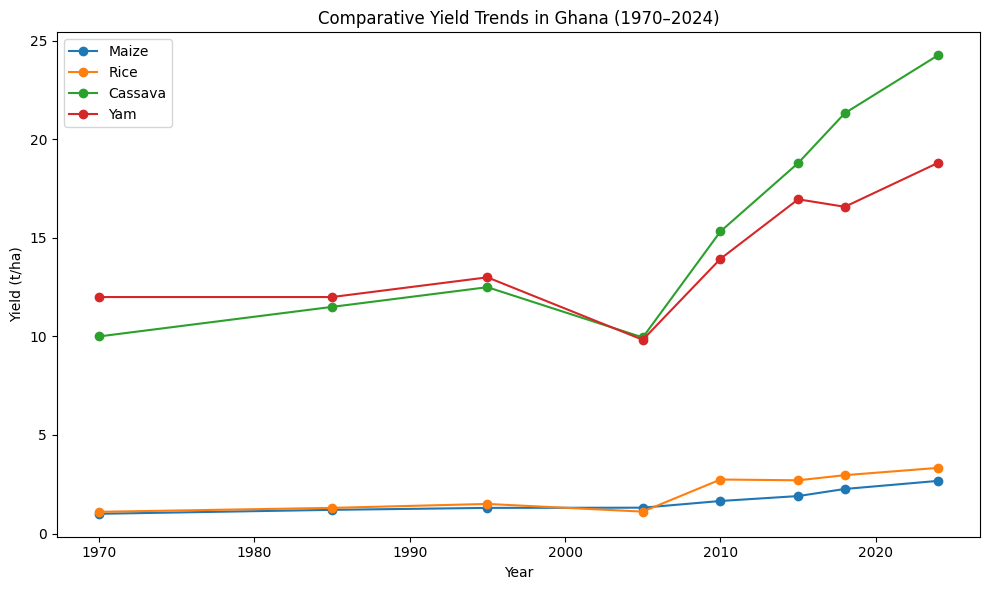
Fig. 4. Six decades of yield trends in Ghana for selected crops. Data source: SRID, MoFA and FAOSTATs
The transition to PFJ 2.0 in 2023 sought to correct implementation bottlenecks in the initial phase by strengthening programme targets, improving input distribution efficiency, and integrating digital monitoring systems. Although it ended prematurely, PFJ 2.0 aimed to consolidate productivity gains while addressing fiscal sustainability and leakages that constrained earlier subsidy models.
The broader Agriculture for Economic Transformation agenda, often framed within the “Feed Ghana” as part of the current government’s 24H+ flagship policy programme, signals a shift from production expansion to structural competitiveness. It emphasises irrigation expansion, commercialisation, agro-processing linkages, and export competitiveness. This reflects recognition that yield growth alone is insufficient without post-harvest systems, finance reform, mechanisation ecosystems, and market integration.
Across all these policy waves, one pattern is unmistakable; Ghana’s yield growth has been policy-responsive. When macroeconomic reforms stabilised markets, private input systems expanded. When FASDEP prioritised productivity, yields improved. When METASIP coordinated investment, gains consolidated. When PFJ subsidised inputs at scale, measurable yield increases followed.
Yet the data also reveal a persistent ceiling. Even at 2.67 t/ha, maize remains far below its agronomic potential of 5–6 t/ha under improved irrigation and soil management. Rice at 3.33 t/ha still lags behind achievable benchmarks above 6 t/ha. Cassava and yam have performed strongly but remain vulnerable to soil degradation and climate variability (Fig. 5). The yield gap is therefore not just technological deficit; it is structural constraint; irrigation deficits, soil fertility decline, mechanisation bottlenecks, limited rural finance, and climate risk exposure.
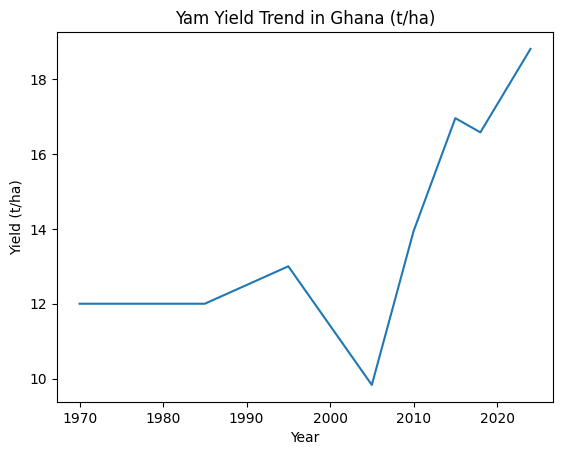
Fig. 5. Yam yield trends in Ghana across six decades (1960–2025). Data source: SRID, MoFA and FAOSTATs
Over 70 years, Ghana has moved from agriculture driven by land expansion to incremental intensification driven by policy intervention. The transformation has been steady but not revolutionary. For each policy regime; Structural Adjustment, FASDEP I and II, METASIP, PFJ, PFJ 2.0, and the Agriculture for Economic Transformation agenda has nudged yields upward. None has yet delivered a systemic productivity breakthrough.
The evidence suggests that Ghanaian smallholders respond predictably to coherent policy signals and accessible inputs. The next phase must therefore move beyond episodic subsidy cycles toward irrigation-led intensification, integrated soil fertility management, sustainable mechanisation services, and structured rural finance. The country has demonstrated capacity for improvement. The strategic question now is whether it will engineer the institutional coherence required to convert incremental yield growth into full agricultural transformation.

