


- Ghana’s Rivers Cannot Wait for Another Task Force as Bishops Demand Radical Action
The Ghana Catholic Bishops’ Conference has renewed its demand for a state of emergency over illegal mining, sharpening a fundamental question confronting President John Dramani Mahama’s administration: does Ghana lack the legal authority to stop galamsey, or has the state repeatedly failed to use the authority it already possesses?
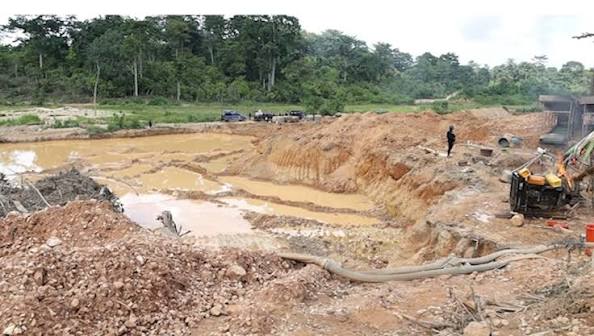
The distinction matters. A state of emergency would be an extraordinary constitutional intervention. It could concentrate security resources, accelerate enforcement and restrict some freedoms in designated areas. But it would not, by itself, explain why excavators enter forest reserves, why illegally produced gold finds buyers, why environmental offences frequently fail to end in successful prosecutions or why damaged land and water bodies remain unreclaimed long after mining operations are disrupted.
President of the Ghana Catholic Bishops’ Conference, Most Rev. Matthew Gyamfi, argues that the scale of the destruction now requires the government to act beyond its conventional enforcement routines.
“Since the President of Ghana held the sword and swore to protect and defend Ghana, we should see him doing certain things radically,” he said.
“These are situations where we say a state of emergency should be declared on this deplorable, wicked situation, so that Ghanaians will be seen to be really and clearly defended.”
His language deliberately shifts galamsey away from being treated as merely an environmental infraction. The Bishops are presenting it as a national protection crisis in which the state’s failure to secure water, food systems, forests and public health is potentially as serious as its failure to protect citizens from other forms of organised insecurity.
That is the deeper significance of their intervention. The argument is no longer simply that illegal miners are destroying rivers. It is that the destruction has continued despite years of presidential declarations, military deployments, specialised task forces, arrests, equipment seizures and regulatory reforms.
Ghana does not suffer from an absence of anti-galamsey announcements. It suffers from a widening credibility deficit between what the state says, what its institutions do and what communities continue to see.
Most Rev. Gyamfi warned that galamsey was contaminating water systems and creating risks that move through the food chain and into the human body.
“You cannot stop fighting galamsey. It is poisonous and very dangerous, creating other sicknesses,” he said.
The attached report similarly frames illegal mining as a public-health, livelihood and economic-sustainability crisis rather than an isolated mining-sector problem. Ghana’s Galamse.docx
This framing is essential because the market value of illegally extracted gold captures only the private benefit enjoyed by miners, financiers, equipment owners, exporters and their political or commercial protectors. It does not reflect the full cost transferred to the public.
When a river is polluted, the miner receives the gold revenue, but households, farmers, businesses and the state inherit the damage. Water treatment becomes more difficult and expensive. Irrigation systems become unsafe. Agricultural land loses productivity. Fishing communities lose income. Public-health risks rise, and future governments face the cost of restoring landscapes from which the immediate profits have already been removed.
Illegal mining therefore operates through a profoundly unequal economic model: gains are privatised, while environmental and social losses are distributed across the population.
This is why arguments that galamsey provides employment, although relevant to the search for solutions, cannot constitute a defence of the activity. Employment that destroys the natural assets on which other jobs, communities and future generations depend is not sustainable economic inclusion. It is the conversion of public wealth into private income without payment for the damage created.
President Mahama has maintained that emergency powers should be a last resort. Speaking in New York on September 25, he rejected suggestions that he had promised to declare a state of emergency and argued that existing laws already gave the government sufficient authority to confront illegal mining.
“States of emergency are useful, but you declare them as a last resort,” he said.
The President also questioned how such a measure could be practically applied when galamsey affects as many as 10 regions. Emergency declarations, he argued, are normally geographically limited, temporary and capable of restricting important rights.
There is logic in that caution. Extraordinary powers should not become a substitute for ordinary government. A state that cannot enforce mining, environmental, customs, financial and criminal laws under normal constitutional conditions will not automatically become effective because it has acquired additional powers.
An emergency declaration could also create risks. Poorly defined operations might punish vulnerable mining communities while financiers, politically exposed actors, gold buyers and equipment suppliers remain untouched. Security deployments could become highly visible but economically superficial, disrupting mining temporarily without dismantling the commercial networks that make it profitable.
The President is therefore correct that the declaration itself is not a policy. At best, it is a legal and operational instrument. Its value depends on the precision of the objective, the geographical scope, the quality of intelligence, the chain of command, the protection of lawful rights and the environmental outcomes it is expected to achieve.
But the President’s caution creates a corresponding obligation. If existing laws are adequate, the government must demonstrate their adequacy through results.
It cannot argue indefinitely that emergency powers are unnecessary while rivers deteriorate, forest reserves remain vulnerable and prosecutions fail to generate sufficient deterrence. Rejecting extraordinary powers raises the performance threshold for ordinary enforcement.
The government must therefore show that its alternative is not simply less disruptive politically, but more effective environmentally.
The apparent disagreement between the Bishops and the President may not be as irreconcilable as it first appears.
The Bishops have previously supported emergency declarations in areas severely affected by illegal mining, rather than necessarily demanding blanket emergency rule across the country. In May 2025, they called for a targeted state of emergency in galamsey-affected locations to mobilise enforcement and rehabilitation resources.
Kenneth Ashigbey, chief executive of the Ghana Chamber of Mines and convenor of the Media Coalition Against Galamsey, has made a similar case. He has argued that emergency powers are particularly warranted in locations where armed groups attack Forestry Commission personnel and public officers cannot safely perform their duties.
“In places where armed groups are attacking Forestry Commission officers, a state of emergency is definitely required,” he said previously, warning that Ghana risked reaching a point where environmental and public-health damage could not be reversed.
A targeted approach could offer a middle course. It would avoid treating 10 regions as a single emergency zone while allowing the government to concentrate personnel, intelligence and logistical resources in districts where state authority has been severely compromised.
Such an intervention should not be defined merely by the deployment of soldiers. It would need clear environmental targets: removal of mining equipment from specified water bodies, protection of defined forest compartments, restoration of access for regulators, measurable improvement in water quality and prosecution of identified financiers and operators.
Emergency action without measurable outcomes risks becoming political theatre. The success of an operation should not be reported principally through the number of excavators burned, miners dispersed or pits raided. Those statistics describe activity, not necessarily impact.
The decisive indicators should be whether mining has stopped in protected areas, whether rivers are recovering, whether illegal gold can still enter formal supply chains and whether those financing the operations have lost both their assets and their liberty through lawful prosecution.
Galamsey persists because it is an organised economic system.
Excavators must be purchased, imported, leased, fuelled and transported. Gold must be aggregated, assayed, purchased, financed and exported. Officials may have to be compromised or ignored. Profits must enter the financial system or be converted into assets.
Focusing enforcement almost entirely on miners at the pit therefore addresses the most visible participants while leaving the economic architecture intact.
A credible response must follow three connected trails: the gold, the machinery and the money.
Gold traceability should make it difficult for buyers and exporters to claim ignorance about the origin of their supply. Regulatory institutions must be able to distinguish gold from licensed concessions and responsible small-scale producers from output originating in protected forests, polluted rivers and unlicensed sites.
Heavy equipment also requires end-to-end monitoring. Registration systems are useful only if regulators can identify the owner, authorised location and movement history of each machine—and impose swift consequences when equipment appears at an illegal site.
Financial investigation is equally important. Large-scale illegal mining requires capital. Those who finance machinery, fuel, security and gold purchases may be more consequential than the labourers arrested during raids.
Unless the state moves upwards through the value chain, arrests will continue to replace individual miners without destroying the commercial incentive.
The Bishops’ call for radical action should not be misinterpreted as an argument for security measures alone. They have previously recognised that enforcement must be accompanied by rehabilitation and sustainable alternatives for communities dependent on mining.
This is not a concession to illegality. It is an acknowledgement of economic reality.
Where agriculture has weakened, land has been degraded and formal employment is scarce, galamsey becomes not only a criminal enterprise but a labour market. Closing a mining site without creating credible alternatives may temporarily suppress activity, but it also creates incentives for operations to relocate or return when security personnel withdraw.
Alternative-livelihood programmes must therefore move beyond occasional training exercises and the distribution of equipment unrelated to actual market demand. They should be tied to viable local economic activity, including land reclamation, commercial agriculture, responsible mining services, construction, logistics and environmental monitoring.
Reclamation itself could become a source of structured employment if it is properly financed, supervised and linked to measurable restoration targets.
However, livelihood concerns cannot become a reason for tolerating operations that poison water and destroy farms. The policy objective should be to make lawful work more accessible while making illegal mining economically and legally unattractive.
The Bishops have placed emergency powers at the centre of the national debate, but the most consequential emergency may be institutional rather than constitutional.
Ghana already has ministries, commissions, environmental regulators, district assemblies, security agencies, customs controls and criminal laws capable of acting across the illegal-mining economy. The persistent crisis suggests failures of coordination, intelligence, prosecution, political protection or institutional independence.
Declaring an emergency may create urgency. It will not automatically create integrity.
The government must therefore answer questions extending beyond whether soldiers should be sent into mining communities. Who purchases the gold? Who owns the excavators? Which officials approved or ignored operations? How many cases have reached conviction? What assets have been confiscated? Which polluted rivers have recorded measurable improvement? How much land has been reclaimed, and who verified it?
These questions turn galamsey from a cycle of outrage into a test of accountable government.
The Bishops are right that Ghana cannot stop fighting. President Mahama is also right that extraordinary powers carry risks and should not be used casually.
But caution cannot become an alibi for incrementalism. If the President chooses not to declare a state of emergency, the burden falls on his administration to produce an enforcement system that behaves with the urgency, coordination and clarity that an emergency would demand.
Ultimately, the argument will not be settled by speeches, task-force announcements or the legal label attached to government action. It will be settled in Ghana’s rivers, forests, farms and mining communities.
If water quality improves, protected areas are secured, financiers are prosecuted and degraded land is restored, the government can credibly argue that existing powers were sufficient.
If those outcomes do not materialise, the Bishops’ warning will become harder to dismiss: Ghana may already be living through an emergency, whether the state formally declares one or not.

