
- Ghana’s US$2.62bn FDI Surge Masks US$1.70bn Gold Programme Loss – IERPP Warns
Ghana’s ability to attract US$2.62 billion in foreign direct investment in 2025 is evidence that investors continue to see opportunity in the economy, but the achievement risks being overshadowed by the reported US$1.70 billion loss associated with the Domestic Gold Purchase Programme, according to the Institute of Economic Research and Public Policy.
The policy institute says the contrast exposes a broader weakness in Ghana’s economic recovery: attracting new capital will have limited transformational impact if large amounts of public resources are simultaneously being eroded through inefficient, costly or poorly understood policy interventions.
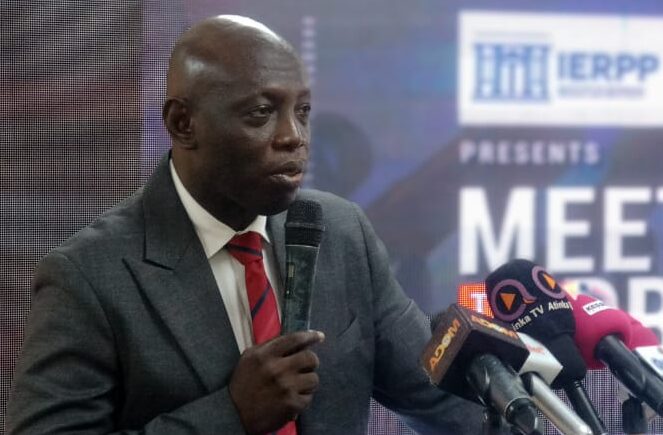
“Certainly, we should acknowledge Ghana’s capacity to draw US$2.62 billion in foreign direct investment,” Prof. Isaac Boadi, Executive Director of IERPP, said.
“It is a sign that in spite of the economic challenges we are experiencing, international investors still have confidence in the opportunities in Ghana.”
But, he added, “we cannot be happy about the money flowing into the economy when we are not looking at the big losses happening in the economy.”
The intervention follows Ghana’s 2025 Annual Investment Report, which recorded US$2.62 billion in foreign direct investment across 254 projects expected to create 18,748 jobs when fully operational.
The headline figure provides evidence of stronger investment activity, but the composition of the inflows is important.
Bank of Ghana balance-of-payments data put net FDI inflows at US$1.91 billion, lower than the headline registered-investment figure, with 95.40% of those inflows reportedly coming from reinvested earnings rather than entirely new foreign capital entering the economy.
That distinction does not make the investment less important.
Reinvested earnings can be a powerful signal that existing businesses retain confidence in Ghana and are willing to keep profits in the country rather than repatriate them.
But it means the US$2.62 billion headline should not automatically be interpreted as an equivalent amount of fresh cash entering Ghana from abroad.
For IERPP, the more important question is what Ghana does with both foreign investment and the domestic assets already under its control.
That concern has centred increasingly on the Domestic Gold Purchase Programme, through which the Bank of Ghana purchased locally produced gold as part of efforts to strengthen foreign-exchange reserves and provide support for the cedi.
The International Monetary Fund has reported that the significant expansion of the programme generated losses of more than US$1.70 billion in 2025, equivalent to approximately 1.50% of Ghana’s gross domestic product, with almost all of the losses associated with purchases of doré gold under the Gold-for-Reserves programme.
IERPP has sought to illustrate the scale of the figure by comparing it with Ghana’s foreign investment performance.
“Every US$1 that Ghana attracts in FDI, the reported loss under the Domestic Gold Purchase Program is equivalent to about 65 cents,” Prof. Boadi said.
The institute stressed that the comparison should not be misunderstood.
“Not that the FDI was lost or that GoldBod was responsible for the entire loss of US$1.70 billion,” Prof. Boadi said. “The point is to show the magnitude of the loss relative to the capital we are celebrating.”
The US$2.62 billion in FDI and the US$1.70 billion associated with the gold programme are not two sides of the same transaction.
Foreign direct investment represents private capital committed to productive activities in Ghana, while losses or policy costs under the domestic gold programme arise from the mechanics of purchasing, pricing, financing and holding gold for reserve-management purposes.
It would therefore be misleading to suggest that Ghana attracted US$2.62 billion and then lost US$1.70 billion of that same money.
IERPP’s argument is instead about economic efficiency.
Ghana is devoting considerable effort to attracting international capital while simultaneously facing questions about whether one of its most important domestic resource-management programmes is imposing excessively high costs.
That makes the issue less about whether foreign investors have confidence in Ghana and more about whether public institutions are managing national assets with comparable discipline.
The Domestic Gold Purchase Programme was designed as a strategic response to Ghana’s recurring foreign-exchange vulnerability.
By purchasing gold locally and converting part of the country’s mineral output into reserve assets, the central bank sought to accumulate foreign reserves without relying exclusively on external borrowing or conventional foreign-exchange purchases.
The programme has played a role in strengthening reserves and increasing foreign-exchange inflows.
But that does not remove the need to examine its cost. A policy can achieve a strategic objective while still being financially inefficient.
The relevant question is therefore not simply whether Ghana accumulated more reserves through gold purchases, but how much it cost to obtain those reserves and whether the same objective could have been achieved more efficiently.
IERPP wants a clearer breakdown of the programme’s economics, including purchase prices, discounts, fees, operating costs, foreign-exchange effects, revenues and the specific role played by the Ghana Gold Board.
The concern has intensified because the reported losses expanded sharply from about US$400 million in 2024 to more than US$1.70 billion in 2025.
IERPP has also pointed to IMF analysis indicating that operating costs reached about 14.50% of the value of gold purchased in 2025, compared with a government target of 5.00%.
If those figures are confirmed through a detailed reconciliation, they would raise substantial questions about cost control within the programme.
The debate has also become more complicated because there is disagreement over what the US$1.70 billion figure actually represents.
Some analysts and policymakers have argued that parts of the amount reflect valuation effects, accounting treatment and deliberate policy costs rather than an outright cash loss.
Parliament has indicated that it intends to examine the issue, including whether the figure should be classified as a financial loss or a policy cost.
Calling the entire US$1.70 billion a straightforward cash loss could oversimplify the accounting mechanics of a programme involving gold purchases, exchange-rate movements, reserve valuation and central-bank operations.
But dismissing the entire amount as merely an accounting or policy cost could equally obscure the real impact on the Bank of Ghana’s financial position.
The central bank’s negative equity position reached about GH¢93.80 billion by the end of 2025, according to figures cited by IERPP, reinforcing concerns over the cumulative financial effect of extraordinary policy interventions.
For Prof. Boadi, the core issue is therefore resource management.
“The question is, are we paying enough attention to how well we manage and protect the resources that we already have in our economy?” he asked.
He likened the situation to “filling a bucket with water while leaving a large hole at the bottom”.
“It would be good news that more water is being poured into the bucket, but the greater responsibility is to ask why we are allowing such a significant amount to escape,” he said.
Ghana cannot build durable prosperity purely by attracting foreign investment. FDI matters because it can increase productive capacity, create jobs, deepen exports, transfer technology and improve foreign-exchange generation.
But those gains can be undermined if public institutions simultaneously accumulate losses, quasi-fiscal costs or inefficiencies large enough to weaken the country’s balance sheet.
The investment numbers themselves also deserve more careful interpretation.
The US$2.62 billion in registered investment covers projects across sectors including manufacturing, mining services and technology.
The expected employment of 18,748 people suggests meaningful potential economic impact.
But expected jobs must ultimately materialise. Registered investment must become actual capital expenditure. Factories must be built. Businesses must expand production. Exports must increase. Technology and skills must be transferred. That is how a headline investment figure becomes economic transformation.
Likewise, the fact that 95.40% of net balance-of-payments FDI came from reinvested earnings points to another policy challenge. Existing investors appear willing to retain earnings in Ghana, which is positive.
But the country still needs to attract a larger pipeline of genuinely new capital, particularly into sectors capable of creating export earnings and high-productivity employment.
Against that backdrop, the domestic gold programme becomes part of a larger credibility question. Investor confidence is not determined only by tax incentives, political stability or market size. It is also influenced by whether public institutions manage policy predictably, whether state interventions are transparent and whether economic losses are investigated rather than obscured.
“There should be no selective enthusiasm when it comes to Ghana’s economic numbers,” Prof. Boadi said.
“When the figures are positive, we must celebrate them; when the figures reveal significant losses, we must ask difficult questions. Both are necessary for a credible economic conversation.”
Ghana’s FDI performance and the reported gold programme losses should not be turned into competing political narratives. The country can be attracting significant investment while still managing parts of its public balance sheet inefficiently.
The gold programme can have strengthened reserves while simultaneously generating unacceptable costs.
Reinvested earnings can demonstrate investor confidence while also showing that the headline FDI number contains less entirely new capital than first impressions suggest.
A credible economic assessment must hold all those realities together. For Ghana, the strategic task is therefore twofold. It must continue rebuilding investor confidence and attracting private capital.
But it must also ensure that its own public institutions, natural resources and monetary-policy instruments generate value rather than silently eroding it.
“We must celebrate Ghana attracting US$2.62 billion in FDI,” Prof. Boadi said.
“But at the same time, we must have the courage to ask why a reported US$1.70 billion loss under the domestic gold programme is equivalent to almost two-thirds of that inflow. Ghana needs both investment and accountability. One without the other cannot deliver sustainable economic transformation.”
The success of Ghana’s recovery will not be judged only by how much capital comes into the economy. It will also be judged by how efficiently the country protects, deploys and compounds the wealth it already possesses.