


- GNPC Supplies 950,000 Barrels of Sankofa Crude to TOR On Commercial Terms
The Tema Oil Refinery has received its first cargo of crude oil from Ghana’s Sankofa-Gye Nyame field, marking a potentially important step in efforts to connect the country’s upstream petroleum production with its domestic refining capacity.
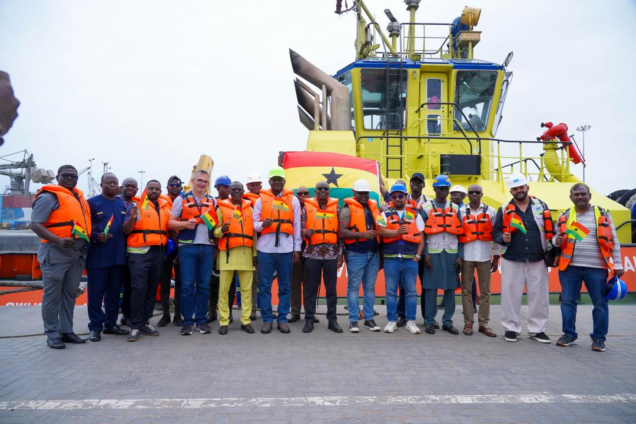
TOR took delivery of about 950,000 barrels of Sankofa crude supplied by the Ghana National Petroleum Corporation and transported aboard the Sonangol Cazenga.
The cargo is expected to be processed into gasoline, gasoil, aviation fuel and liquefied petroleum gas for the Ghanaian market.
Its significance extends beyond the volume delivered. The transaction tests whether Ghana can establish a commercially sustainable petroleum chain in which locally produced crude is refined domestically and sold into the national fuel market.
“The supply of Sankofa crude to TOR on commercial terms represents more than a transaction between two state institutions,” said Kwame Ntow Amoah, chief executive of GNPC.
“It is an opportunity to take a Ghanaian resource, process more of it in Ghana, and create value across our own petroleum industry.”
For years, Ghana has faced the paradox of producing crude oil while importing most of the refined petroleum products consumed by households and businesses.
The problem has not been a simple shortage of crude. Refinery reliability, maintenance, working capital, operational efficiency and commercial governance have all limited Ghana’s ability to convert domestic oil production into a dependable source of locally refined fuel.
The Sankofa shipment therefore places TOR’s recovery under a more demanding test.
The central question is no longer whether the refinery can receive and process a cargo. It is whether TOR can operate consistently enough to become a credible long-term buyer of Ghanaian crude without accumulating new liabilities.
A functioning TOR would give GNPC another market for the crude volumes available to the national oil company.
“We don’t have to look far afield for buyers,” Mr Amoah said. “We know there is a dependable buyer for our oil in-country, and it is a commercial arrangement.”
That proposition offers several potential benefits.
Selling crude to a domestic refinery could reduce some of the logistical distance between production and final consumption, support local technical employment and retain a greater share of processing activity within Ghana.
It could also create a more direct relationship between upstream production and the domestic fuel market.
However, proximity does not automatically make domestic refining more economical than exporting crude and importing finished products.
The viability of the model will depend on TOR’s operating efficiency, processing losses, financing costs, product yields and ability to sell its output at competitive prices.
If the refinery cannot process crude reliably or if its cost structure is significantly higher than that of competing suppliers, directing domestic crude to TOR could simply shift costs within the state-owned energy system.
The arrangement must therefore continue to be assessed on commercial terms.
The first cargo is a milestone, but a sustainable refining model requires repeated transactions whose costs and revenues can be independently evaluated.
GNPC says it currently has approximately eight to 10 similar crude cargoes available each year, although some of those volumes are already committed under existing arrangements.
That suggests a potentially meaningful feedstock pipeline for TOR if the refinery can demonstrate consistent processing capacity and meet its payment obligations.
At 950,000 barrels per shipment, eight cargoes would represent about 7.6mn barrels, while 10 would amount to approximately 9.5mn barrels.
Not all of those volumes would necessarily be available to TOR. Existing contractual commitments, GNPC’s financing requirements and the relative economics of domestic and international sales would affect allocation decisions.
The figure nevertheless shows that the current shipment could form part of a regular supply programme rather than remain an isolated transaction.
For TOR, predictable feedstock would allow management to plan production, maintenance and product sales more effectively.
For GNPC, a dependable local customer could diversify its crude-marketing options.
The key word is dependable.
GNPC must have confidence that crude delivered to the refinery will be paid for fully and on time. TOR, in turn, must be confident that agreed volumes will arrive according to a schedule compatible with its operations.
The financing arrangement is one of the most important aspects of the transaction.
Edmond Kombat, Managing Director of TOR, said the cargo had been fully paid for through a Letter of Credit accepted by GNPC and that no debt exposure arose from the supply.
That structure distinguishes the shipment from arrangements under which a state institution receives fuel or crude without an adequately secured payment mechanism.
A Letter of Credit reduces counterparty risk by providing a formal banking commitment to pay once the relevant contractual conditions have been satisfied.
For GNPC, it offers greater certainty that the value of the cargo will be recovered. For TOR, it provides a structured mechanism for financing the purchase rather than allowing the obligation to become an unpaid inter-company balance.
This discipline will be essential if the partnership is to continue.
A refinery cannot be sustainably revived through crude allocations unsupported by cash flow. It needs adequate working capital to purchase feedstock, finance processing and bridge the period between paying for crude and receiving revenue from product sales.
The long-term model must therefore combine secured crude financing with efficient production and dependable product offtake.
If any of those components fails, pressure could reappear elsewhere in the chain.
Mr Kombat described Sankofa crude as light and sweet, characteristics that can make it attractive to refiners.
Light crude generally produces a larger share of higher-value products such as petrol, diesel and aviation fuel, while sweet crude has a lower sulphur content and may require less intensive treatment than heavier, higher-sulphur grades.
TOR expects the cargo to produce gasoline, gasoil, aviation turbine kerosene and LPG.
The actual value generated will depend on the refinery’s recovery rate, the operating condition of its units and the market prices of the products produced.
Publishing the results of the processing run would help establish whether the domestic refining arrangement is commercially competitive.
Relevant information would include the volume of finished products obtained, operating costs, processing time, plant utilisation and any losses incurred.
Without such disclosure, the public may know that crude was refined locally but remain unable to assess whether the transaction created more value than alternative marketing arrangements.
The Sankofa-Gye Nyame field remains an important part of Ghana’s upstream petroleum portfolio.
GNPC’s 2024 annual report indicates that the field produced about 9.61mn barrels, representing roughly 20 per cent of Ghana’s total crude output for that year.
But Ghana’s upstream sector is contending with declining production.
GNPC said the country recorded a fifth consecutive annual fall in crude output in 2025, reinforcing the need for new investment in exploration, field development and production optimisation.
The decline creates a strategic tension.
Ghana wants to refine more crude domestically at the same time that the overall volume of crude produced is under pressure.
A sustainable domestic refining programme cannot depend entirely on reallocating a shrinking pool of barrels among existing customers.
It requires either increased production from current fields, new discoveries moving into development or, where commercially sensible, supplementary imported crude compatible with TOR’s configuration.
“We are seeing an uptick in production, and we are continuing with our aggressive exploration efforts, including our onshore pursuit of the Voltaian Basin exploratory programme, to increase production and sustain the supply of crude to the refinery,” Mr Amoah said.
Exploration, however, involves long lead times and uncertain outcomes. The Voltaian Basin may contribute to future production, but it cannot be treated as guaranteed near-term feedstock.
TOR’s immediate operating plan must therefore be based on confirmed crude availability rather than anticipated discoveries.
GNPC and TOR are also discussing the supply of natural gas to support refinery operations.
Gas could strengthen the integration of Ghana’s upstream and downstream assets by providing the refinery with an additional domestic energy input.
Its commercial benefit would depend on the price, required infrastructure and reliability of supply.
A broader crude-and-gas partnership could improve the refinery’s operating economics, but it must be governed by clearly defined contracts and payment arrangements.
“We believe the collaboration with TOR will continue to grow stronger,” Mr Amoah said.
That outcome will depend on whether the two state-owned institutions maintain the commercial discipline established for the first Sankofa cargo.
The shipment arrives as TOR seeks to restore sustained operations following maintenance and renewed crude processing.
The refinery’s rehabilitation has again placed it at the centre of Ghana’s energy-security debate.
A reliably operating TOR could reduce some dependence on imported finished products, develop domestic refining expertise and provide an additional market for Ghanaian crude.
But the refinery’s national importance cannot exempt it from commercial scrutiny.
The most important measure of success will be whether TOR can process cargoes safely, efficiently and repeatedly while paying suppliers without creating debts for GNPC, the government or the banking system.
The Sankofa delivery creates that opportunity.
If it becomes the first of several commercially viable cargoes, Ghana could begin building a more integrated petroleum industry in which upstream production, domestic refining and fuel consumption reinforce one another.
If it remains a ceremonial milestone, the country’s longstanding petroleum paradox will endure: exporting crude while importing much of the value added to it elsewhere.

