


- Gold Stars Coach’s Debibi Pitch Attack Raises Questions Over GFA Venue Approval
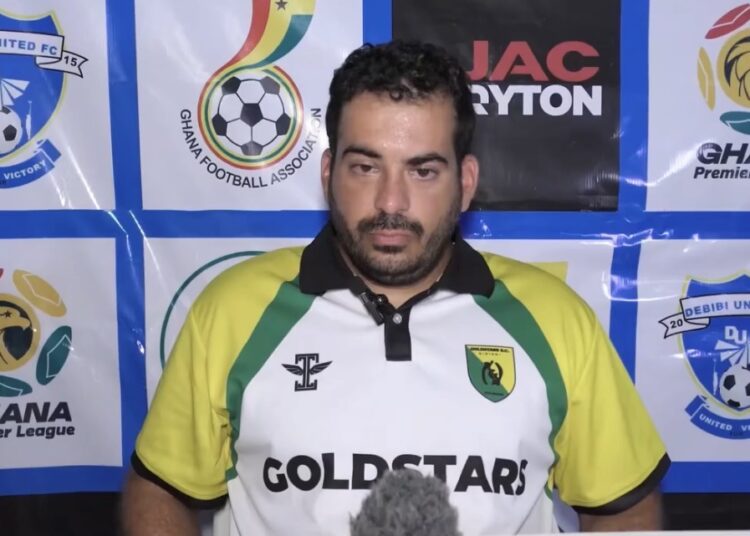
Bibiani Gold Stars head coach Petros Koukouras has delivered a blunt assessment of the playing surface at Debibi Presby Park, arguing that the venue was more suitable for cultivating cassava than staging Ghana Premier League football.
His criticism followed Gold Stars’ 1-0 defeat to newly promoted Debibi United on October 18, when Maxwell Agyemang scored shortly before half-time to secure the hosts’ first victory in four matches. The result moved Debibi United out of the relegation zone and level with Gold Stars on seven points.
Koukouras, however, was unwilling to analyse the football.
“We cannot discuss football. I don’t think this is a pitch designated for football. Maybe it is designated for cassava plantation. I don’t have anything else to say,” the Greek coach said after the match.
The description was deliberately provocative, but the issue it raises extends beyond the frustration of a losing coach. A playing surface is not a decorative part of a football match. It influences passing speed, ball movement, tactical execution, physical safety and the overall credibility of the competition.
Poor surfaces can neutralise technical quality by making control and passing unpredictable. They may reward direct football, aerial contests and second-ball battles rather than structured possession. When that happens, the quality of the spectacle deteriorates and coaches find it harder to implement tactical systems built around movement, pressing and accurate distribution.
The challenge for the Ghana Football Association is that Debibi Presby Park is not an unofficial venue selected without its knowledge. The association designated it for the Matchday Seven fixture, appointed the match officials and assigned a match commissioner and venue media officer. The ground has also hosted Debibi United’s other league matches during the season.
That makes Koukouras’ criticism indirectly a question about the inspection and approval process. If the surface satisfied the applicable requirements before the season, the relevant authorities must determine whether its condition subsequently deteriorated. If concerns were already visible, questions arise over how the venue retained approval for top-flight matches.
The GFA’s club-licensing rules require Premier League venues to comply with the Laws of the Game, while the field must be natural grass or a FIFA-approved synthetic surface. Yet formal compliance cannot be reduced to whether grass exists or pitch dimensions are correct. A field may satisfy basic structural criteria and still provide a poor surface for professional competition.
The important question is therefore not simply whether Debibi Presby Park passed an initial inspection. It is whether monitoring continued after approval and whether match reports identified deterioration early enough for corrective work. Venue licensing should operate as a continuous standard, not a certificate granted once and assumed to remain valid throughout the season.
There is also a need to separate competitive disappointment from an objective assessment. Gold Stars lost the match, and defeated teams frequently criticise pitches, referees or other conditions. Debibi United played on the same surface and managed to win. That fact does not automatically invalidate Koukouras’ complaint, but it makes independent technical evaluation essential.
The strongest response would not be a verbal exchange between the clubs or sanctions against a coach for colourful language. It would be a prompt inspection, supported by photographs, measurements and the reports of the referee and match commissioner. The findings should establish whether the surface met the required standard on matchday and what remedial action, if any, is necessary.
Player safety must sit at the centre of that review. Uneven ground, exposed patches, unstable footing and poor drainage can increase the risk of ankle, knee and muscle injuries. A league that expects clubs to invest in players cannot treat the ground on which those players perform as a secondary concern.
For promoted clubs such as Debibi United, infrastructure demands can be particularly difficult. Moving from the lower divisions into the Premier League brings higher expectations without necessarily delivering an immediate increase in revenue. Maintaining grass, drainage, irrigation and ground staff can impose costs that smaller clubs struggle to absorb.
That reality calls for a development response as well as enforcement. The GFA can insist on minimum standards while helping clubs access technical expertise on pitch maintenance. Local authorities, traditional leaders and private sponsors may also have roles in upgrading venues that serve communities beyond football.
But financial difficulty cannot become a permanent exemption. Home advantage should come from support, familiarity and tactics, not from a surface so difficult that opponents cannot play their normal game. Consistent pitch standards are part of competitive integrity because every club should encounter broadly comparable conditions across the league.
Debibi United’s victory remains legitimate unless the governing body determines otherwise. Agyemang took his opportunity, the hosts collected three points and ended their three-match winless sequence. They will now travel to Bechem United seeking to build momentum, while Gold Stars must regroup before hosting Heart of Lions.
Nevertheless, the result should not close the discussion. Koukouras’ words have created an opportunity for the GFA to demonstrate how seriously it treats infrastructure complaints. Silence would allow the controversy to become another passing argument. A transparent inspection would show that venue standards are measurable and enforceable.
The episode also illustrates a wider tension in Ghanaian football. The league wants better coaching, stronger youth development, larger broadcast audiences and more commercial investment, but all those ambitions begin with basic playing conditions. Tactical sophistication cannot flourish where the ball cannot travel predictably, and player development suffers when athletes spend matches adapting to avoidable surface problems.
Koukouras may have chosen language designed to sting, but the governing authorities should look beyond the insult. The real test is whether Debibi Presby Park is fit for elite football and whether the league possesses a system capable of identifying and correcting weaknesses before they damage players, matches and public confidence.
Ghanaian football does not need every venue to resemble the world’s richest stadiums. It does, however, need surfaces that are safe, playable and consistent with a professional national competition. That is ultimately the standard against which the “cassava plantation” claim should now be independently tested.

