

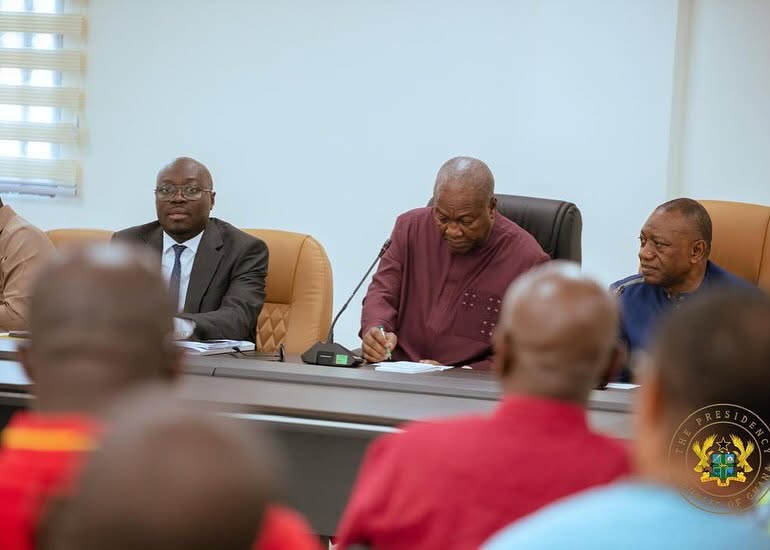

- Government and Labour Agree 8% Base Pay Rise for 2027, 10% for 2028
The Government of Ghana and Organised Labour have agreed on a two-year public sector remuneration framework that will increase base pay by 8% in 2027 and a further 10% in 2028.
The agreement, signed on Wednesday, October 28, 2026, covers public service remuneration from January 1, 2027, to December 31, 2028.
It was concluded through the Public Services Joint Standing Negotiating Committee and is intended to give public sector workers, government institutions and fiscal planners greater certainty over compensation for the next two years.
The 2027 arrangement provides for a total remuneration adjustment of 9%. Eight percentage points will apply to base pay across the board, while the remaining one percentage point will be allocated to Conditions of Service.
The distinction is important because public sector workers will not receive the entire 9% as an increase in base salary. Only the 8% component will directly increase base pay, with the remaining portion applied through agreed Conditions of Service.
For 2028, workers will receive a 10% across-the-board increase calculated on the base pay applicable as of December 31, 2027.
Because the second increase will apply after the 2027 adjustment, the two increases would produce a cumulative base-pay rise of 18.80% over the two years, before accounting for the separate Conditions of Service component.
A worker with a base salary of GH¢1,000 at the end of 2026 would receive GH¢1,080 after the 2027 adjustment. Applying the 10% increase in 2028 would take the base amount to GH¢1,188.
Actual monetary gains will differ according to each employee’s grade, salary level, allowances and applicable Conditions of Service.
The agreement reflects an attempt to balance two competing pressures.
Public sector workers want remuneration that protects their purchasing power after periods of high inflation and rising living costs. The government must simultaneously contain the wage bill, protect fiscal consolidation and ensure that higher compensation does not crowd out spending on infrastructure and public services.
A two-year settlement provides some predictability for both sides.
Workers gain early visibility over the direction of pay, while the Ministry of Finance can incorporate the increases into the 2027 and 2028 budgets with greater certainty.
The framework could also reduce the risk of annual pay disputes and support industrial stability. However, its success will depend on whether actual inflation remains close to the assumptions used during negotiations.
The agreement considered the prevailing inflation rate of 5.20% and the government’s medium-term projection of 8%, plus or minus two percentage points, for both 2027 and 2028.
If inflation averages 8% in 2027, the 8% base-pay increase would broadly preserve the purchasing power of workers’ base salaries. The additional one percentage point allocated to Conditions of Service could provide a small real improvement, depending on how it is distributed.
If inflation reaches the upper end of the projection at 10%, however, the base-pay adjustment would fall below the increase in consumer prices. Workers could experience a reduction in real base income despite receiving a nominal salary increase.
For 2028, a 10% base-pay increase would provide some real income growth if inflation remains around the 8% midpoint. If inflation reaches 10%, the increase would broadly preserve rather than improve purchasing power.
The agreement includes a provision allowing the negotiating committee to reconvene if inflation rises substantially above the government’s projection.
It states that if year-on-year inflation for December 2027 exceeds the 8% midpoint projection “by a factor of two,” the committee must review the 2028 base pay.
On a literal reading, this suggests that the review would be triggered if December 2027 inflation exceeded 16%.
The clause provides protection against an extreme inflation shock but may offer limited relief if inflation rises moderately above the government’s target.
For example, inflation of 11%, 13% or even 15% could materially weaken workers’ purchasing power without necessarily activating the specified trigger.
The provision also does not guarantee an automatic additional pay increase. It only requires the parties to reconvene and review the 2028 adjustment.
The eventual outcome would still depend on negotiations, the state of public finances and the economic conditions prevailing at the time.
This makes inflation management central to the sustainability of the agreement. If the government maintains price stability, the negotiated increases could protect incomes without placing unexpected pressure on the budget.
If inflation accelerates, both the real value of the settlement and the government’s ability to finance it could come under strain.
The agreement gives the government a clearer basis for projecting compensation expenditure, but the fiscal impact will extend beyond the headline percentage increases.
An across-the-board base-pay adjustment affects salaries and may also influence allowances, pensions and other benefits linked to base pay. The resulting increase in public expenditure could therefore exceed the direct adjustment to monthly wages.
Government must ensure that revenue grows sufficiently to accommodate the settlement without expanding borrowing or reducing essential capital expenditure.
The composition of the public wage bill will also matter. Compensation sustainability depends not only on pay levels but also on the number of workers, payroll integrity, recruitment controls and the relationship between remuneration and productivity.
If public employment grows rapidly alongside higher salaries, the fiscal cost could rise more sharply than anticipated.
Payroll audits, the removal of irregular names, improved human-resource information systems and disciplined recruitment will therefore remain important.
The agreement is also linked to the proposed transition from the Fair Wages and Salaries Commission to an Independent Public Emoluments Commission.
The transition is expected to cover the legislative framework, institutional design, a National Emoluments Policy, a National Negotiations Policy and a performance- and productivity-linked pay framework.
Organised Labour is to be consulted quarterly on reforms affecting workers. Existing institutions, including the Fair Wages and Salaries Commission, will continue exercising their lawful responsibilities until the necessary legislation transfers authority.
The planned reform could be more consequential than the two-year percentage increases.
Ghana’s public sector compensation system has long faced concerns about salary distortions, inconsistent allowances, job classification and differences in remuneration among workers performing comparable roles.
An independent commission could help create greater consistency and transparency, but institutional independence will depend on how appointments, funding and decision-making powers are designed.
The proposed productivity-linked framework also requires careful implementation.
Productivity is relatively straightforward to measure in some public institutions but more difficult in education, health, security and regulatory services. Poorly designed performance indicators could reward easily measured activities while overlooking the quality and social value of public services.
The government and labour unions must therefore agree on performance measures that are fair, transparent and relevant to each category of work.
The agreement was signed by Fair Wages and Salaries Commission Chief Executive Dr George Smith-Graham and Trades Union Congress Secretary-General Joshua Ansah.
Finance Minister Dr Cassiel Ato Forson and Ghana National Association of Teachers General Secretary Thomas T. Musah witnessed the agreement.
The parties committed themselves to resolving implementation disputes through dialogue, established negotiation processes and lawful dispute-resolution mechanisms.
That commitment will be tested by the timing of salary payments, the treatment of Conditions of Service and the progress of institutional reforms.
Workers will expect the increases to take effect without arrears or administrative delays. Government institutions will need early payroll instructions and sufficient budgetary allocations to implement the agreement from January 2027.
The two-year framework offers Ghana an opportunity to move away from short-term wage negotiations toward a more predictable compensation system.
But predictability alone is not enough. The settlement must preserve workers’ purchasing power, remain affordable for the state and support a public service that delivers better outcomes.
The ultimate success of the agreement will be measured not only by industrial peace but by whether Ghana can connect public sector pay to fiscal capacity, productivity and the quality of services received by citizens.

