

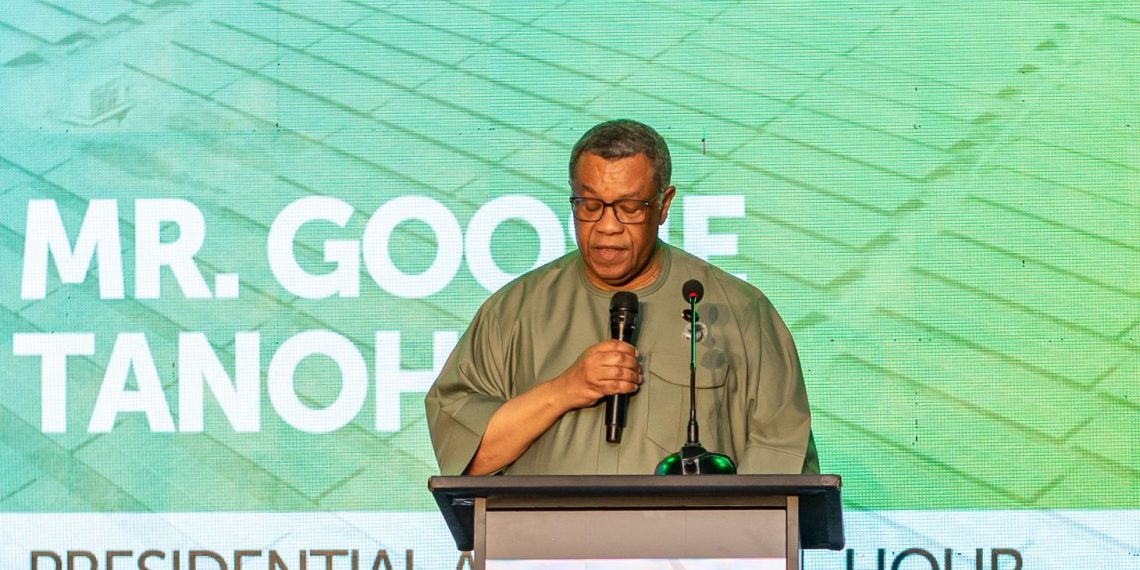

- Government Prioritises 15 Projects as 24-Hour Economy Enters Job-Creation Phase
Presidential Adviser on the 24-Hour Economy and Accelerated Export Development Programme, Augustus Goosie Tanoh, says Ghanaians should begin seeing significant employment outcomes from the initiative within the next one to two years as the government moves selected projects from planning to implementation.
The timeline provides the clearest indication yet that the programme’s promised employment impact will not be immediate, despite its launch in July 2025 and its headline target of creating at least 1.7 million jobs over four years.
Speaking on the sidelines of the Africa Bio Conference on Tuesday, October 27, 2026, Mr Tanoh said the programme has developed a pipeline of 32 projects but is initially concentrating resources and implementation efforts on between 10 and 15.
“Many things are happening, and we have a deal book of our 32 projects. We are concentrated on the first 10 to 15, and once those are rolled out, you will see the jobs coming in about a year or two,” he said.
The statement shifts the immediate test of the programme from the number of projects announced to the government’s ability to bring its first portfolio of investments to financial close, commence construction and establish commercially sustainable operations.
This distinction matters because large industrial, agricultural and infrastructure projects typically have long development periods. Land acquisition, environmental approvals, engineering designs, financing agreements and construction must often be completed before large-scale permanent employment begins.
Some temporary jobs may emerge during construction, but the deeper employment gains promised under the 24-Hour Economy will depend on factories, farms, energy systems and logistics platforms becoming operational and generating consistent demand for workers.
Mr Tanoh said the programme is also seeking to strengthen domestic production and provide industries with a dependable supply of raw materials, enabling existing and new businesses to operate closer to full capacity.
That objective touches on one of the main constraints confronting Ghanaian industry. Many local manufacturers operate below their installed capacity because of unreliable raw-material supplies, expensive credit, energy costs, weak demand and competition from imported goods.
A 24-hour production model cannot succeed simply by encouraging businesses to remain open for longer periods. Firms will extend their operating hours only when additional shifts are commercially viable and supported by sufficient electricity, raw materials, transport, security and market demand.
The programme’s employment strategy must therefore be built around productivity and investment rather than extended working hours alone. If industries can obtain raw materials locally, reduce downtime and produce competitively for domestic and export markets, longer operations could create additional shifts and employment.
However, Mr Tanoh’s one-to-two-year timeline will intensify calls for the government to publish measurable milestones against which progress can be evaluated.
The opposition New Patriotic Party has demanded evidence of the programme’s practical implementation, while the Institute of Economic Research and Public Policy has called for a comprehensive account of its financing, project development and job-creation outcomes.
Government initially announced that it would seek to mobilise US$4 billion over four years for the 24-Hour Economy programme. The amount was a mobilisation target rather than money already held by the state, with financing expected from government, development finance institutions, private investors and other partners.
Officials have also disclosed that four major agreements signed under the programme are projected to generate more than 160,000 direct jobs. These include projects in renewable energy, agriculture, biofuels and industrial development.
Among them is the proposed US$1.45 billion Buipe Solar Farm in the Savannah Region, expected to generate approximately 13,000 jobs. The US$300 million Kambonwule Oil Palm Anchor Project has been projected to create 120,000 jobs, while a bioenergy and biofuels programme in Buipe and Damanko is expected to create 30,000 jobs.
These projections are substantial, but their credibility will depend on financing, implementation and transparent employment measurement.
A job forecast attached to an investment agreement is not the same as a worker employed and receiving an income. Similarly, a direct construction job lasting several months cannot be treated as equivalent to a permanent position in an operating factory or processing facility.
This makes the proposed two-year period more than a delivery timeline. It is an accountability window within which the government must establish how jobs will be defined, measured and reported.
Ghana requires a monitoring framework that distinguishes permanent employment from temporary construction work, indirect jobs in supplier industries and induced employment generated by increased consumer spending.
Without such distinctions, the headline employment figures could become difficult to verify and vulnerable to duplication. A farmer supplying raw materials, a construction worker building a factory and a permanent employee operating that factory all represent economic opportunities, but they are different categories of employment.
The Ghana Statistical Service is reportedly working with the programme’s Secretariat to develop a system for measuring employment results. That work should ideally establish a baseline showing existing employment before each project begins, allowing new jobs to be separated from positions that already existed.
The decision to prioritise between 10 and 15 projects out of a portfolio of 32 may be sensible. Concentrating financing, technical expertise and administrative support on fewer commercially viable projects could produce better results than spreading resources across an extensive list of initiatives.
Yet the selection criteria must be disclosed. Ghanaians need to know why particular projects have been prioritised, the financing secured, expected public contributions, implementation partners and projected economic returns.
The government must also explain whether its support involves direct expenditure, tax incentives, subsidised credit, guarantees, infrastructure provision or land. Each arrangement carries different fiscal implications and must be assessed against the jobs and exports it is expected to generate.
Mr Tanoh’s statement offers a realistic acknowledgement that transformative projects require time. It also creates a clear public expectation: by October 2027 or October 2028, Ghana should be able to point to operational projects and verifiable jobs arising from the programme.
The 24-Hour Economy will ultimately be judged not by the size of its project pipeline but by the number of investments that move from the “deal book” into production. The next two years must therefore become a period of disciplined execution, public reporting and measurable employment creation.
For Ghanaians waiting for jobs, patience may be necessary. But patience must be supported by transparency, visible project milestones and credible evidence that the promised opportunities are moving steadily from projections into livelihoods.

