
- Gov’t Accepts GH¢5.48bn in Bids After Strong T-Bill Oversubscription
Government raised GH¢5.48 billion from the latest Treasury bills auction, exceeding its target as investor demand for short-term securities remained firm.
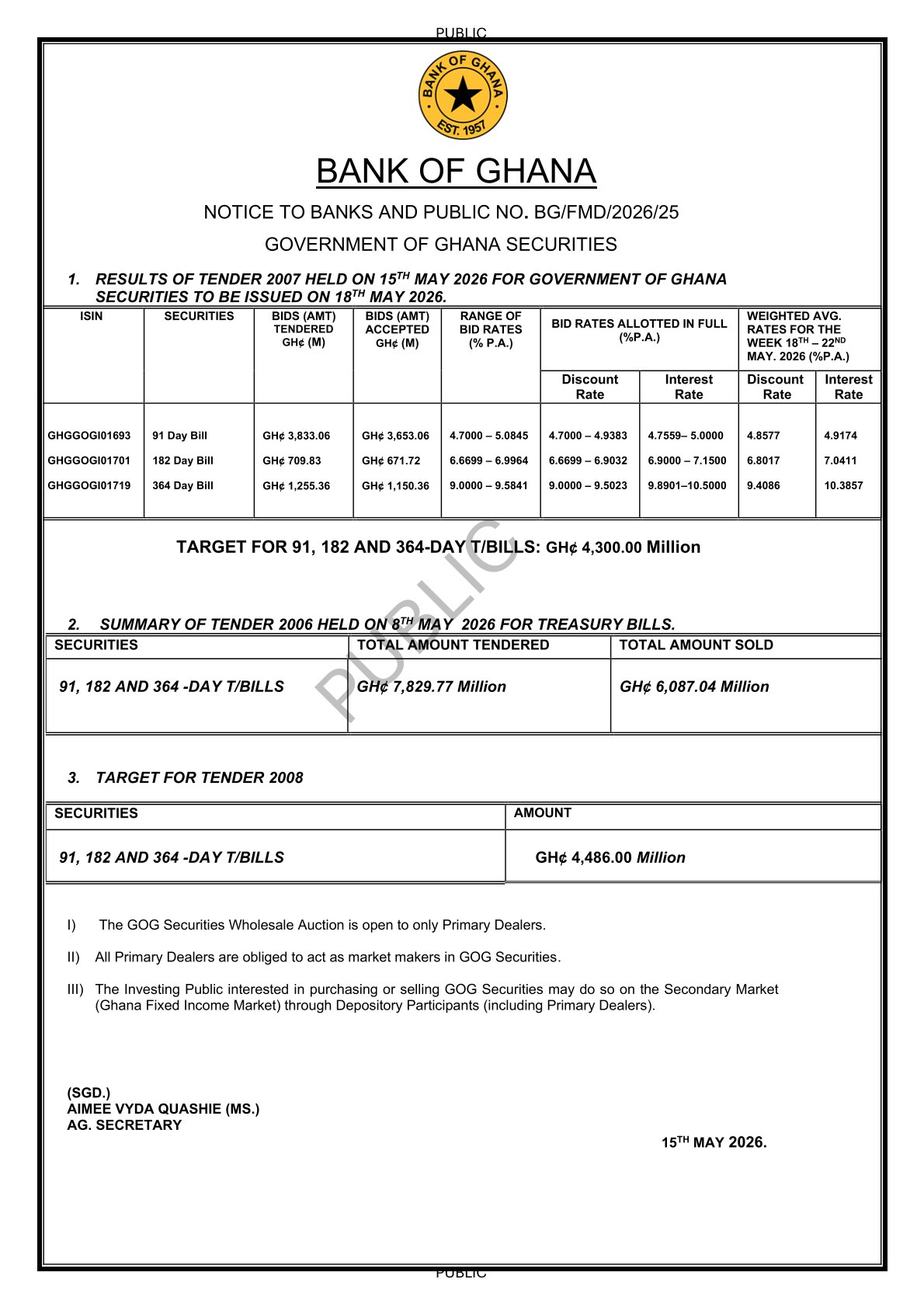
According to the Bank of Ghana’s results for Tender 2007, held on May 15, 2026, total bids tendered for the 91-day, 182-day and 364-day bills amounted to GH¢5.80 billion, against a target of GH¢4.30 billion. Government accepted GH¢5.48 billion, representing an oversubscription of about GH¢1.18 billion above the target.
The latest auction result points to sustained investor appetite for short-term government instruments, even as yields remain compressed relative to levels seen during Ghana’s recent period of tighter monetary conditions.
The 91-day bill remained the most dominant instrument, attracting GH¢3.83 billion in bids, of which GH¢3.65 billion was accepted. The weighted average discount rate for the 91-day bill was 4.8577%, with the equivalent interest rate at 4.9174%.
The 182-day bill received GH¢709.83 million in bids, with GH¢671.72 million accepted. Its weighted average discount rate stood at 6.8017%, while the interest rate was 7.0411%.
For the 364-day bill, investors tendered GH¢1.26 billion, out of which government accepted GH¢1.15 billion. The one-year bill recorded a weighted average discount rate of 9.4086%, with the equivalent interest rate at 10.3857%.
The auction outcome shows that liquidity remains concentrated at the short end of the yield curve, with the 91-day bill accounting for about two-thirds of total accepted bids.
That pattern is consistent with recent fixed income market activity, where investors have continued to favour shorter-tenor instruments and liquidity-preserving strategies over longer-duration exposure.
The strong uptake also suggests that Treasury bills remain attractive to banks, funds and other market participants seeking low-risk instruments in a declining interest-rate environment.
However, the yield levels also show how sharply the money market has adjusted as inflation has eased and the Bank of Ghana’s policy stance has softened.
The results show bid rates for the 91-day bill ranged between 4.7000% and 5.0845%, while accepted rates were allotted in full between 4.7000% and 4.9383%. For the 182-day bill, bid rates ranged from 6.6699% to 6.9964%, with full allotment between 6.6699% and 6.9032%. The 364-day bill attracted rates between 9.0000% and 9.5841%, with full allotment between 9.0000% and 9.5023%.
For government, the auction provides important short-term financing support, particularly as fiscal authorities continue to rely on domestic market funding while navigating post-debt restructuring financing conditions. With investors, the auction confirms that Treasury bills remain the main liquidity anchor in the domestic fixed income market, even as returns continue to moderate.
The Bank of Ghana also disclosed that in the previous auction, Tender 2006, government received GH¢7.83 billion in bids and sold GH¢6.09 billion worth of Treasury bills. For the next auction, Tender 2008, government has set a target of GH¢4.49 billion for the 91-day, 182-day and 364-day bills. The next auction will therefore test whether investor demand remains strong after two consecutive weeks of heavy government acceptance.
The key signal from Tender 2007 is clear: demand for Ghana’s short-term securities remains resilient, but the market continues to price government paper at significantly lower yields, reflecting easing inflation, improved liquidity conditions and a broader reset in domestic interest-rate expectations.