


- GRA’s Circle Crackdown Exposes the Challenge of Taxing Ghana’s Informal Economy
The challenge of taxing Ghana’s informal economy is not simply getting traders to pay. It is identifying who owes what, making the rules understandable and applying them consistently without turning compliance into a threat to livelihoods.
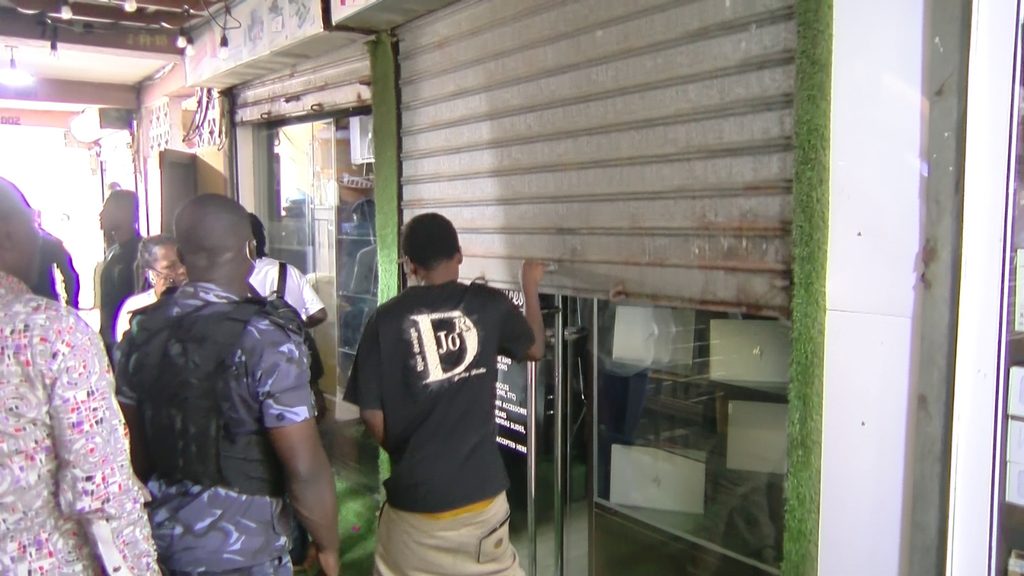
A Ghana Revenue Authority (GRA) operation at the Kwame Nkrumah Circle enclave on Tuesday, November 24, has brought that challenge into sharp focus.
Officers flagged more than 48 mobile phone shops for non-compliance and temporarily locked up about 48 businesses, while setting up a tax-assessment point and registering traders under the Modified Taxation Scheme (MTS).
The exercise was conducted with support from the Mobile Phone Dealers Union, and the GRA says it will continue its compliance drive.
The operation is significant not only because of the number of shops affected but also because it exposes the tension at the heart of tax enforcement in a large informal trading hub: the state needs revenue and compliance, while many small businesses operate with limited accounting systems and may not know which tax obligations apply to them.
Joseph Annan, the GRA’s Accra Area Enforcement Manager and Assistant Commissioner, described the scale of infractions as “seriously overwhelming”.
He said the Authority had begun educating shop owners on the VAT system’s thresholds and registering some businesses under the MTS. Traders below the VAT threshold, he said, may still have tax obligations under that scheme.
That distinction matters. Ghana’s VAT registration threshold for businesses dealing in goods is GH¢750,000 in annual taxable supplies.
Falling below it means a business may not be required to register for VAT, but it does not automatically exempt the owner from every form of tax.
The GRA’s current guidance describes the MTS as a simplified framework for eligible individuals in the informal sector.
Following the 2026 amendment, qualifying businesses with annual turnover above GH¢20,000 and up to GH¢750,000 may pay presumptive tax at 3% of turnover, subject to the scheme’s rules.
For traders, the difference between VAT and income tax can easily become blurred. A shopkeeper may hear “below the threshold” and assume that no tax applies.
A tax officer may see an unregistered business with no reliable records and conclude that the trader must be brought into the modified system.
If the distinction is not clearly explained, enforcement risks being experienced as a surprise bill rather than a route into the tax system.
That is why the GRA’s decision to combine enforcement with registration and education is important.
The Authority says the Circle operation is part of ongoing random compliance checks, and Mr Annan argued that consistent operations would help address the problem.
A tax stand at the market can make registration and payment more accessible, particularly where traders have not previously engaged with formal tax administration.
But a stand-alone cannot solve the deeper problem. Tax compliance depends on traders being able to understand their obligations, keep enough records to determine the correct tax treatment and trust that rules are being applied fairly.
A one-off operation can generate immediate registrations and payments. Sustained compliance requires follow-up, guidance and a process through which businesses can question assessments they believe are wrong.
The GRA’s own description of the enclave points to the scale of the task. Mr Annan said the infractions were so extensive that even the entire tax office might not complete the work in two months.
That is a striking indication of how difficult it can be to establish a complete picture of business activity in a dense commercial centre. It is also a warning that enforcement cannot rely indefinitely on officers visiting shop after shop.
Better taxpayer records, accessible digital registration and cooperation with trade associations will matter if the Authority is to move from episodic crackdowns to regular compliance.
The role of the Mobile Phone Dealers Union could therefore prove pivotal. Its chairman, Eric Gyamfi, said members were ready to pay taxes when approached by the GRA, but accused officials of concentrating on larger shops while allowing micro, small and medium-sized enterprises to escape payment.
That complaint introduces a question of equity. If enforcement is concentrated on the most visible or best-established businesses, compliant traders may feel they are carrying a disproportionate burden, while less visible operators avoid scrutiny.
Yet if the GRA moves too aggressively against small traders without explaining the applicable thresholds and assessment process, it risks making formalisation appear punitive.
Both concerns can be true at once. The Authority must enforce the law, and businesses should not be able to use informality as a permanent shield against tax.
But compliance will be more durable if enforcement is predictable and reaches businesses across the market, rather than appearing to single out selected groups.
The union’s participation offers a channel for communicating rules and identifying gaps, but it will also need to encourage members to register and keep basic records.
There is a wider fiscal question behind the operation. Ghana needs a stronger domestic revenue base to fund public services and development priorities. Bringing more economic activity into the tax net can help broaden that base.
But the revenue gains from informal businesses depend less on the spectacle of a lock-up than on whether registration leads to regular, accurate and affordable compliance.
The MTS is designed to make that transition simpler for eligible taxpayers. Its effectiveness will depend on whether traders understand the categories, know how their turnover is assessed and can meet their obligations without incurring costs that are out of proportion to the scale of their businesses.
For phone dealers in particular, where stock values and sales can fluctuate, clarity on record-keeping and assessment will be essential.
The GRA has said it intends to continue its revenue drive in the coming days. The test will be whether the Circle operation becomes a sustained effort that reaches the wider market, explains obligations clearly and treats businesses consistently.
If it does, the exercise could help convert an enforcement visit into a practical step towards formalisation. If it does not, the immediate payments may be followed by mistrust and renewed non-compliance.
The more than 48 shops flagged at Circle are therefore part of a larger test: whether Ghana can expand tax compliance by making the system visible and fair to businesses that have long operated outside conventional tax administration.
The success of the crackdown will not be measured only by how many shops were locked or how much was collected on Tuesday. It will be measured by whether traders understand what they owe and continue to comply after the enforcement team leaves.

