


- GSE Looks to Green Bonds, Pension Funds and Digital Trading to Broaden Capital Market
The Ghana Stock Exchange is positioning sustainability standards, expanding pension assets and digital retail access as central pillars of its next phase of growth, as it seeks to deepen a market that still has relatively few listed companies despite a growing pool of domestic capital.
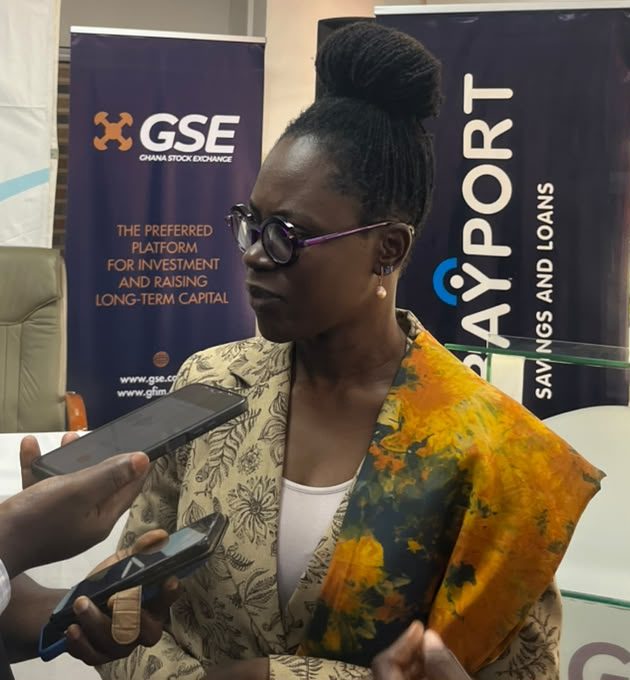
Abena Amoah, Managing Director of the Ghana Stock Exchange, said the exchange’s ambition is to create a market capable of financing a broader range of Ghanaian businesses and long-term development projects while giving investors more opportunities beyond traditional government securities.
Speaking on the sidelines of Bayport Savings and Loans PLC’s “Facts Behind the Figures” session in Accra on Thursday, August 20, Ms Amoah said environmental, social and governance considerations should increasingly be viewed as questions of business survival rather than peripheral corporate responsibility.
“It is so critical for the business to look at every single activity it does, every single decision it makes, and say, how is my decision going to affect the people, the planet?” she said.
“And not just that, how is the planet and people within the communities I’m operating in? How do their actions affect me and my strategy?”
Her argument reflects a wider shift in capital markets in which ESG factors are increasingly incorporated into financial risk analysis. Climate exposure, governance failures, technological disruption and changing consumer expectations can affect profitability, access to capital and ultimately whether a business model remains viable.
Ms Amoah illustrated that point using the media industry.
“If you’re a newspaper and you are not looking at what is happening globally, what are the new technologies that have happened? How does that impact your business? You won’t survive,” she said.
“If you’re a newspaper and you are not looking at how does my activity affect people, and therefore set ethical standards for how you should report… what happens to [the newspaper] after I’ve sold my hard prints? You are not thinking about that. Your business will not survive.”
The GSE has been building the institutional framework needed to support that shift. The exchange has updated its ESG manual and continues to refine sustainability disclosure requirements intended to help companies measure and communicate environmental, social and governance performance more systematically.
The bigger challenge, however, is converting frameworks into securities. The exchange wants to develop a deeper market for green, social and gender bonds that can channel capital towards renewable energy, affordable housing, women-led enterprises and other projects with measurable sustainability outcomes.
“For us, our work is to launch the market. So we’ve launched the market. We’ve looked at the framework and keep revising the framework. We are talking to potential issuers who can use the market,” Ms Amoah said.
“When we develop markets, we don’t develop it only for today. We develop it again for the sustainable future.”
She said potential issuers could include solar-energy developers, social-housing businesses and financial institutions seeking capital specifically for women-owned enterprises.
“There will be companies that are doing that need to scale up, whether it’s solar farms, whether it’s social housing, whether it’s financing of women businesses, which is a gender bond you can issue, that they will come to the market,” she said.
That supply of new securities will be crucial because Ghana’s challenge is increasingly not simply whether domestic capital exists, but whether enough productive assets are available to absorb it.
Ms Amoah pointed to the continued expansion of pension savings as evidence that the country already has a substantial pool of long-term capital.
“As all of us are paying our contributions into Tier 2, Tier 1 and Tier 3, we are seeing those funds grow,” she said.
“The latest figures from the NPRA says after almost 12 years we have 120 billion Ghana cedis of assets under management… So there is capital in Ghana.”
That is a strategically important development for the economy. Pension funds naturally require long-duration assets capable of matching long-term liabilities. In a deeper capital market, that could create demand for corporate bonds, infrastructure securities, listed equities and sustainability-linked investments rather than leaving institutional portfolios concentrated in a narrower range of instruments.
For companies, greater access to pension capital could also reduce excessive dependence on bank lending.
Ghanaian businesses have traditionally relied heavily on commercial banks for financing, even where projects require longer maturities than banks are well placed to provide. A deeper capital market can complement the banking system by providing equity and long-term debt for expansion.
The GSE’s problem is that the number of listed companies remains small relative to that ambition.
“We need more products. We need more listed companies. Today on the equities market, we have 39 companies. We need to get to 100, right?” Ms Amoah said.
That target is ambitious, but it goes to the heart of market development. A stock exchange cannot deepen only through rising share prices. It also needs a broader issuer base, more sectors represented, greater free float, higher liquidity and a regular pipeline of companies raising fresh capital.
The exchange has attempted to address part of that through the Ghana Alternative Market, which offers a route to listing for smaller and medium-sized businesses, alongside its Main Market. New Equities Market Rules also took effect in February 2026.
There are signs that the primary market is beginning to revive after years of limited activity. But sustained progress will depend on whether private companies see enough benefit in listing to justify the greater disclosure, governance and scrutiny that come with public-market status.
Retail participation is the other side of the equation. Ms Amoah said financial education, media coverage and digital trading tools were making the market more accessible to ordinary Ghanaians.
“Are we seeing the Ghanaian investor a lot more interested in the Ghana Stock Exchange? I say yes,” she said.
“Some of our stockbrokers have launched market access tools that from your bedroom you can go online, open an account on an app and start trading in the securities.”
Digital access could prove particularly significant because one of the traditional barriers to capital-market participation has been friction.
If investors can open accounts remotely, fund them electronically and trade through mobile or online platforms, participation becomes easier for younger investors and people outside Accra who may previously have viewed the stock market as remote or inaccessible.
But digital access alone will not guarantee healthy market development. Investors must also understand risk, diversification and the distinction between long-term investment and short-term speculation.
The exchange is also benefiting from stronger market sentiment. According to figures disclosed by the GSE this week, the Composite Index had gained about 73.00% year-to-date as of August 18, while trading volumes and values had approximately doubled compared with the corresponding period in 2025. Monthly trades have also increased sharply from about 25,000 last year to around 300,000 this year.
Those gains can help renew attention on equities, but Ms Amoah cautioned that the durability of the recovery will depend heavily on the wider macroeconomic environment.
“Do I believe this is the start of something stronger? Yes, so long as the macroeconomic environment continues to be stable and to facilitate investment, that will happen,” she said.
“And we have the right environment today: low inflation, low interest rates, and they are all good signals for private companies to invest, to hire more people, to provide goods and services. So we are confident of the outlook.”
That link between macroeconomic stability and capital-market development is critical.
Companies are more likely to issue shares or bonds when interest rates, inflation and exchange-rate risks are sufficiently predictable to support long-term planning. Investors are similarly more willing to commit capital when they can assess future returns with greater confidence.
The next test for the GSE is therefore whether the current improvement in sentiment can be converted into structural depth.
That means turning ESG frameworks into actual sustainable-finance issues, connecting pension capital to productive domestic assets, attracting significantly more companies to the market and making retail access easier without sacrificing investor protection.
If the exchange can move from 39 listed companies towards its target of 100 while broadening the range of available securities, the significance would extend beyond the GSE itself.
It would mark a gradual change in Ghana’s financing architecture from an economy heavily dependent on banks and government securities towards one in which domestic savings play a larger role in financing corporate investment, infrastructure and sustainable development.
The capital, as Ms Amoah argues, is increasingly available.

