

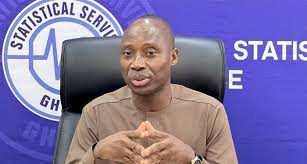

- GSS Report shows Informal Cross-Border Trade Now Equals 2.93% Of GDP
Ghana’s informal cross-border trade with Togo, Burkina Faso and Côte d’Ivoire reached GH¢31.00 billion in the first three quarters of 2025, exposing the scale of a largely unrecorded border economy that feeds households, sustains jobs and keeps markets supplied across the country’s frontier communities.
A Ghana Statistical Service presentation on the 2025 Q1–Q3 Informal Cross-Border Trade findings shows that informal trade accounted for 6.00% of Ghana’s total trade over the period and 2.93% of GDP, making it too large to be treated as a marginal economic activity.
The findings are significant because informal cross-border trade has historically operated outside formal customs records, creating a major blind spot in Ghana’s trade statistics, Balance of Payments data, food security planning and regional integration policy.
According to the GSS, informal cross-border trade with Ghana’s three neighbours exceeded formal trade over the same period. Informal flows stood at GH¢31.00 billion, compared with formal trade of GH¢20.10 billion, meaning informal trade was about 1.50 times formal trade with Togo, Burkina Faso and Côte d’Ivoire.
The report shows that informal trade is especially dominant in Ghana’s relationship with Togo. Ghana’s trade with Togo was largely informal, rising from 70.50% in the first quarter of 2025 to 77.80% in the third quarter. With Côte d’Ivoire, informal trade consistently accounted for more than three-fifths of total trade across all three quarters. Trade with Burkina Faso also shifted after the first quarter, with informal activity accounting for more than 52.00% in subsequent quarters.
For policymakers, these numbers carry a clear message: Ghana’s economy cannot be fully understood through formal customs data alone. A large share of real economic activity is taking place through small crossings, border markets, motorbikes, tricycles and informal trader networks.
The food security implications are even more urgent. The GSS said Ghana’s food trade deficit with neighbouring countries doubled through 2025, rising from about GH¢400.00 million in the first quarter to about GH¢800.00 million in the third quarter. This came as the country’s non-food trade surplus narrowed from about GH¢1.00 billion to GH¢800.00 million over the same period.
Cooking oil emerged as the leading informal food import, although its share declined from 16.30% in the first quarter to 14.40% in the third quarter. Rice, livestock and other food items also featured strongly in informal flows, reinforcing the point that border trade is directly linked to household consumption and market supply.
On the export side, alcoholic drinks, soft drinks and energy drinks together accounted for about 30.00% of all food products exported informally to Ghana’s neighbours across the three quarters. Burkina Faso remained the main destination for Ghana’s agricultural exports, accounting for an average of 62.90%, while Togo was the leading destination for fuel, food items and beverages.
The transport pattern also reveals the small-scale nature of the trade. Most goods moved by tricycle, not truck. Tricycles accounted for an average of about GH¢2.00 billion in exports and GH¢1.70 billion in imports across the three quarters. This shows that informal border trade is not dominated by large logistics operators, but by frequent, small-scale movement of goods by individuals and micro-enterprises.
The regional picture is equally revealing. Four out of 10 border regions Volta, North East, Northern and Oti consistently recorded trade deficits, meaning they served mainly as destinations for imports rather than sources of exports. This has implications for regional development, market infrastructure, border road investment and local production planning.
The GSS survey covered 206 active border points across 10 of Ghana’s 16 regions, involving Togo, Burkina Faso and Côte d’Ivoire. Data were collected by 676 trained officers, made up of 523 interviewers and 153 supervisors, selected from 1,009 recruits. The survey used direct observation of goods crossing the borders, face-to-face interviews with traders and digital data collection for 14 days each month between 6:00 a.m. and 6:00 p.m.
This gives the findings policy weight. The survey was not a casual estimate. It was built on field observation, trader interviews, border mapping and international statistical methodology, including the African Union continental approach and IMTS 2010 standards.
The key policy question now is how Ghana responds. The GSS is not calling for informal trade to be punished or shut down. Rather, the evidence points to the need for smarter formalisation that makes registration and licensing simpler for small, high-frequency traders; upgrades roads, markets and border posts at busy crossings; links GSS, GRA and Immigration data systems; and designs services and finance products for both women and men who trade.
The report also calls for investment in local production and value chains around goods that dominate informal flows, particularly cooking oil, rice and livestock. This is important because reducing food import dependence cannot be achieved only through border controls. It requires domestic production, storage, processing and distribution systems that make local supply more competitive.
The findings also strengthen the case for deeper regional cooperation under the African Continental Free Trade Area. If Ghana’s trade with its neighbours is heavily informal, then AfCFTA implementation must take informal traders seriously. Harmonising customs procedures, sharing trade data and simplifying border processes could help bring more of this activity into official systems without destroying livelihoods.
The broader lesson is that Ghana has now measured an economy that was previously difficult to see. Informal cross-border trade is not merely a border issue. It is a trade policy issue, a food security issue, a gender issue, a fiscal issue and a regional integration issue.
The GH¢31.00 billion figure should therefore change how government, businesses and development partners think about Ghana’s borders.
The border economy is already active. The task now is to make it safer, better counted, better financed and more productive without killing the flexibility that keeps it alive.

