

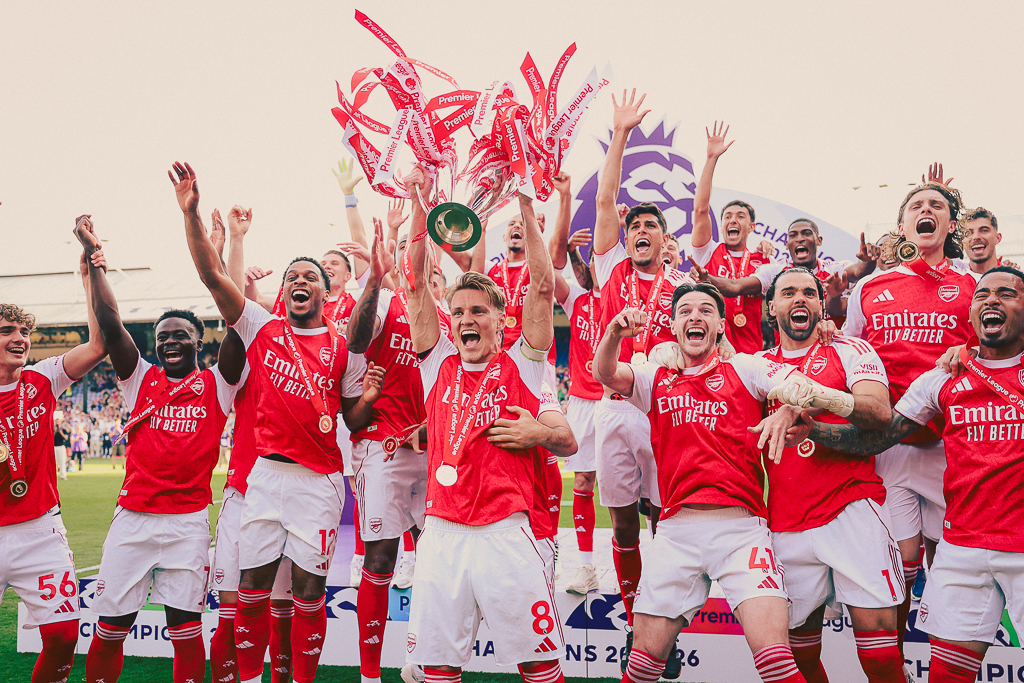

- Gunners Crowned Champions, West Ham Fall and Sunderland Dream Again
Arsenal ended years of frustration by lifting the Premier League trophy on a dramatic final day that also delivered historic European qualification for Sunderland and Bournemouth, relegation heartbreak for West Ham United and late survival relief for Tottenham Hotspur.
Captain Martin Ødegaard lifted the trophy at the Emirates Stadium in emotional scenes after a campaign in which Arsenal stayed top for long stretches and finally converted Mikel Arteta’s project into Premier League glory.
For Arsenal, the triumph was more than a title win. It was vindication after months of criticism over style, methods and identity. Rivals and pundits had repeatedly labelled Arteta’s side “Set-Piece FC” because of their dominance from dead-ball situations, while critics argued that their football lacked the flair often associated with previous Premier League champions.
Former Manchester United midfielder Paul Scholes went as far as describing Arsenal as potential “worst Premier League title winners ever,” while Liverpool manager Arne Slot drew attention to the number of goals Arsenal scored from set-pieces in what many interpreted as a veiled criticism of the champions.
But none of that mattered when the final whistle confirmed Arsenal’s return to the summit of English football.
Arteta’s side built their title charge on defensive structure, tactical flexibility and an ability to survive pressure. Injuries to key attacking players including Ødegaard, Bukayo Saka and Leandro Trossard affected Arsenal’s attacking rhythm for significant parts of the season, forcing the Gunners to become more pragmatic and defensively resilient.
The old “1-0 to the Arsenal” mentality became a recurring theme, with seven of their league victories coming by a single-goal margin. Since defeats to Bournemouth and Manchester City in April, Arsenal had not conceded an open-play goal in the league, a run that included title-defining fixtures and high-pressure Champions League ties.
Arteta defended the approach throughout the season, insisting his team had adapted to circumstances rather than abandoned ambition. Arsenal also impressed in Europe, reaching the Champions League final unbeaten against elite opponents including Bayern Munich, Inter Milan and Atlético Madrid.
While Arsenal celebrated in north London, the race for Europe and survival produced chaos elsewhere.
Newly promoted Sunderland completed one of the stories of the season by defeating Chelsea 2-1 at the Stadium of Light to qualify for the Europa League.
Trai Hume gave Sunderland the lead with a brilliant first-half volley before Malo Gusto turned Brian Brobbey’s effort into his own net early in the second half. Chelsea pulled one back through Cole Palmer, but their hopes faded when Wesley Fofana was sent off.
Led by captain Granit Xhaka, Sunderland held firm to secure seventh place and European football for the first time since 1973.
Chelsea’s miserable campaign ended in 10th place, leaving them without European football next season and facing another summer of questions over direction, squad balance and managerial pressure.
Bournemouth also made history, securing their first-ever European qualification after drawing 1-1 with Nottingham Forest.
Forest took the lead through Morgan Gibbs-White before Marcus Tavernier equalised with a superb finish. Bournemouth briefly dreamed of Champions League qualification, but Aston Villa’s comeback win over Manchester City denied them a top-five finish.
Still, sixth place and Europa League qualification marked a remarkable achievement for departing manager Andoni Iraola, whose work has lifted Bournemouth from survival hopefuls to European contenders.
Liverpool sealed a Champions League place despite being held to a tense 1-1 draw by Brentford at Anfield. Mohamed Salah created the opener for Curtis Jones before Kevin Schade equalised for Brentford, whose hopes of a first-ever European qualification ultimately fell short.
Liverpool finished fifth, securing the final Champions League spot and salvaging a season that had threatened to unravel at key moments.
At the bottom, Tottenham survived relegation after beating Everton in a nervy final-day encounter.
João Palhinha scored the decisive goal for Spurs, preserving their Premier League status under Roberto De Zerbi, who took charge in March and guided the club to safety after a turbulent campaign.
West Ham United, however, were relegated despite a 3-0 victory over Leeds United at the London Stadium.
The result was not enough to save the Hammers, whose campaign ended in anger and recrimination. Supporters directed protests at majority owner David Sullivan during the match, reflecting deep frustration over the club’s decline.
Captain Jarrod Bowen admitted the pain of relegation after a season in which West Ham failed to meet expectations.
“It hurts,” Bowen said after the match. “We shouldn’t be in the position we’re in, but we’ve not done enough to stay up.”
For Arsenal, the final day closed with celebration and release. For Sunderland and Bournemouth, it opened a new European chapter. For Tottenham, it brought survival without comfort. For West Ham, it marked the end of their Premier League stay.
It was a final day that captured the extremes of English football: glory, vindication, shock, survival and collapse all unfolding at once.

