


- Harry Kane’s Ballon d’Or Triumph Rewards Goals, Growth and Delayed Success
Harry Kane has won the 2026 Ballon d’Or, completing a remarkable transformation from a striker once questioned for his lack of major trophies into the player judged to have delivered the finest individual season in world football.
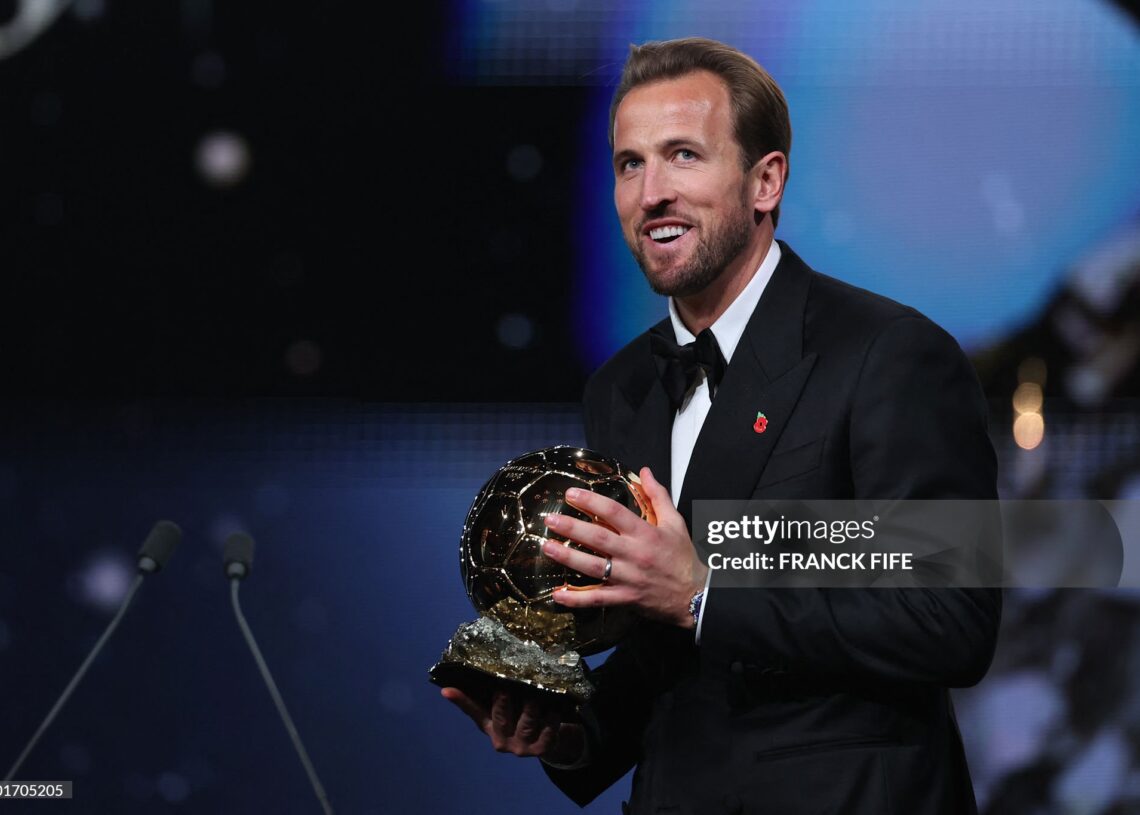
The Bayern Munich and England captain received the award at a ceremony in London after scoring 73 goals for club and country during the 2025-26 campaign. His victory makes him the first Englishman to win the prestigious prize since Michael Owen in 2001.
Kane finished ahead of Real Madrid forward Kylian Mbappé and Barcelona winger Lamine Yamal, two players whose performances ensured that the contest was about more than goals alone. Mbappé placed second, with Yamal third, followed by Rodri and Lionel Messi.
Yet the scale and consistency of Kane’s production became difficult for voters to overlook.
The 33-year-old scored 61 goals and supplied seven assists in 51 appearances for Bayern Munich, helping the German club secure major domestic honours. His influence extended to international football, where he scored six times during the 2026 World Cup and helped England reach the latter stages of the competition.
Those numbers gave Kane’s candidacy the combination Ballon d’Or voters traditionally find compelling: elite personal output, team success and decisive performances at an international tournament.
However, the deeper importance of his victory lies in what it says about the relationship between reputation and achievement in modern football.
For much of Kane’s career, his goalscoring record was accompanied by an unavoidable qualification: he had not won the major trophies expected of a player seeking recognition alongside football’s most celebrated names. His individual excellence at Tottenham Hotspur and with England was rarely disputed, but the absence of silverware shaped how his career was assessed.
His 2023 move from Tottenham to Bayern changed that calculation.
The transfer provided access to a club accustomed to competing for domestic and European honours, but it also placed Kane under greater pressure. Moving to Germany was not merely an escape from Tottenham’s trophy drought. It was a decision to exchange comfort and familiarity for the expectation that he must convert personal brilliance into collective success.
The 2025-26 campaign delivered the clearest justification for that decision. Kane did not simply join a successful institution and benefit from its strength; his goals became one of the central reasons Bayern returned to the summit.
His Ballon d’Or therefore represents more than recognition for one prolific season. It closes the gap between statistical greatness and the tangible success that had previously eluded him.
The award also challenges football’s tendency to associate individual brilliance primarily with dazzling dribbling, explosive speed or youthful promise. Kane’s game is built on movement, positioning, decision-making and finishing, supported by an ability to create chances for teammates.
His victory rewards efficiency and sustained excellence. He may not always produce the sport’s most viral moments, but he repeatedly delivers its most valuable commodity: goals.
That makes his triumph especially significant at 33. The award has arrived at a stage when many forwards begin to decline, yet Kane has continued to refine his game. His scoring has not depended solely on pace. Instead, anticipation, technical precision and an increasingly sophisticated understanding of space have allowed him to remain decisive.
Kane’s personal journey also formed an important part of his acceptance speech. Before becoming Tottenham’s leading goalscorer and England’s captain, he experienced several loan spells and struggled to establish himself as an elite prospect.
Reflecting on that journey, he told young players that “anything is possible” and stressed the importance of working when nobody is watching.
The message was not incidental. Kane’s career has developed through accumulation rather than sudden arrival. His reputation was built season by season, goal by goal, until the consistency became impossible to treat as ordinary.
The striker also dedicated the achievement to his family, particularly his wife, Kate Goodland, whom he described as his best friend and strongest supporter. He acknowledged the sacrifices she had made throughout his career and said the achievement would not have been possible without her
That dedication gave the ceremony a human dimension. Elite sporting careers are usually judged through visible outcomes, while the private support structures behind them remain largely unseen. Kane’s recognition of his wife framed the Ballon d’Or not solely as an individual achievement, but as the product of a long partnership that had accompanied him through uncertainty, near misses and eventual success.
His victory also carries symbolic significance for English football. Despite the Premier League’s global commercial power and England’s abundance of highly valued players, no Englishman had won the men’s Ballon d’Or for a quarter of a century.
Kane now joins an exclusive national list that includes Stanley Matthews, Bobby Charlton, Kevin Keegan and Owen
The question will inevitably turn to legacy. One award cannot settle every debate about where Kane ranks among the greatest centre-forwards, and future assessments will still consider European trophies, international honours and longevity.
But the central argument has changed decisively. Kane is no longer merely an outstanding scorer whose career lacked the trophies needed to validate his numbers. He is a Ballon d’Or winner whose persistence ultimately carried him beyond that criticism.
For a player whose career has repeatedly been defined by what he had not won, the 2026 Ballon d’Or offers the most emphatic answer possible.

