


- Higher Carbon Prices Could Accelerate Korea’s Shift from Coal to Gas – Study Finds
South Korea’s planned overhaul of its emissions trading system will require substantially more than changes to the way free carbon allowances are allocated if the country is to deliver meaningful reductions in power-sector emissions, according to new research led by Pusan National University.
The study finds that stronger carbon pricing, expanded auctioning of emission allowances and complementary investment support will be necessary to shift generation away from higher-emitting fuels without destabilising the electricity market.
The findings come as South Korea prepares reforms to the fourth implementation phase of the Korean Emissions Trading Scheme, or K-ETS, covering 2026 to 2030. Introduced in 2015, the scheme places limits on corporate emissions and allows companies to trade emission permits, but structural weaknesses have prompted the government to reconsider how allowances are allocated and priced.
Researchers led by Assistant Professor Dowon Kim of Pusan National University developed a computational model of the Korean electricity market and tested different combinations of three major policy variables.
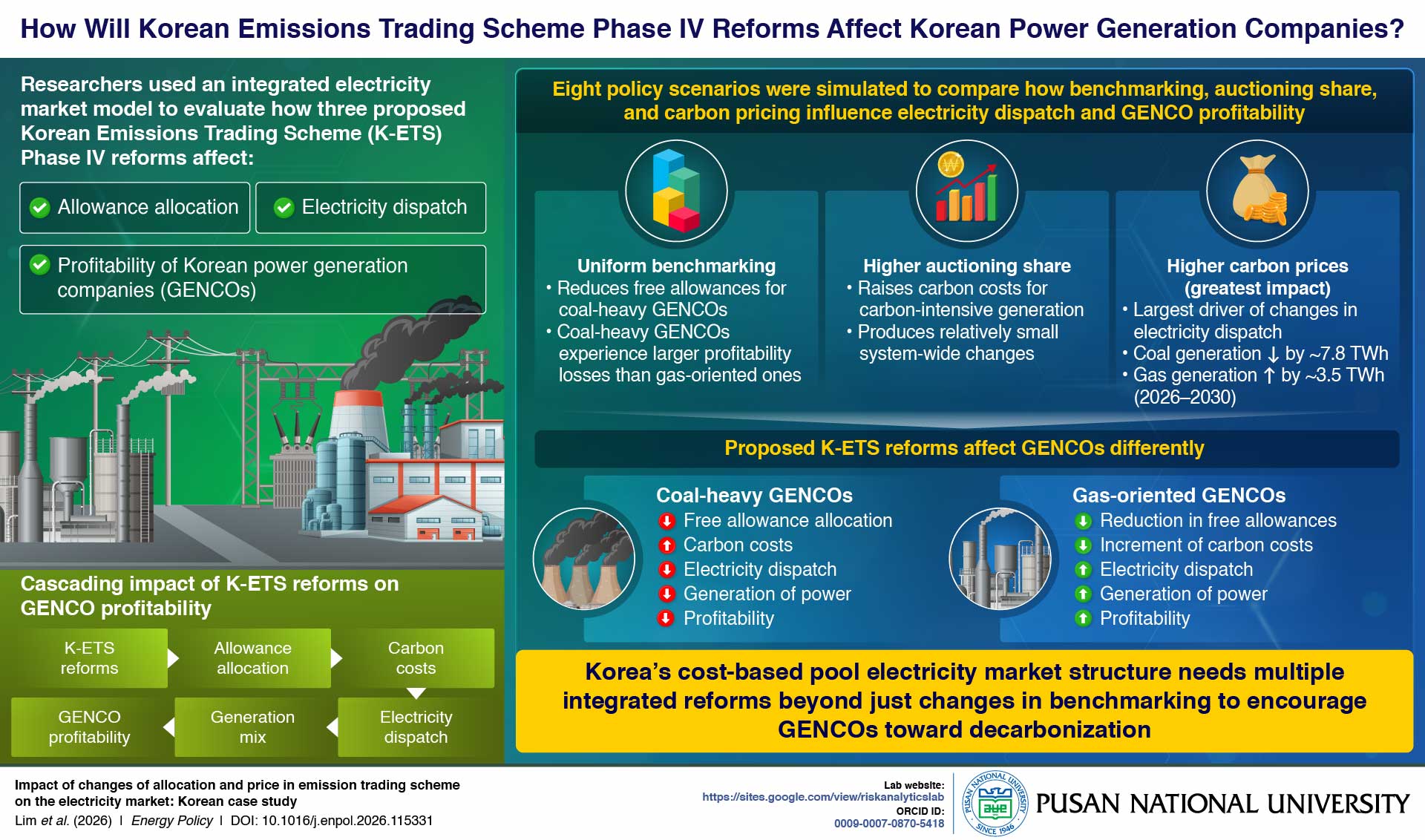
These covered the shift from fuel-specific to uniform emissions benchmarks, an increase in the proportion of allowances sold through auctions and higher carbon pricing, allowing the researchers to assess how different configurations would affect various types of electricity generators.
“The power sector is expected to contribute nearly 44.3% of Korea’s total national emissions reduction target, making it critical to understand the interaction between K-ETS reforms and electricity market operation,” Prof. Kim said. The research was made available online on April 24, 2026 and published in Volume 215 of Energy Policy on August 1, 2026.
The results suggest that moving from fuel-specific benchmarks to a uniform benchmark would reduce the volume of free emission allowances received by fossil-fuel generators, but the economic effects would not be evenly distributed.
Coal-fired companies would experience considerably sharper reductions in profitability, while natural gas generators would be less severely affected, reflecting the greater carbon intensity of coal-fired electricity production.
Increasing the proportion of allowances that companies must purchase through auctions would place further pressure on fossil-fuel generators by increasing the marginal cost of producing electricity. Again, coal producers would face the greatest impact, creating an incentive for generation companies to shift gradually towards lower-emission fuels such as natural gas, although the study found the effects of benchmark and auctioning reforms alone would remain relatively modest.
The most significant behavioural change emerged when researchers increased the carbon price. Higher carbon prices raised generation and emissions costs more sharply for coal than for gas, encouraging a partial switch from coal-fired generation towards natural gas and demonstrating that the price attached to emissions may have considerably greater influence over generation decisions than changes in free-allocation rules alone.
That finding has important implications for the broader design of emissions trading systems because carbon markets are intended not merely to raise revenue or allocate permits, but to alter the relative economics of polluting and cleaner technologies.
If carbon prices remain too low, companies can continue producing from high-emission plants without facing a sufficiently strong financial incentive to change investment or operational decisions.
The researchers consequently argue that Korea should avoid treating individual reforms as substitutes for a comprehensive decarbonisation strategy. Moving to a uniform benchmark may reduce preferential treatment for some generation technologies, while additional auctioning makes pollution more expensive, but neither measure appears strong enough on its own to create the scale of fuel switching required to meet national emissions targets.
Korea’s electricity-market structure also complicates the policy challenge. Unlike more liberalised markets where generators may pass a greater share of carbon costs to consumers through wholesale electricity prices, Korea’s highly centralised system limits the ability of power companies to recover rising costs directly from customers, increasing the financial pressure placed on generators during the transition.
“The proposed K-ETS reforms should be implemented along with complementary measures, like targeted investment and transitional support, to maximize their impact, mostly because Korea’s electricity market is highly centralized and limits companies’ ability to recover rising costs by charging consumers more,” Prof. Kim said.
The implication is that aggressive carbon pricing without investment support could weaken generator balance sheets before sufficient lower-carbon replacement capacity is available.
That creates a familiar policy tension for governments attempting to decarbonise power systems: carbon prices must be high enough to change behaviour, but the transition must also be managed carefully enough to protect security of supply and avoid excessive economic disruption.
Targeted financing, investment incentives and transitional arrangements could therefore be required alongside tougher emissions pricing to allow generators to invest in lower-carbon technologies while retiring or reducing utilisation of more polluting assets.
The study also carries wider lessons for countries designing carbon markets around frameworks developed elsewhere. Korea’s system and proposed reforms draw heavily from the European Union Emissions Trading System, but the researchers caution that differences in electricity-market structure mean policies that delivered particular outcomes in Europe may not produce identical results in Korea.
For South Korea, the policy conclusion is that decarbonisation cannot be achieved by changing the allocation formula for emissions permits alone. A combination of more extensive auctioning, stronger carbon prices and carefully targeted investment support appears more capable of shifting the economics of power generation while maintaining system stability.
The study therefore reframes Korea’s emissions-trading reform as a question of policy integration rather than a single regulatory adjustment. Its central message is that carbon markets become effective when the price of pollution is sufficiently meaningful to change corporate decisions and when complementary policies give companies a credible pathway to invest in cleaner alternatives without placing excessive strain on the power system.

