

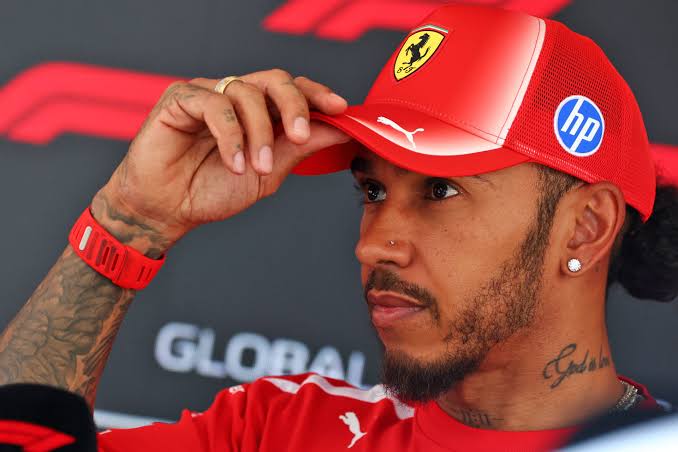

- Hill Says Ferrari Must Back Hamilton to Mount A 2027 Title Challenge
Damon Hill has challenged Ferrari to make Lewis Hamilton its clear number one driver for 2027, arguing that the team’s championship ambitions may be undermined if the seven-time world champion and Charles Leclerc continue to race one another without a clear hierarchy.
The former champion’s intervention follows a first-lap collision between the Ferrari drivers at the Mexico City Grand Prix. Hamilton was leading, with Leclerc in second, when their battle disrupted Ferrari’s chance of a one-two finish.
Leclerc received a five-second penalty, and Max Verstappen went on to win. The incident brought renewed attention to how Ferrari manages two high-profile drivers with title ambitions.
Hill’s argument is that Ferrari has made a substantial commitment to Hamilton and should now organise its title campaign around him. “I think it makes sense to me to put all your eggs behind Lewis,” he said, reasoning that a competitive Ferrari could contend for both championships next season if the team gives its support to one driver.
The proposal is straightforward in one sense: a team with a car capable of winning races may improve its chances by coordinating strategy around a lead driver. Clear priorities can help with pit stops, race tactics and decisions about when one driver should support the other.
But imposing that status before the season begins would carry costs too. It could alienate Leclerc, whose long association with Ferrari and record in the team make him more than a supporting driver.
Hill points to Hamilton’s stature and recent return to form. After a difficult first Ferrari campaign, the Briton has secured pole positions and a Grand Prix victory with the team in 2026. Hill said Hamilton had “rebuilt himself” and described him as an “extraordinary individual”, arguing that the results have shown what he can still contribute.
That case is strengthened by Hamilton’s experience and his record of winning championships. But reputation is not the same as a guarantee of future performance. Ferrari would need to judge whether his recent results represent a sustained competitive advantage over Leclerc, rather than a short-term improvement or a reflection of specific conditions.
A team order based chiefly on past achievements could prove difficult to defend if the drivers’ results reverse.
Hill’s own comments acknowledge the political difficulty. He suggested that factions within Ferrari may already be backing one driver or the other. If that is the case, making Hamilton the designated number one could settle the question or intensify the divisions. Team orders can align strategy, but they cannot substitute for trust between drivers and engineers. A policy that appears to favour one side without transparent performance criteria could create more tension than it resolves.
Anthony Davidson, who joined Hill in the discussion, offered the central counterargument: number one status should be earned. He compared Ferrari’s decision with the preferential treatment given to dominant drivers at other teams, saying that such status is justified when it follows consistent performance.
He was uncomfortable with a rule that would require Leclerc to finish behind Hamilton regardless of their positions or form.
The current standings underline why Ferrari may find it difficult to make the call on reputation alone. Hamilton is fourth in the 2026 drivers’ standings, one place ahead of Leclerc, but the gap between them is only 12 points.
Leclerc, who joined Ferrari as a 21-year-old and has spent eight seasons with the team, has nine Grand Prix victories. That combination of current proximity and Leclerc’s record makes a pre-emptive demotion hard to justify without a clear performance-based rationale.
The Mexico clash made the practical case for clearer rules. Ferrari had its drivers running first and second, a position that offered the team a chance of a major result. Their battle ended with a penalty for Leclerc and the loss of a likely one-two.
The incident raises a wider question: how should Ferrari define acceptable competition when both drivers have a chance to win? A team can preserve equal status while setting firm rules on contact, overtaking and risk management.
The dispute was later addressed in talks involving Hamilton, Leclerc and team principal Frédéric Vasseur. Both drivers said they had put the Mexico incident behind them after speaking at the São Paulo Grand Prix.
Hamilton said they had “squashed it and we’re moving on”, while Leclerc described the matter as a closed chapter. The immediate row may have eased, but the strategic question remains for the team.
Ferrari therefore faces a choice between a fixed hierarchy and a flexible system based on results. A fixed lead-driver policy could help the team focus its resources, particularly if one driver establishes a clear advantage early in the season.
But it risks discouraging the other driver and losing points if the chosen leader is not consistently the faster option. A performance-based approach would preserve competition, but requires rules for when the team intervenes and how it handles a title fight.
The strongest case for Ferrari may be to set the conditions for priority in advance, rather than grant unconditional number one status now. The team could define measurable triggers such as championship position, qualifying pace or a sustained points advantage while establishing clear rules to prevent internal battles from costing it results.
Such a framework would give Hamilton a route to priority if his performance warrants it, while recognising Leclerc’s established place in the team.
Hill’s intervention is ultimately a challenge to Ferrari’s leadership as much as to its drivers. The team has to decide whether its next title attempt will be built around one champion’s experience or managed through competition between two capable drivers.
Either strategy can work. The risk lies in allowing uncertainty over the rules to become the story each time the cars meet on track.

