

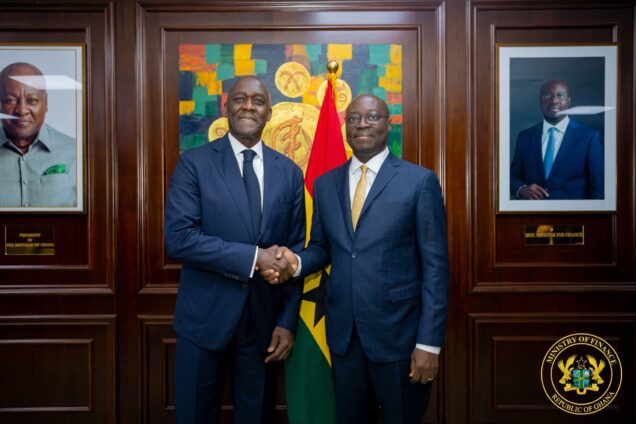

- IFC Targets US$1.2bn Ghana Investment Pipeline as Stabilisation Opens Private Capital Window
The International Finance Corporation is preparing a potential US$1.2 billion investment pipeline for Ghana, signalling renewed interest in long-term private capital as the country attempts to convert recent macroeconomic stabilisation into energy projects, infrastructure, commercial agriculture and stronger domestic businesses.
Makhtar Diop, Managing Director of the World Bank Group’s private-sector arm, said after meeting Finance Minister Dr Cassiel Ato Forson in Accra that IFC currently has a portfolio of about US$500 million in Ghana and a pipeline of approximately US$1.2 billion, with scope to expand further.
“We have now a portfolio of 500 million dollars, and we have a pipeline of 1.2 billion. But we will do more,” Mr Diop said.
The distinction between IFC’s existing portfolio and the pipeline is important. The US$1.2 billion represents prospective transactions rather than money already committed or disbursed, meaning individual projects will still need to satisfy commercial, financial, environmental and other due-diligence requirements before reaching financial close.
For Ghana, however, the size of the pipeline offers a useful indication of how international development finance institutions are reassessing the country after a period marked by debt distress, elevated inflation, currency volatility and restrictive financing conditions.
Mr Diop said Ghana had “turned the tide” in recent years through economic adjustment and reforms intended to reduce the risk of a return to unsustainable debt and inflationary pressures.
Macroeconomic stability is not sufficient on its own to generate productive investment, but it materially affects how investors evaluate projects whose costs and returns must be projected over several years. Persistent exchange-rate instability, high inflation and uncertain fiscal conditions can undermine otherwise viable factories, infrastructure projects or agricultural investments.
The government has identified energy, infrastructure and agriculture as priority areas for increased IFC support. The Finance Ministry said discussions with Mr Diop focused particularly on commercial agriculture, value addition and employment, with sugar, cocoa processing, palm oil and poultry among sectors where Ghana wants greater private investment.
Energy remains fundamental to industrial competitiveness because manufacturers require reliable supply at costs that allow them to compete domestically and across export markets. Private capital could help finance generation and other energy assets, provided projects have commercially credible revenue models and predictable regulation.
Infrastructure presents a different financing challenge. Roads, logistics systems, digital infrastructure and other long-duration assets require substantial upfront investment and financing horizons that can extend beyond what domestic commercial banks are typically able to provide at scale.
Agriculture could generate an even wider multiplier if investment moves beyond primary production into storage, processing, distribution and industrial linkages.
The economic opportunity is not simply for Ghana to produce more agricultural commodities, but to retain more value locally by processing crops domestically and connecting farmers with manufacturers and large commercial buyers.
The potential IFC expansion is also relevant because development finance institutions can play a catalytic role beyond their own balance sheets.
IFC frequently invests in transactions where commercial investors may be reluctant to absorb all of the risk independently. Its participation can therefore improve project credibility and potentially mobilise banks, institutional investors and strategic partners alongside its own financing.
That could prove particularly useful for Ghana as government attempts to accelerate investment without rebuilding the same public-debt pressures that contributed to the recent fiscal crisis.
The state cannot indefinitely finance large-scale infrastructure and industrial expansion through sovereign borrowing. Greater reliance on commercially viable private investment could allow government to direct scarce public resources towards activities where private capital is less appropriate.
Mr Diop also placed domestic production and African business expansion at the centre of IFC’s strategy.
Through its “Local Champion” initiative, IFC wants to support African investors and companies capable of expanding across markets on the continent. For Ghana, that objective intersects with the opportunities created by the African Continental Free Trade Area.
A Ghanaian business able to achieve sufficient scale and competitive production costs can potentially use the country as a base for serving markets beyond its domestic population.
But achieving that requires affordable finance, efficient logistics, technology, reliable electricity and internationally competitive production costs.
Mr Diop emphasised that local production must remain competitive rather than becoming an exercise in replacing imports regardless of cost.
“What I’m seeing right now is to see more and more how we can [take] things that were imported and can be produced in the continent at a competitive cost, produced locally,” he said.
He cited poultry as an example of an industry where Ghana could expand domestic production, while also identifying pharmaceuticals, energy and other strategic sectors as areas where localisation could strengthen resilience and employment.
That emphasis on resilience has become more important following repeated global supply-chain disruptions caused by geopolitical tensions, shipping interruptions, commodity-price swings and currency pressures.
Greater domestic production can reduce some exposure to external shocks, create jobs and broaden the tax base. But local production that is materially more expensive than imported alternatives could simply shift higher costs onto consumers.
Productivity, technology, infrastructure and access to finance will determine whether Ghana can convert localisation into sustainable industrial growth rather than expensive import substitution.
That is also why the US$1.2 billion pipeline should be viewed as an opportunity rather than a completed investment outcome.
Ghana still has to turn prospective projects into bankable transactions capable of passing due diligence and reaching financial close. Investors will continue to assess regulatory predictability, infrastructure reliability, procurement, foreign-exchange risk and commercial returns alongside improving macroeconomic indicators.
If those projects materialise, the impact could extend well beyond the headline financing figure through new productive capacity, jobs, value-added agriculture, energy assets and additional private capital mobilised alongside IFC.
If they remain prospective, the effect on the real economy will be considerably smaller.
For Ghana, the US$1.2 billion pipeline is therefore an early test of the country’s transition from stabilisation to investment.
The harder phase now begins: turning renewed international confidence into factories, farms, infrastructure, energy capacity and competitive Ghanaian businesses capable of generating growth without recreating the public-debt vulnerabilities the country has spent the past several years trying to repair.

