


- Indigenous Banks Must Get First Shot at Stanchart Retail Business — Nduom
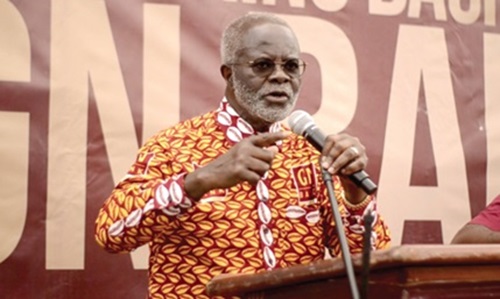
Founder and Chairman of Groupe Nduom, Dr Papa Kwesi Nduom, has called for any sale of Standard Chartered Bank Ghana’s retail banking business to be reserved for an indigenous Ghanaian company, arguing that the opportunity should be used to deepen local ownership in Ghana’s financial sector.
His intervention adds a strong indigenous enterprise voice to the growing debate over the future of Standard Chartered’s wealth and retail banking operations in Ghana, following reports that the bank is exploring the sale of that part of its business while retaining its corporate and investment banking operations.
In a post on his official Facebook page on Friday, June 26, Dr Nduom said the identity of any buyer should matter to policymakers and regulators.
“Make no mistake about this: if Standard Chartered is selling its retail banking business, the buyer should be an indigenous Ghanaian company,” he wrote.
Although brief, the statement is likely to intensify public discussion over whether Ghana should use the potential transaction as a strategic opportunity to strengthen local participation in banking, or allow the business to be acquired by another foreign or regional financial institution with deeper capital and operational scale.
Standard Chartered’s reported plan to divest its retail and wealth banking operations comes at a time when global banks are reassessing their exposure to smaller retail markets, cutting costs, reducing complexity and concentrating resources on corporate, institutional and high-net-worth clients.
For Ghana, however, the issue goes beyond Standard Chartered’s internal strategy.
The possible sale raises questions about who controls major banking assets, how customers will be protected, what happens to staff, and whether the Bank of Ghana should actively encourage local ownership in the event of any formal transaction.
Dr Nduom’s position is straightforward: if a valuable retail banking franchise is becoming available, Ghanaian investors should not be spectators.
The argument reflects a broader concern that indigenous financial institutions have often struggled to compete with multinational and pan-African banking groups that have larger balance sheets, stronger regional networks and easier access to capital.
Supporters of local ownership argue that allowing a Ghanaian-owned bank or consortium to acquire Standard Chartered’s retail business could give indigenous capital a rare opportunity to scale quickly.
Such an acquisition could provide immediate access to retail deposits, affluent clients, wealth management infrastructure, branch relationships, digital systems and an established customer base.
In a sector where scale matters, buying an existing franchise can be more powerful than building slowly from scratch.
The intervention is also significant because of Dr Nduom’s long-standing advocacy for indigenous enterprise and his personal history in Ghana’s financial sector.
His Groupe Nduom has been at the centre of a prolonged legal and regulatory battle following the revocation of the licence of GN Savings and Loans during Ghana’s financial sector clean-up. A recent court decision in favour of restoring the institution’s licence has renewed public discussion around the treatment of local financial institutions during the banking reforms.
Against that background, Dr Nduom’s call is likely to resonate with those who believe Ghana’s financial sector consolidation has not done enough to preserve and build strong indigenous institutions.
A retail banking acquisition of this nature would require significant capital, strong governance, regulatory credibility, advanced technology systems and a proven ability to manage deposits, loans, wealth products and customer service without disruption.
The Bank of Ghana would therefore have to balance national ownership ambitions with strict prudential requirements.
Any buyer, whether indigenous, regional or foreign, would need to pass rigorous fit-and-proper tests. The central bank would have to examine the source of funds, capital adequacy, liquidity strength, risk management systems, anti-money laundering controls, operational resilience and capacity to protect customers during transition.
That regulatory burden cannot be relaxed simply because a buyer is Ghanaian. The challenge is to find a structure that supports local ownership without compromising financial stability.
One possible route would be an acquisition by a well-capitalised indigenous bank. Another could be a consortium of Ghanaian investors, pension funds and strategic local institutions. A third could be a public offering or partial listing that allows broader Ghanaian participation through the capital market.
A direct local acquisition could be faster, but only if the acquiring institution has the balance sheet and systems to absorb the business. A consortium could spread risk and deepen local participation, but governance and control would need to be clear. A public flotation could broaden ownership, but it would be more complex and time-consuming.
What should not happen, according to advocates of local banking ownership, is a passive regulatory process in which the asset simply moves from one foreign balance sheet to another without a national conversation on long-term financial-sector strategy.
Standard Chartered has operated in Ghana for more than a century and remains one of the country’s most recognisable banking brands. Its retail and wealth banking customers include professionals, high-net-worth individuals, businesses and households that have built long relationships with the bank.
Whoever acquires that business would inherit not only deposits and accounts, but also trust.
This is why customer protection must be central to any transaction.
Retail clients will need clarity on the safety of their deposits, continuity of services, treatment of loans, investment products, account access, card services, digital banking platforms and branch operations.
Wealth management clients will also require assurance that advisory standards, custody arrangements, investment products and service quality will not deteriorate under new ownership.
Banking acquisitions often lead to branch rationalisation, duplicated roles and possible job losses. The Bank of Ghana will need to ensure that any transition plan includes clear commitments on staff treatment, redundancy processes, pension obligations and business continuity.
Dr Nduom’s comments therefore arrive at an important moment. They push the debate beyond the mechanics of a possible sale and into the deeper question of financial sovereignty.
Should Ghana use moments like this to build indigenous champions? Should regulators actively prioritise local ownership when major financial assets become available? Or should the market be left to determine the strongest buyer, regardless of nationality?
A weak local buyer would be dangerous. A strong foreign buyer may protect stability but do little to deepen Ghanaian ownership. A well-structured indigenous acquisition could advance both national interest and financial-sector development, but only if backed by sufficient capital, governance and regulatory discipline.
The Bank of Ghana’s task, therefore, is not to choose nationalism over prudence. It is to ensure that prudence does not become an excuse for excluding capable local capital.
For Ghana’s banking industry, the potential Stanchart transaction could become a defining test.
It could either reinforce the dominance of foreign and regional banking groups, or open a new path for stronger indigenous participation in high-value retail and wealth banking.
The harder question now is whether Ghana has the financial structures, regulatory imagination and local capital strength to make that happen without putting customers or the banking system at risk.

