


- ISSER Urges 2027 Budget to Replace Fiscal Compression with Productive Investment
Ghana’s next economic test is no longer simply whether inflation falls, debt ratios improve or the government remains within its expenditure limits. It is whether the stability being restored can produce factories, better-paid work and household incomes strong enough to make the recovery visible beyond official statistics.
That is the challenge emerging from two interventions by the Institute of Statistical, Social and Economic Research, which has called for manufacturing-led growth while urging stronger domestic revenue mobilisation in the 2027 Budget.
Together, the proposals carry a warning: Ghana cannot build prosperity through spending restraint alone, but neither can it finance transformation by returning to excessive borrowing.
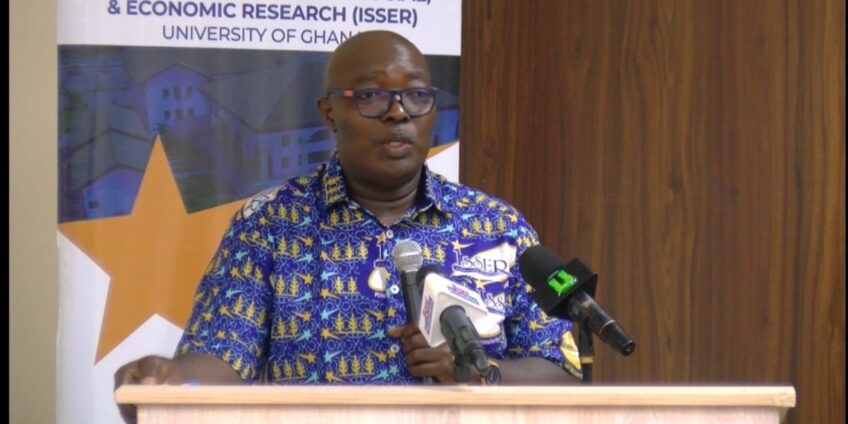
At the launch of ISSER’s 2025 State of the Ghanaian Economy Report, Director Professor Robert Darko Osei reduced the growth challenge to a practical objective: “We need to translate that into real jobs, real sector improvements.”
The statement cuts through the comforting language of macroeconomic recovery. Growth matters most when it expands production, raises productivity and creates employment capable of supporting households.
ISSER’s emphasis on manufacturing is therefore significant. Ghana’s long dependence on exporting raw commodities, including gold, exposes growth, public revenue and foreign-exchange earnings to global price cycles. Commodity earnings can strengthen reserves and government accounts, but they do not automatically create enough jobs for an expanding labour force.
Manufacturing offers a different transmission mechanism: it connects agriculture to processing, builds supplier networks, develops technical skills and produces goods that can replace imports or enter regional markets.
The institute estimates that lifting economic growth by two percentage points could shorten the period required to double per-capita income by roughly five years, from an estimated 17 years. Yet faster growth without structural change could leave the labour market untouched.
An economy can expand through mining output or capital-intensive projects while unemployment, informality and weak wages persist. The quality and composition of growth therefore matter as much as the headline rate.
This is where ISSER’s second intervention becomes crucial. The institute says Ghana’s 2025 fiscal consolidation relied predominantly on expenditure restraint rather than a durable improvement in revenue mobilisation.
Total revenue and grants stood at 16.1 per cent of gross domestic product, while capital expenditure fell from 2.5 per cent to 1.4 per cent. Public debt declined from 62.7 per cent to 46 per cent of GDP, helped by fiscal adjustment and cedi appreciation, but the compression of spending also carried consequences for households and development.
The numbers reveal the policy dilemma facing the 2027 Budget. Fiscal discipline is indispensable after Ghana’s recent debt crisis, but repeatedly reducing investment is not a sustainable development strategy.
Roads, power, water, logistics, education and industrial infrastructure are the public inputs that make private manufacturing competitive. If capital spending becomes the easiest item to cut whenever revenue disappoints, fiscal stability may be achieved at the cost of the productive capacity needed to sustain it.
ISSER consequently wants government to broaden the tax base, improve compliance, reduce leakages and spend more efficiently, while protecting priority infrastructure and social programmes. This is more credible than relying on narrow tax increases imposed repeatedly on compliant businesses and salaried workers. A revenue system that concentrates burdens on the formal sector risks weakening enterprises expected to invest, hire and expand production.
The distinction between mobilising more revenue and merely raising tax rates is important. Better administration, digital enforcement, fewer unjustified exemptions and stronger collection from under-taxed activities can increase receipts without punishing productive firms.
The objective should be a system that is broad, predictable and fair. Manufacturers making long-term investment decisions require certainty over energy costs, import duties, tax obligations and access to foreign exchange; abrupt levies or inconsistent exemptions distort those decisions.
Financing conditions pose another constraint. Professor Osei warned that persistent government borrowing could crowd out credit to private businesses. When banks can earn attractive returns by financing the state, lending to manufacturers with longer repayment periods and greater operational risk becomes less appealing. Ghana may then achieve fiscal financing at the expense of industrial financing, leaving smaller firms unable to acquire machinery, expand plants or fund working capital.
The 2027 policy framework must therefore coordinate fiscal, monetary and industrial objectives. Stronger revenue collection should reduce the government’s financing need. Lower public borrowing should create room for banks to support private investment.
Protected capital expenditure should improve the infrastructure on which manufacturers depend. Agricultural productivity should provide reliable inputs for agro-processing, while trade policy should help competitive Ghanaian firms reach the larger African Continental Free Trade Area market.
Household welfare remains the final test. Professor Fred Dzanku noted that lower inflation does not mean prices have fallen. Families continue to face elevated living costs, and stability will feel abstract unless earnings recover. Manufacturing-led employment could help close that gap by creating regular incomes and supporting demand across local economies. But jobs must be productive enough to raise disposable income, not merely add workers to low-paid informal activity.
There are clear, serious risks. Aggressive taxation could suppress investment, while premature spending could revive deficits, inflation and debt stress. Protecting every existing tax exemption in the name of investment would preserve leakages; eliminating incentives indiscriminately could deter genuine industrial projects. The answer lies in transparent, performance-based support tied to employment, exports, local sourcing and measurable investment.
ISSER’s message is ultimately that Ghana must move from stabilisation by compression to stability through production. The country needs revenue not simply to balance accounts, but to finance the foundations of growth. It needs manufacturing not as a slogan, but as a disciplined strategy linking farms, finance, infrastructure, skills and markets.
The 2027 Budget will show whether policymakers accept that connection. If it broadens revenue fairly, protects productive investment, restrains waste and creates space for private credit, Ghana can convert macroeconomic gains into employment and rising incomes.
If it relies again on cuts, borrowing or taxes on the already compliant, stability may endure on paper while opportunity remains scarce. That would be fiscal progress without economic transformation.

