


- Higher Yields Are Not Enough as AGRA Urges Africa to Tackle Agriculture’s ‘Value Trap’
Africa’s agricultural economy has recorded significant gains over the past two decades, but the continent now faces a more difficult test: converting higher production and improving productivity into sustainable incomes, stronger businesses and greater resilience for farmers.
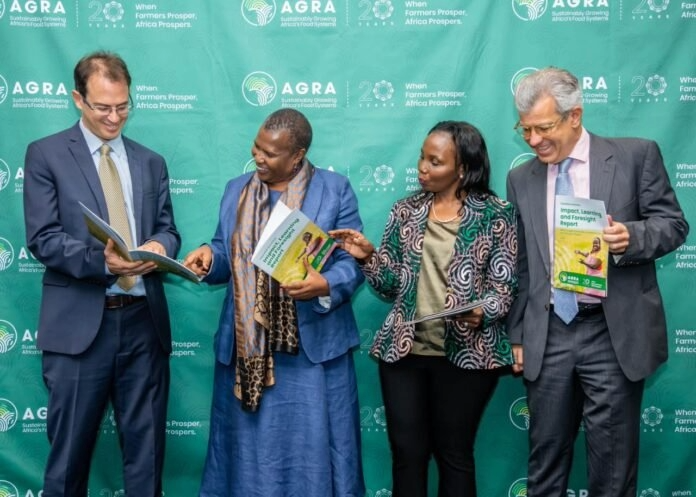
That is the central conclusion of a new Impact, Learning and Foresight Report by the Alliance for a Green Revolution in Africa, which argues that the continent’s food-system transformation has advanced but remains incomplete. Agriculture continues to sit at the heart of employment, rural livelihoods and food security, even as African countries contend with hunger, climate shocks, weak infrastructure, inadequate financing and fragmented markets.
The report, Africa’s Agrifood System Transformation and the Path Ahead, cautions against treating higher output alone as evidence of structural transformation. Africa’s agriculture gross value-added growth has increased from about 2.30% to almost 4.00%, farm output has doubled in real terms since 2005, farmer incomes have also doubled and cereal yields have risen by about 40.00%.
Those numbers show that change is possible, but they also expose the gap between producing more and earning more. AGRA says productivity gains remain uneven, significant productivity gaps persist and hunger has risen in parts of the continent, leaving too many farmers unable to convert higher production into predictable income.
That distinction is increasingly important for policymakers. Agricultural policy across much of Africa has traditionally focused on raising yields through improved seeds, fertiliser, extension services and climate-smart practices, yet a farmer who produces more maize, rice, cocoa or vegetables does not necessarily become wealthier.
Poor roads, inadequate storage, expensive financing and limited processing capacity can force farmers to sell immediately after harvest, often when prices are weakest. The result is that some of the economic value created through higher production is captured further along the supply chain rather than by the farmer who produced the crop.
AGRA describes this as part of a wider “value trap” within African agriculture. “Twenty years of evidence show that Africa’s agrifood sector can move when the conditions are right. The task now is to turn that progress into income, resilience, dignity and opportunity for farmers,” said Alice Ruhweza, President of AGRA.
The report identifies three interconnected constraints — the productivity, value and capability traps — that need to be addressed simultaneously. The productivity trap limits farmers’ ability to produce reliably and withstand shocks, while the value trap prevents them from capturing a proportionate share of the economic gains from what they produce.
The capability trap is more institutional. It concerns whether governments and public institutions possess the finance, data, coordination, accountability and technical capacity required to turn agricultural strategies into sustained results.
These constraints reinforce one another. Improved seeds can raise output but have limited economic effect where farmers cannot access affordable credit; financing can increase production but still produce weak returns where markets and processing facilities are absent; and infrastructure can underperform when institutions lack the data and coordination needed to manage agricultural value chains effectively.
That is why AGRA is calling for a more integrated approach rather than a collection of isolated projects. Over the past 20 years, the organisation and its partners have supported 118 seed companies, more than 650 improved seed varieties, over 25,000 agro-dealers and 33,000 community extensionists, while five million farmers received training in soil health and climate-smart farming.
AGRA also says it helped leverage about US$691 million for national agricultural investment plans. It is careful, however, to describe these achievements as contributions to a much broader continental transformation shaped by national policies, private investment, farmer decisions, commodity prices and environmental conditions.
The deeper message from the report is that Africa needs to stop treating agriculture solely as a food-security issue. Agriculture is also an employment policy, an industrial policy, an investment policy and a trade policy because improvements in farmer incomes create demand for machinery, transport, storage, finance, processing, packaging and retail.
The reverse is equally true. When agricultural incomes stagnate, the effects spread across rural economies, contributing to weaker employment, higher food prices, rising import bills and diminished confidence among young people that agriculture can provide a viable economic future.
This matters as Africa confronts a demographic transition that will put increasing pressure on labour markets. Public-sector employment alone cannot absorb the continent’s growing workforce, meaning agriculture and the industries surrounding it will need to generate a much larger share of productive employment.
That will require a shift from subsistence farming towards commercially integrated food systems, with processing playing a particularly important role. African countries continue to export large volumes of agricultural commodities while often capturing considerably greater value when those same products are processed domestically.
The African Continental Free Trade Area offers another opportunity by expanding the market available to food producers and processors. But trade integration will only deliver meaningful agricultural transformation if farmers can produce consistently, meet quality standards and connect to logistics networks capable of moving goods efficiently across borders.
Finance will also be decisive. Agriculture remains highly exposed to weather, price volatility and long production cycles, making conventional commercial lending difficult and expensive in many African markets.
AGRA argues that the next phase of transformation will require financial products designed around the realities of agriculture, with banks, development-finance institutions, insurers and institutional investors working alongside governments. Investment opportunities extend beyond farming itself into irrigation, storage, logistics, cold chains, processing plants, agricultural technology, input distribution and digital financial services.
Yet capital will follow scale, predictability and policy credibility, making institutional capability central to the transformation agenda. Agricultural outcomes are increasingly shaped by decisions taken outside agriculture ministries, including in finance, energy, trade, water, infrastructure, education, science and climate policy.
“Agriculture can no longer be treated as the responsibility of agriculture actors alone,” the report says. “Farmer prosperity depends on choices made across finance, trade, water, energy, infrastructure, health, nutrition, education, climate, science and industry.”
Hailemariam Dessalegn, AGRA Board Chair and former Prime Minister of Ethiopia, said progress should only be regarded as transformation when productivity is restored, value is retained and institutional capability is sustained. “The question for the next decade is not only what Africa can produce, but whether the systems around farmers allow them to prosper,” he said.
That may be the report’s most important conclusion. Africa does not simply need more agricultural programmes; it needs systems that connect farmers to finance, technology, infrastructure, processing and markets in a way that allows them to retain a greater share of the value they create.
AGRA itself was established in 2006, with former Ghanaian UN Secretary-General Kofi Annan as its first board chair, and has spent two decades promoting agricultural innovation aimed at improving the incomes and livelihoods of small-scale farmers. The next phase, however, will require governments to strengthen institutions, businesses to build commercially sustainable links with farmers and financial institutions to expand agriculture-specific financing.
The benchmark must increasingly become farmer prosperity. Higher yields, greater output and better seeds remain important, but if they fail to translate into stronger household incomes, resilient rural businesses, competitive value chains and greater food security, the transformation remains incomplete.
Africa has demonstrated that its agrifood systems can change. The harder challenge now is ensuring that the economic value created by that transformation remains within African economies and, above all, reaches the farmers who produce the food.
For policymakers, investors and development partners, the question is therefore shifting from how much Africa can produce to how effectively its food systems can turn production into prosperity. That is where the continent’s next agricultural revolution will ultimately be won or lost.

