
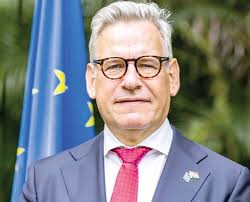

European Union Commends Ghana’s Recovery Momentum, Calls for Policy Discipline
The European Union has described Ghana’s ongoing economic recovery as “positively surprising,” while cautioning that sustaining the gains will require continued reforms and policy discipline.
EU Ambassador to Ghana, Rune Skinnebach, made the remarks at a press briefing to launch Europe Month, indicating that the bloc is closely monitoring developments in the Ghanaian economy.
According to him, while recent macroeconomic indicators point to a rebound, the durability of the recovery will hinge on consistent implementation of reforms and adherence to fiscal and structural measures.
“It is a development that we follow closely that is positively surprising. We need to keep that situation sustainable because success is based on reforms, it is also based on gold prices, debt restructuring efforts and we cannot have that coming up again,” he stated.
The Ambassador further noted that Ghana’s recovery has been supported in part by favourable external conditions, including global commodity price movements and progress on debt restructuring, warning that these factors may not remain constant.
On the issue of slavery as a historical injustice, Mr Skinnebach clarified the EU’s position on a recent vote at the United Nations, explaining that the bloc’s abstention should not be interpreted as a denial of the legacy of slavery.
He emphasised that the EU and its member states continue to acknowledge the historical impact of slavery, with some countries undertaking restitution efforts, including the return of cultural artefacts.
Touching on development cooperation, Mr Skinnebach disclosed that the EU is prioritising interventions aimed at addressing regional inequalities in Ghana.
He noted that approximately 60 percent of EU-funded development programmes are concentrated in the northern regions, as part of efforts to reduce vulnerability and limit potential spillover effects from instability in neighbouring countries driven by socio-economic pressures.

