

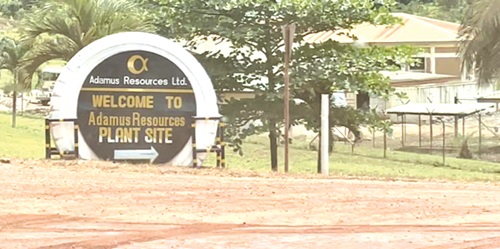

- Adamus Backs 12-Month Mine Turnaround Plan as Government Seeks to Restore Operations
Adamus Resources Limited has welcomed a government-backed 12-month turnaround programme aimed at reviving its struggling mining operations, addressing outstanding liabilities and restoring investor confidence in one of Ghana’s few indigenous large-scale gold producers.
The intervention follows a meeting at the Presidency that brought together representatives of the company, the Ministry of Lands and Natural Resources and the Minerals Commission to develop a coordinated response to the mine’s financial and operational difficulties.
Under the agreement, the parties will jointly prepare a comprehensive turnaround roadmap covering the next 12 months. A six-member management team, comprising three representatives from Adamus Resources and three government appointees, will supervise its implementation.
The roadmap must be completed and submitted to the Presidency within two weeks, making the immediate period critical to determining the mine’s operational future.
Adamus described the agreement as a “significant and constructive step forward” towards preserving the mine and protecting the interests of employees, contractors, suppliers, financiers and communities whose livelihoods depend on its operations.
“Adamus remains committed to the future of the mine,” the company said in a statement, acknowledging that developments surrounding its operations had created uncertainty and anxiety among stakeholders.
The company said the joint approach would allow management and the government to concentrate on restoring sustainable production while preserving the mine’s economic value to Ghana and its host communities.
The proposed roadmap is expected to address Adamus Resources’ outstanding financial obligations to the Ghana Revenue Authority, the Minerals Income Investment Fund, financial institutions and suppliers.
Resolving those liabilities will be central to any sustainable revival, particularly because unpaid statutory and commercial obligations could constrain working capital, complicate relationships with creditors and undermine the company’s ability to attract new investors.
The government and Adamus are also expected to assess options for fresh capital injection. These could include bringing additional investors into the company through an equity acquisition or another financing structure capable of providing the capital required to restart and sustain operations.
The precise size of the company’s outstanding liabilities and the amount of new investment required have not been publicly disclosed.
Adamus urged its employees, suppliers, contractors and host communities to remain calm and support the process while the parties work on the roadmap.
The company said the mine remained an important economic asset, supporting jobs, local businesses and communities in the Western Region while contributing to Ghana’s broader mining value chain.
“Adamus Resources Limited remains committed to working with all stakeholders to turn this opportunity into a successful turnaround, a stronger future for the mine and restore confidence in the Ghana mining industry,” it said.
The Ghana Chamber of Mines has also endorsed the agreement, describing the collaborative framework as evidence of a commitment to dialogue, investor confidence and the preservation of productive mining assets.
The Chamber said the successful revival of Adamus was important because of the company’s position as one of Ghana’s few indigenous large-scale mining operators.
It argued that restoring the mine would help protect employment, sustain businesses within its supply chain, support host communities and preserve revenue flows to the government.
The industry body, however, urged the parties to maintain transparency and accountability throughout the turnaround process. It identified the settlement of outstanding liabilities and mobilisation of the required investment as two of the most important conditions for success.
“We encourage all parties to maintain transparency, accountability and commitment to the agreed roadmap, including addressing outstanding liabilities and securing the investment required for the sustainable operation of the mine,” the Chamber said.
The Adamus intervention comes at a sensitive time for Ghana’s mining industry as the government seeks to increase local participation while tightening regulatory and fiscal oversight of mineral assets.
The handling of the company’s difficulties will therefore be closely watched by investors, creditors and other mine operators. A transparent and commercially credible turnaround could demonstrate that Ghana is capable of resolving disputes and operational crises without allowing economically valuable assets to deteriorate.
However, the 12-month reprieve by itself does not guarantee a successful revival. The process will require credible management reforms, a realistic debt-settlement arrangement, adequate working capital and clear performance milestones.
The composition and mandate of the six-member management team will also be important. Its authority over operational decisions, financial controls, creditor negotiations and capital mobilisation must be clearly defined to prevent overlapping responsibilities between the company and government representatives.
For employees and host communities, the immediate priority will be the restoration of stable operations and protection of livelihoods. For the government, the broader objective will be preserving revenue, maintaining productive mining capacity and demonstrating that increased Ghanaian ownership can be supported by sound corporate governance.
The first major test will come within two weeks, when the parties are expected to present the completed roadmap to the Presidency. Its credibility will depend on whether it provides measurable targets for settling liabilities, mobilising capital, restoring production and rebuilding confidence among suppliers, workers and investors.

