

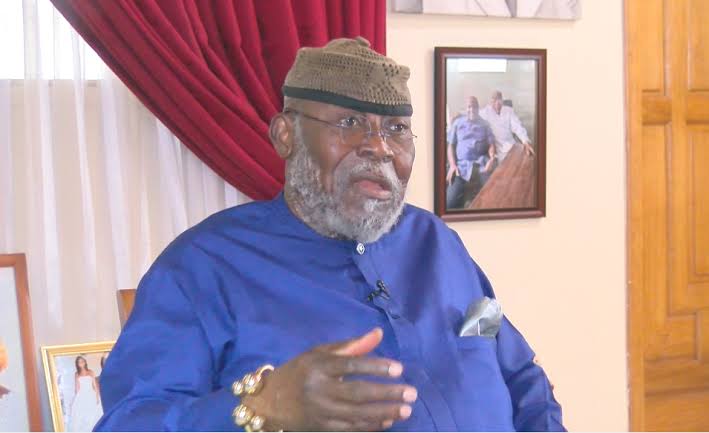

- Kurt Okraku Should Quit Over Ghana’s Deteriorating Football Results — Nyaho-Tamakloe
Former Ghana Football Association chairman Dr Nyaho Nyaho-Tamakloe has called on GFA President Kurt Okraku to resign, arguing that the repeated failures of the Black Stars should carry consequences for the leadership of the country’s football governing body.
His intervention follows Ghana’s poor start to the 2027 Africa Cup of Nations qualifying campaign, during which the Black Stars have lost their opening two matches against Côte d’Ivoire and The Gambia.
The pressure intensified after Ghana suffered a 4-2 home defeat to The Gambia, leaving its qualification prospects under serious threat at an early stage of the campaign.
“If he feels that he has failed and he has the culture of resignation, then nobody will tell him; he will resign by himself, as I did when I was there,” Dr Nyaho-Tamakloe said in an interview on Citi FM’s Eyewitness News.
“If he is not coming up with good results, that’s why I use the words ‘culture of resignation’. There are certain things you don’t force on people.”
He added that stepping down would demonstrate principle and personal accountability.
“He should just quit, like others have done in the past,” Dr Nyaho-Tamakloe said.
The call adds to growing dissatisfaction with the performance of Ghana’s senior national team under Mr Okraku’s presidency.
During his tenure, the Black Stars have suffered two consecutive group-stage eliminations at the Africa Cup of Nations and failed to qualify for the 2025 tournament.
The defeats to Côte d’Ivoire and The Gambia have now raised the possibility that Ghana could miss a second successive AFCON.
For a country that has won the tournament four times and traditionally considers itself one of Africa’s leading football nations, that decline has turned sporting results into a broader governance question.
Responsibility for a national team’s performance does not rest solely with the GFA president. Players, coaches, technical staff and the sports authorities all influence outcomes.
But the frequency of coaching changes, uncertainty surrounding player selection and repeated failures at major competitions have increased public scrutiny of the systems created by the association’s leadership.
Mr Okraku’s supporters may argue that resignation after poor results would create instability and that rebuilding Ghanaian football requires patience. They may also point to the development of domestic competitions, infrastructure projects and youth-football initiatives as evidence that the GFA’s performance should not be measured only through the Black Stars.
The difficulty for the association is that the senior national team remains the clearest public measure of Ghanaian football’s health. When results repeatedly deteriorate, institutional explanations begin to sound less persuasive.
Football associations frequently respond to failure by dismissing the national-team coach. That approach concentrates responsibility on the technical bench while leaving the administrators who appointed the coach untouched.
Dr Nyaho-Tamakloe’s argument challenges that pattern. His invocation of a “culture of resignation” raises the question of whether football administrators should accept personal responsibility when the strategies and appointments made under their leadership consistently fail.
The former GFA chairman also supported the continued tenure of Black Stars coach Carlos Queiroz, suggesting that his demand for change is directed more strongly at the association’s leadership than the technical team.
That position will be debated. Queiroz is responsible for preparing the team and delivering results, while Mr Okraku and the GFA are responsible for the broader structure within which the coach works.
Meaningful accountability would therefore require an assessment of both the coach’s decisions and the administration’s recruitment, planning and oversight.
Removing the GFA president would not, by itself, resolve Ghana football’s deeper problems.
The country still needs a coherent player-development system, competitive domestic leagues, transparent national-team expenditure, independent performance assessment and a long-term technical plan that survives changes in coaches and administrators.
A resignation without reform could simply replace one personality with another while leaving the underlying structure unchanged.
Yet institutional reform also becomes difficult when leadership appears insulated from repeated failure. Accountability at the top can signal that positions in football administration carry measurable obligations rather than merely electoral mandates.
The GFA has not indicated that Mr Okraku intends to step down. Any decision on his position must also operate within the association’s statutes and governance processes.
But the latest defeats have changed the nature of the debate. The question is no longer limited to whether the Black Stars can recover and qualify for the 2027 AFCON.
It is whether Ghana’s football leadership can credibly demand accountability from coaches and players without applying the same standard to itself.

