


- LEAP Coverage Rises 29% as Ghana Expands Social Safety Net to 450,000 Households
Ghana is expanding its flagship Livelihood Empowerment Against Poverty programme to cover as many as 450,000 households while increasing cash grants under an inflation-linked payment system, marking a significant widening of the country’s social safety net as government attempts to protect vulnerable families from rising living costs.
The programme ceiling is increasing from 350,000 to 450,000 households, creating capacity for about 100,000 additional households, equivalent to an expansion of almost 29%.
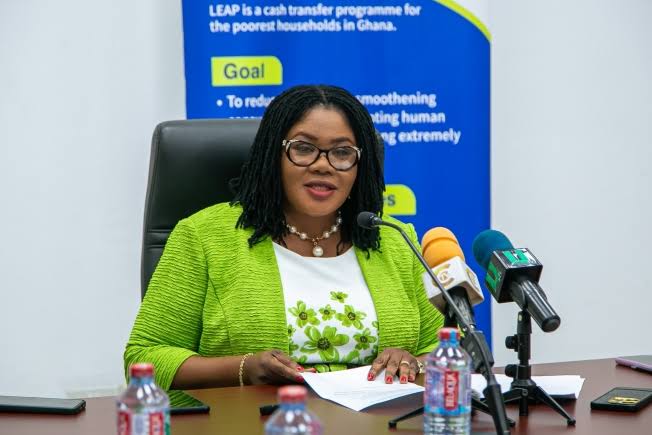
Minister for Gender, Children and Social Protection Dr Agnes Naa Momo Lartey said the changes follow a comprehensive reassessment of existing beneficiaries using the Ghana National Household Registry, with the objective of ensuring that assistance is concentrated on households that continue to meet vulnerability criteria.
The government says more than 226,000 of approximately 350,000 households assessed were identified as having moved out of extreme poverty under the reassessment. That figure represents the government’s classification based on registry data rather than an independent poverty assessment.
The expansion is accompanied by a revised six-tier grant structure based on household size and whether a household contains a vulnerable member.
Households with one or two members will receive GH¢392 every two months where there is a vulnerable member and GH¢380 where there is none. Those with three to four members will receive GH¢474 or GH¢452 respectively, while households with five or more members will receive GH¢630 where a vulnerable member is present and GH¢594 otherwise.
The first and second payment cycles for 2026 commenced on September 14 and are being paid together, meaning eligible households in the current disbursement receive twice their applicable bi-monthly rate.
The more significant policy shift, however, is the introduction of an indexation mechanism intended to protect the real value of LEAP grants from inflation.
For poor households, that distinction is important because the usefulness of a cash transfer depends less on its nominal value than on what it can purchase. If food, transport, healthcare and other essential costs rise while grants remain unchanged, the effective level of assistance declines even when government continues paying the same amount.
The Gender Ministry says indexation is intended to make the programme more responsive to changing economic conditions and preserve purchasing power for beneficiaries. Government had already announced that the expansion would form part of a broader effort to strengthen social protection for poor, vulnerable and excluded households.
Increasing the programme ceiling by 100,000 households, raising grant levels and protecting payments against inflation creates a larger recurrent expenditure commitment. If inflation rises sharply, maintaining the real value of transfers could require additional government resources at the same time fiscal authorities are attempting to maintain spending discipline.
Better targeting therefore becomes central to the sustainability of the expanded programme.
The Ghana National Household Registry is expected to provide much of the evidence for that targeting.
The registry now contains information on more than 11.24 million people across 2,906,288 households in all 16 regions, including 508,870 households classified as extremely poor for social-protection targeting purposes, according to the Gender Ministry.
That infrastructure could allow government to move towards a more dynamic social-protection system in which households that improve economically can leave programmes while families pushed into vulnerability by economic shocks can be identified for assistance.
Such a system could improve the efficiency of social spending, but only if the underlying household information is accurate, regularly updated and applied transparently.
A larger programme also increases the importance of accountability around beneficiary selection and payments. The Ministry has provided grievance and enrolment channels through the LEAP Management Secretariat as government scales up implementation.
The economic impact of the programme extends beyond the direct cash transfer.
Low-income households typically spend a large proportion of additional income on necessities such as food, transport, healthcare and education. LEAP payments can therefore support household consumption while injecting modest amounts of demand into local economies where beneficiaries live.
But cash transfers alone cannot eliminate the structural causes of poverty.
LEAP can help protect households against extreme deprivation and smooth consumption during difficult periods, but sustainable improvements in income ultimately depend on employment, education, healthcare, skills, productive assets and access to markets.
That distinction becomes more important as government attempts to link social protection with broader human-capital and poverty-reduction policies.
The legal framework around social protection is also being strengthened. Government says the Social Protection Act, 2025 and accompanying 2026 regulations are intended to provide a more coordinated structure for identifying and supporting vulnerable households.
For Ghana, the challenge is therefore no longer simply expanding the number of people receiving assistance.
The policy test is whether a larger, inflation-responsive LEAP programme can remain fiscally sustainable while ensuring that benefits reach households genuinely in need and retain enough purchasing power to make a meaningful difference.
The rise to a 450,000-household ceiling signals a substantial expansion of Ghana’s social safety net.
But its success will ultimately be measured less by the headline number of beneficiaries than by whether the combination of tighter targeting, reliable payments and inflation protection translates into stronger economic security for vulnerable families without weakening the fiscal sustainability needed to keep the programme operating over time.

