

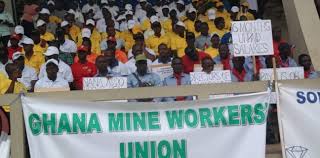

- Local Mining Contract Rules Could Weaken PAYE, Pensions and Worker Benefits – GMWU
The Ghana Mineworkers’ Union has urged government to halt the forced transition of owner-mining operations to local contractors, warning that the policy could reduce tax revenues, weaken pension contributions and erode hard-won labour standards in the mining industry.
The union says it supports the broader objective of increasing Ghanaian participation in the extractive sector, but argues that the current implementation path under local content rules risks producing unintended economic and social consequences.
Speaking on the sidelines of the 98th Annual General Meeting of the Ghana Chamber of Mines in Accra, Deputy General Secretary of the GMWU, Jerry Kwabena Andoh, said the state must not pursue local ownership in a manner that lowers wages, weakens worker benefits and reduces public revenue.
“What does the nation stand to gain if you give a contract to a Ghanaian contractor who pays lower wages, resulting in lower pay-as-you-earn taxes, reduced pension contributions and generally lower benefits? Everything goes down. As a result, even the corporate-related payments that should accrue to the state and support economic development are reduced,” he said.
The concern is rooted in the operational differences between large multinational mining companies and many emerging domestic contract mining firms.
According to the union, major owner-mining companies typically maintain structured employment systems, higher wage levels, stronger collective bargaining arrangements and more reliable pension contributions. Local contractors, by contrast, may lack the financial capacity or willingness to sustain comparable labour standards.
The union fears that a rapid shift to contractor-led mining could replace higher-quality jobs with lower-paying arrangements, reducing Pay-As-You-Earn tax collections, social security contributions and Tier Two pension payments.
Local content is designed to ensure that Ghanaians participate more meaningfully in the mining value chain. But if implementation leads to weaker wages and lower tax flows, the policy could reduce some of the very benefits it is intended to create.
The immediate issue stems from enforcement of the Minerals and Mining (Local Content and Local Participation) Regulations, 2020, L.I. 2431.
Under the 6th edition of the Local Procurement List, which took effect on January 1, 2025, the Minerals Commission directed major producers to phase out internal owner-mining departments. Surface mining operations are expected to be executed by wholly Ghanaian-owned contract mining firms, while underground mining contracts require a minimum of 50.00% indigenous equity and corporate directorship.
Failure to comply could attract regulatory sanctions.
The GMWU says the policy should not be extended in its current form until government has established stronger safeguards for workers, revenue protection and genuine indigenous participation.
Mr Andoh warned that workers generally have greater confidence in multinational owner-mining firms because they are more likely to honour salaries, social security obligations and pension contributions.
“If you conduct a survey among workers in the mining sector and ask them to choose between working for a local company and a foreign company, most will choose the foreign company,” he said.
Local content cannot succeed if workers associate it with lower pay, weaker protections and less secure retirement benefits. A policy designed to create national value must also protect the people whose labour sustains mining production.
The union’s warning also raises questions about the risk of corporate fronting. Mr Andoh cautioned that without strict audits, some entities may appear Ghanaian on paper while effectively operating on behalf of foreign interests. If that happens, Ghana may gain neither genuine local capacity nor improved revenue retention.
Such fronting would undermine the purpose of localisation. It would allow foreign interests to remain in control through local proxies while workers face weaker terms and the state risks lower tax receipts.
The challenge, therefore, is not whether Ghana should deepen local participation in mining. It should.
A credible local content policy must build Ghanaian capacity without weakening labour standards, reducing tax revenues or creating room for politically connected front companies.
That requires proper due diligence on local contractors, minimum labour benchmarks, pension compliance checks, technical capacity assessments and transparent ownership disclosures.
Contractors granted exclusive operational roles should be required to demonstrate financial strength, equipment capacity, safety systems, tax compliance and the ability to maintain decent wages and benefits.
Government must also ensure that workers transferred from owner-mining operations to contractor arrangements do not lose rights already secured through collective bargaining.
The GMWU’s position is therefore not anti-local content. It is a demand for a safer transition.
The union wants implementation paused until the system is cleaned up and binding safeguards are in place.
“We align with the objective, but it should not be extended for now until we have cleaned up the system,” Mr Andoh said.
Ghana’s mining sector is entering a period of stronger resource nationalism, higher expectations for local participation and renewed scrutiny of foreign operators. But localisation must be designed carefully.
If it simply changes the ownership label while weakening jobs, reducing taxes and enabling fronting, it will fail the national interest test.
If, however, it creates strong Ghanaian mining firms that pay decent wages, meet pension obligations, invest in safety and compete transparently, it could become a powerful tool for economic transformation.
Government should pause the rushed transition, consult labour and industry, audit contractor capacity and establish enforceable standards.
Ghana needs local participation in mining. But it must be real, responsible and revenue-enhancing.

