

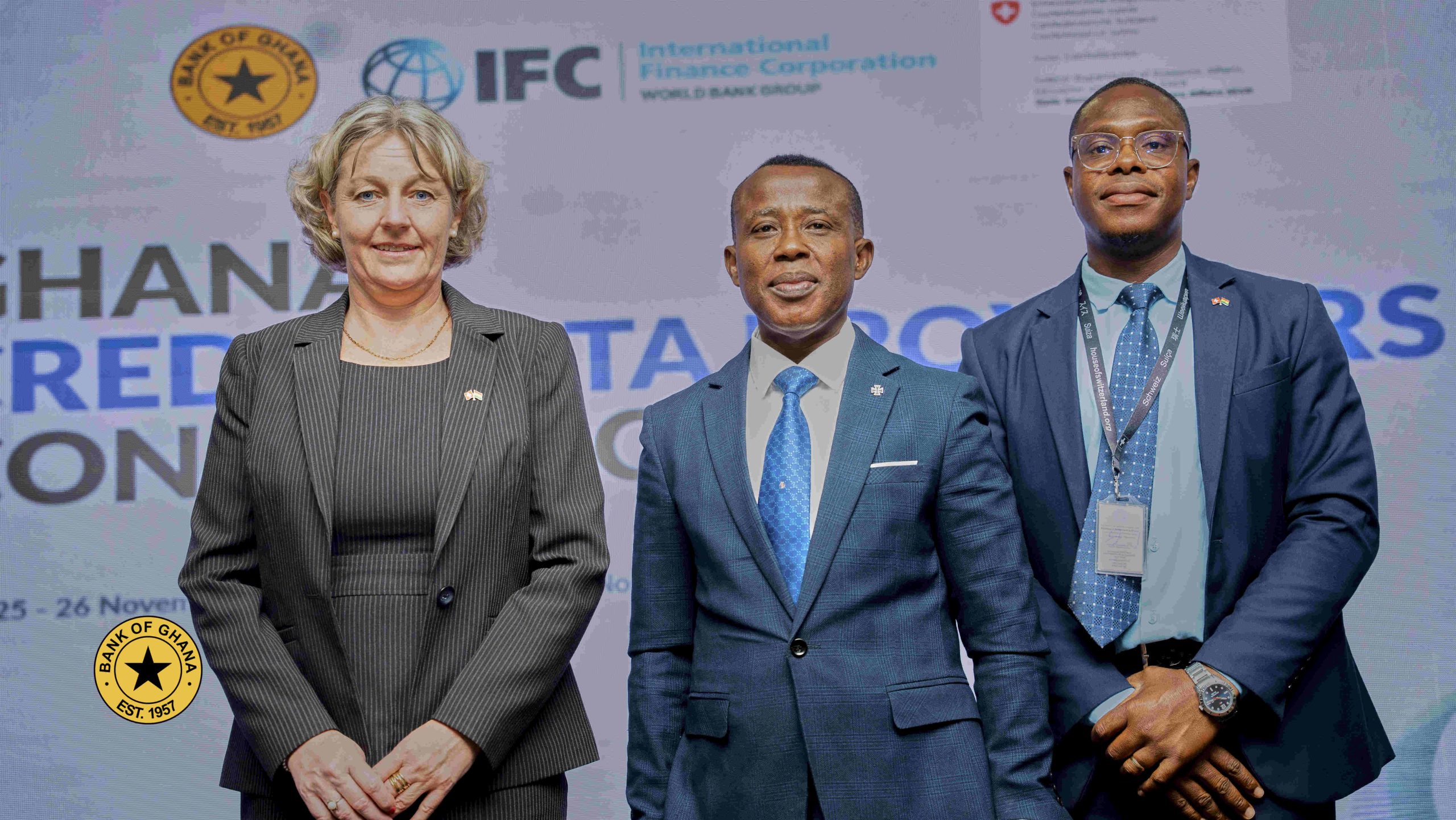

- IFC Calls for Overhaul of Credit Assessment as Ghana’s 1.9 million Enterprises Face Financing Barriers
The International Finance Corporation (IFC) has called for a fundamental improvement in Ghana’s credit reporting infrastructure, warning that inadequate borrower information continues to restrict access to financing for micro, small and medium-sized enterprises (MSMEs), despite their substantial contribution to employment and economic activity.
Deo Onyango, Principal Country Officer of IFC Ghana, said financial institutions must adopt more comprehensive methods of assessing creditworthiness by incorporating alternative data generated through everyday commercial activities, including mobile money transactions and business payment histories.
Speaking at a stakeholder conference on enhancing MSME access to finance through alternative data and collaboration, Mr Onyango argued that Ghana’s financial system must move beyond traditional credit assessment models that often fail to capture the economic activities of businesses operating outside established banking relationships.
He disclosed that Ghana has approximately 1.9 million enterprises, making the availability of reliable credit information particularly important for improving financial inclusion and supporting private-sector growth.
The IFC official said lenders face a persistent information gap when evaluating smaller businesses, many of which maintain commercial relationships and conduct regular transactions without generating the financial statements or borrowing histories traditionally used by banks.
The challenge, he explained, affects both sides of the credit market: viable businesses struggle to demonstrate their capacity to repay loans, while financial institutions face difficulties distinguishing creditworthy borrowers from those presenting higher default risks.
For Ghana’s banking industry, this information imbalance has become particularly important as lenders seek to expand private-sector credit while managing non-performing loans and protecting their balance sheets.
Mr Onyango stressed that sound lending decisions begin with a clear understanding of the businesses seeking financing.
“Every credit decision starts with a very simple question: How well do I understand this business?”
The question illustrates a central weakness in Ghana’s credit market, where businesses may generate substantial transaction records but remain unable to translate those records into financial information that lenders can use confidently.
The IFC’s intervention comes as Ghana seeks to strengthen its credit reporting framework through collaboration involving the Bank of Ghana, financial institutions, credit bureaus, fintech companies and other data providers.
The initiative is supported by the Government of Switzerland through its State Secretariat for Economic Affairs (SECO), which is providing funding for work intended to improve credit reporting and expand responsible lending to smaller enterprises.
Mr Onyango said the objective is to develop systems that provide lenders with a more complete and reliable assessment of borrowers, particularly those without extensive formal credit histories.
He explained that determining creditworthiness requires understanding both a borrower’s ability to repay and their willingness to honour financial obligations.
This means that information about sales, payment patterns and existing commitments can be important even when a business has never obtained a conventional bank loan.
The IFC believes that alternative data could help close these information gaps and enable financial institutions to make better-informed lending decisions.
The scale of Ghana’s digital financial transactions illustrates the potential significance of the approach.
Mr Onyango cited mobile money transactions exceeding GH¢3 trillion in 2024, involving approximately eight billion transactions, as evidence of the substantial volume of economic information generated outside conventional banking channels.
The figures demonstrate how rapidly financial activity has migrated towards digital platforms, creating transaction records that could potentially improve lenders’ understanding of business cash flows.
For example, a retailer receiving regular mobile money payments may have a record of daily sales activity that provides useful information about turnover and revenue patterns.
Similarly, an agricultural trader making repeated payments to suppliers may demonstrate a history of fulfilling financial obligations even without possessing audited financial statements.
Such information could help lenders structure financing arrangements around the operating characteristics of individual businesses.
However, transaction volume alone does not establish creditworthiness.
Large payments passing through an account do not necessarily represent business profit, disposable income or an ability to service debt.
The commercial value of alternative data therefore depends on whether lenders can interpret the information accurately and distinguish genuine repayment capacity from transaction activity.
Mr Onyango emphasised that alternative data becomes useful when it helps financial institutions understand how businesses generate revenue, settle obligations and manage their commercial operations.
The IFC’s approach is intended to improve the quality of credit decisions rather than encourage indiscriminate lending.
This distinction matters because Ghana’s MSME sector presents both considerable growth opportunities and significant credit risks.
Mr Onyango acknowledged that financial institutions encounter repayment difficulties among smaller borrowers, contributing to the challenge of managing non-performing loans.
Yet the same segment of the economy remains essential to employment creation and broader private-sector expansion.
“A lot of their non-performing loans actually come from that micro, small, medium-sized enterprises.”
He immediately drew attention to the economic importance of the sector, describing it as an engine of growth.
The implication is that restricting lending to smaller businesses may reduce some immediate credit exposure but could also constrain the productive enterprises on which Ghana depends for employment and economic diversification.
Conversely, expanding credit without improving risk assessment could increase loan defaults and weaken the banking system.
The policy challenge is therefore to develop a credit market capable of serving viable smaller businesses while maintaining prudent lending standards.
The IFC believes that improved borrower information can help address this dilemma.
Financial institutions equipped with reliable transaction histories and more complete borrower profiles may be better positioned to price loans according to risk, identify emerging repayment problems and offer financing products suited to different business models.
The benefits could extend to smaller businesses that require relatively modest amounts of working capital but cannot satisfy the documentation requirements associated with conventional commercial lending.
Mr Onyango said the IFC was pursuing reforms across the credit cycle rather than focusing exclusively on the expansion of credit bureau information.
These interventions include improving credit assessment, strengthening lending secured by movable assets and developing more effective frameworks for managing non-performing loans and financially distressed businesses.
Movable-asset financing is particularly relevant for smaller enterprises that possess equipment, machinery, inventories or receivables but lack land and buildings traditionally accepted as collateral.
Strengthening the legal and operational arrangements surrounding such lending could help businesses obtain financing against assets already used in their commercial operations.
However, the effectiveness of these reforms depends on reliable registration systems, enforceable security interests and financial institutions capable of assessing collateral risks.
The IFC’s broader programme therefore recognises that limited access to credit cannot be resolved simply by collecting more borrower information.
It also requires improvements in lending practices, collateral arrangements and financial-sector risk management.
A major component of the current initiative is an alternative data diagnostic study examining information sources available in Ghana, barriers to their use and practical mechanisms for incorporating them into the credit reporting ecosystem.
The study is expected to inform decisions about which forms of alternative data should receive priority and how different institutions can contribute to a more comprehensive credit reporting framework.
For the IFC, the central objective is to ensure that lenders obtain information that improves their understanding of borrowers while maintaining responsible data-management practices.
The initiative also requires cooperation among banks, credit bureaus, fintech companies, telecommunications providers and other institutions that hold relevant transaction information.
Such cooperation is not without challenges.
Data held by different institutions may be recorded in incompatible formats, while privacy obligations and commercial considerations can restrict information sharing.
Poor-quality records or inaccurate borrower identification can also create risks for credit decisions.
Addressing these constraints will require agreed technical standards, effective governance arrangements and clearly defined responsibilities among participating institutions.
Mr Onyango consequently called for practical outcomes from the stakeholder conference rather than another round of policy discussions without implementation.
He identified three priorities: determining the most relevant alternative data sources and business groups, establishing the responsibilities of participating institutions and developing mechanisms for sustained cooperation.
He also welcomed the proposed establishment of a Credit Data Providers Association, which could provide a platform for coordinating the different institutions involved in gathering and supplying credit information.
The association, if established, could help address persistent coordination problems by encouraging common standards and structured engagement between lenders, data providers and regulators.
However, its effectiveness would depend on clear governance arrangements and measurable responsibilities.
Mr Onyango urged stakeholders to agree on an implementation plan, including institutional commitments and timelines.
The IFC, he said, would continue supporting the Bank of Ghana and industry participants in efforts to strengthen credit reporting and improve financing opportunities for smaller businesses.
The initiative complements the Bank of Ghana’s broader efforts to expand financial inclusion through improved credit information.
At the same conference, Dr Settor Kwabla Amediku, Special Aide to the Governor on Financial Stability, speaking on behalf of Second Deputy Governor Matilda Asante-Asiedu, disclosed that Ghana’s credit bureau coverage had increased from 33.20% in 2019 to approximately 60.00% by December 2025.
The improvement indicates progress in expanding the formal credit reporting system, although the central bank acknowledged that substantial gaps remain in the quality and completeness of information available to lenders.
The challenge is particularly significant because being included in a credit database does not necessarily mean that a financial institution possesses sufficient information to evaluate a borrower’s commercial activities.
The central economic opportunity lies in transforming Ghana’s rapidly expanding digital transaction infrastructure into reliable financial information capable of supporting productive lending.
For banks, better information could improve loan pricing, strengthen credit portfolios and reduce uncertainty surrounding smaller borrowers.
For entrepreneurs, it could create opportunities to access working capital and investment financing without relying exclusively on conventional credit histories or fixed-property collateral.
For the wider economy, improved MSME financing could support business expansion, employment creation and domestic production.
Nevertheless, success will depend on whether alternative data can be incorporated into lending decisions without weakening consumer protections or exposing financial institutions to excessive risk.
The IFC’s message is that Ghana’s credit market must evolve alongside the country’s changing financial infrastructure.
Mobile money and other digital payment systems have already transformed how businesses conduct transactions.
The next challenge is ensuring that the information generated by those transactions can help financial institutions distinguish viable enterprises from borrowers presenting unsustainable credit risks.
For Ghana’s approximately 1.9 million enterprises, the outcome could determine whether their commercial activities remain visible only in payment records or become credible evidence for accessing the financing required to expand.

