

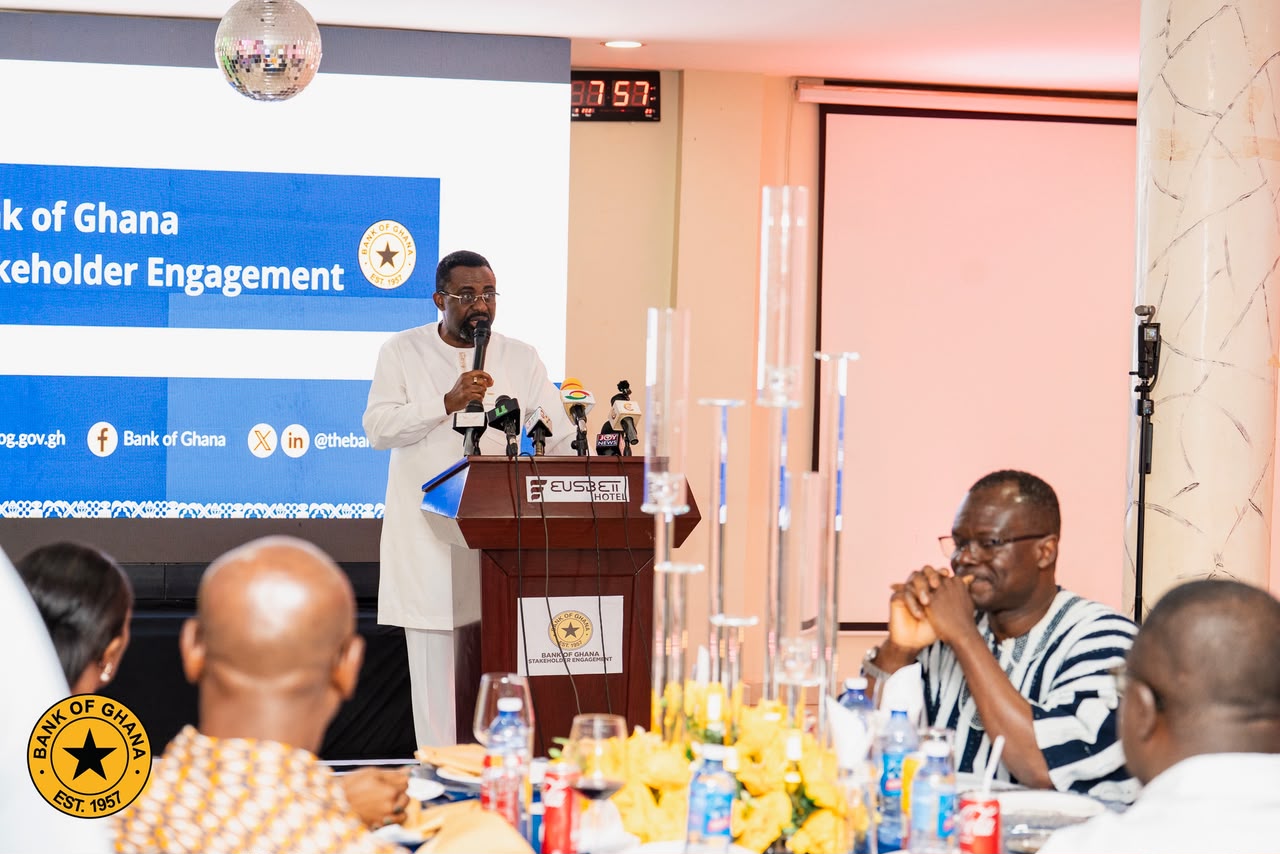

- Macroeconomic Stability Is a Shared Responsibility – BoG Governor Tells Businesses
Bank of Ghana Governor Dr Johnson Pandit Asiama has cautioned that sustaining Ghana’s improving macroeconomic environment cannot be left to the central bank alone, calling for stronger cooperation among policymakers, businesses, financial institutions, traders, farmers and households as the economy navigates lingering external risks.
Speaking at a stakeholder engagement in Sunyani, Dr Asiama said Ghana’s recent economic gains would prove more durable if economic actors understood that maintaining stability was a collective responsibility rather than exclusively a monetary policy assignment.
“Macroeconomic stability is not the responsibility of the Bank of Ghana alone it is a partnership between policymakers, businesses, financial institutions, traders, farmers, and households,” the Governor said.
“When we understand one another, when we collaborate, and when we trust the process, the path to stability becomes clearer and more achievable.”
The remarks offer a broader framing of the central bank’s current policy position at a time when inflation remains relatively low, economic growth has strengthened and private-sector credit is expanding, but external developments including higher global oil prices and geopolitical tensions continue to pose risks.
For the Governor, the challenge is no longer simply achieving macroeconomic stability but protecting it.
Dr Asiama said the Bank’s decisions inevitably affect businesses, commercial banks, traders, farmers, manufacturers and households, making regular engagement with those groups an important part of policymaking.
“The Bank of Ghana makes decisions that affect businesses, banks, traders, farmers, manufacturers and every Ghanaian,” he said.
“It is therefore important that we hear directly from you about the challenges you face and share with you what we are doing to support a stable economy.”
The Governor said one of his priorities since assuming office had been to make the Bank of Ghana more open and transparent while building stronger relationships with stakeholders.
That communication strategy is significant because monetary policy works partly through expectations. Businesses making investment decisions, banks pricing loans, households planning expenditure and traders making foreign-exchange decisions all respond not only to present economic conditions but also to what they expect inflation, interest rates and the currency to do in future.
The central bank’s latest assessment suggests that some of those indicators have moved in a favourable direction.
The Monetary Policy Committee maintained the policy rate at 14% at its latest meeting, with Dr Asiama arguing that the decision provided an appropriate balance between maintaining price stability and allowing room for economic activity.
“We took this decision because we believe it is the right balance,” he said. “It will help keep inflation under control while supporting businesses, investment and economic growth.”
The stance, he added, also gives the central bank flexibility to respond should global economic conditions deteriorate.
Inflation increased from 3.70% in May to 5.30% in June, but remains below the Bank of Ghana’s target range.
Dr Asiama attributed the increase principally to higher transport costs arising from the rise in global crude oil prices, describing the development as temporary while stressing that the central bank would continue monitoring price pressures closely.
“The good news is that inflation remains low,” he said.
“Although it increased slightly from 3.7 percent in May to 5.3 percent in June, it is still below the Bank of Ghana’s target range.”
The Governor linked low and predictable inflation directly to the everyday economic decisions of households and businesses.
“Low and stable inflation is good for everyone. It helps families manage their household budgets, allows businesses to plan with greater confidence, and encourages investment,” he said.
That connection underscores the Governor’s wider argument that macroeconomic stability cannot be viewed as an abstract collection of indicators managed from the central bank’s headquarters.
Price stability affects purchasing power. Exchange-rate stability influences import costs and business planning. Banking-sector stability determines access to savings and credit, while fiscal decisions ultimately shape the monetary environment in which the Bank of Ghana operates.
Ghana’s economy expanded by 6.40% in the first quarter of 2026, slightly above the 6.20% recorded during the corresponding period of 2025.
According to Dr Asiama, services and industry were the main drivers of the expansion, while economic activity was also being supported by stronger bank lending, increased trade, higher industrial production and recovering tourism.
Businesses and consumers were also displaying stronger confidence, while lending rates had declined, improving the environment for firms seeking financing for investment.
Perhaps one of the clearest indicators of the changing economic environment is the acceleration in credit.
Private-sector lending to businesses and households grew by more than 41.00% in June 2026, compared with roughly 9.00% a year earlier.
“Most importantly, banks are lending more to the private sector,” Dr Asiama said.
“This means more businesses have access to financing to expand, create jobs and contribute to economic growth.”
The rapid increase in credit is potentially significant for Ghana’s recovery.
For several years, businesses have complained that high borrowing costs and tight credit conditions limited investment even when headline macroeconomic indicators improved.
A sustained increase in productive private-sector lending could therefore help translate macroeconomic stability into employment, business expansion and household income growth.
Credit expansion can support growth when lending is productive and banking-sector asset quality remains strong. If accompanied by excessive liquidity, poor underwriting or renewed inflationary pressure, however, rapid credit growth could create a different set of risks.
The Governor nevertheless described Ghana’s banking sector as strong and stable, saying banks remained well capitalised, deposits continued to increase and loan quality had improved.
Strong gold and cocoa exports helped Ghana record a higher trade surplus during the first half of 2026, according to Dr Asiama, while foreign exchange reserves stood at approximately US$12.9 billion, equivalent to about five months of import cover.
“These reserves give us a strong buffer against external shocks and help the Bank of Ghana support stability in the foreign exchange market,” he said.
The cedi experienced pressure earlier in the year amid global developments, particularly the conflict in the Middle East, but subsequently recovered, the Governor said.
The central bank remains committed to maintaining what he described as an “orderly and well-functioning foreign exchange market”.
Yet the broader message from Sunyani was that the encouraging statistics should not create complacency.
Ghana’s economic history contains several periods in which stabilisation was achieved only for fiscal slippages, external shocks or loss of confidence to reverse earlier gains.
That makes the question of institutionalising stability particularly important.
Businesses have a role through investment, productivity, responsible pricing and employment creation. Financial institutions influence the economy through prudent lending and responsible risk management. Traders respond to exchange-rate expectations and market conditions, while households influence savings, consumption and inflation expectations.
Government and other policymakers carry an even larger responsibility because fiscal choices can either reinforce or undermine the central bank’s monetary stance.
The Governor did not minimise the external risks.
“The progress we have made is encouraging, but we must not become complacent,” Dr Asiama said.
“The global economy remains uncertain, and events beyond our borders can still affect us.”
The Bank of Ghana would therefore continue taking decisions designed to protect the cedi, maintain low inflation, preserve financial stability and support sustainable economic growth, he said.
“Our goal is simple: to create an economic environment where businesses can grow with confidence, households can plan for the future, and every Ghanaian can share in the benefits of a stable and growing economy.”
That objective ultimately returns to the Governor’s central proposition: macroeconomic stability is valuable only if it becomes embedded beyond the Bank of Ghana.
Interest rates can be set by a committee. Liquidity can be managed through monetary operations. Foreign reserves can provide buffers against external shocks.
But lasting stability depends on whether fiscal policy, business behaviour, financial-sector decisions and public expectations move in the same direction.
Ghana’s immediate indicators may be pointing favourably inflation is contained, growth has remained strong, private-sector credit is expanding and reserves provide a substantial external buffer.
The larger test is whether the country can convert those gains into an economic culture in which stability is protected before a crisis forces adjustment.
Dr Asiama’s message to stakeholders in Sunyani was therefore as much a warning as an expression of confidence: the Bank of Ghana can protect price and financial stability with the instruments available to it, but sustaining those gains will ultimately require the rest of the economy to pull in the same direction.

