

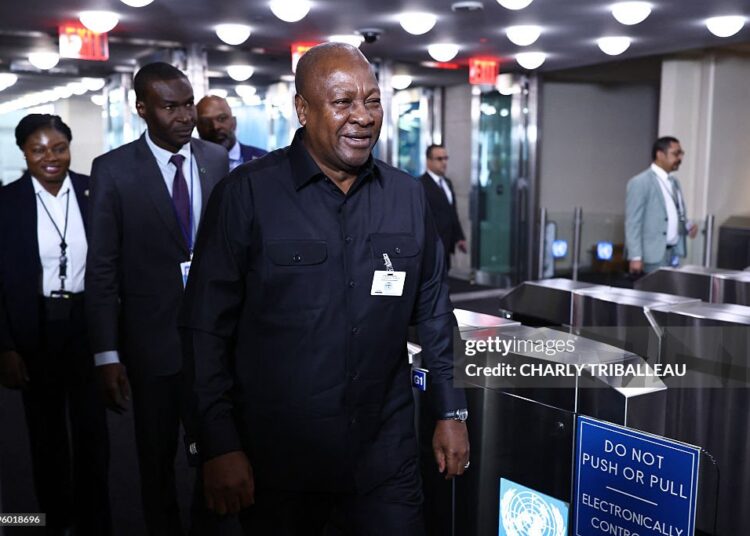

- Mahama Endorses Ethiopia’s AFCON Ambition After Bahir Dar Stadium Tour
President John Dramani Mahama has endorsed Ethiopia’s bid to host the 2028 Africa Cup of Nations, describing the country’s facilities as impressive and arguing that it deserves another opportunity to stage Africa’s biggest football tournament after an absence of more than five decades.
President Mahama offered his support after inspecting the renovated Bahir Dar International Stadium with Ethiopian Prime Minister Abiy Ahmed and other African leaders attending the 12th Tana High-Level Forum on Security in Africa.
The 52,000-capacity facility has received approval from the Confederation of African Football following extensive renovation work, allowing Ethiopia’s national team to resume playing international matches at home after spending several years using venues abroad.
“This is a very impressive stadium, a 52,000-capacity stadium, and it’s already CAF-certified,” President Mahama said.
He argued that Ethiopia’s long absence from hosting the competition should be considered alongside the country’s infrastructure improvements, saying the facilities demonstrated its readiness to organise a successful tournament.
The endorsement carries diplomatic significance, particularly because it was delivered in the presence of African leaders and Ethiopia’s Prime Minister. But the decision on the 2028 host rests with CAF, which has introduced a competitive evaluation process covering technical, commercial, financial and security requirements.
Ethiopia formally submitted its final bid in August 2026 and is competing against other proposals, including bids associated with Morocco and southern African countries.
CAF opened the bidding process for the 2028, 2032 and 2036 tournaments in July, supported by PwC and independent technical, financial and legal advisers. The governing body says the framework is intended to produce a transparent and credible selection process.
Ethiopia’s historical case is compelling. It hosted AFCON in 1962, 1968 and 1976 and won its only continental title on home soil in 1962.
But the tournament has changed dramatically since Ethiopia last hosted it. The 1976 competition featured eight teams, while the modern AFCON involves 24 countries and requires several competition venues, training facilities, hotels, transport systems, broadcast infrastructure, medical services and security arrangements.
Bahir Dar Stadium therefore strengthens Ethiopia’s bid but cannot secure hosting rights by itself.
CAF must determine whether Ethiopia has enough compliant stadiums across multiple cities and whether supporting infrastructure can be completed within the relatively short period before the tournament.
A technical delegation reportedly inspected six proposed stadiums and the planned tournament headquarters in October. The venues were located in Addis Ababa, Bahir Dar, Dire Dawa, Hawassa and Jimma.
The inspection was intended to compare conditions on the ground with Ethiopia’s bid documents. It did not amount to confirmation that the country had satisfied every hosting requirement.
This distinction is important because Ethiopia had previously struggled to provide CAF-approved venues. Its national team was forced to play designated home fixtures in countries including Morocco and Tanzania after domestic facilities failed to meet the required standards.
The approval of Bahir Dar Stadium marks progress, but CAF will need firm completion schedules and financial guarantees for the remaining venues.
Tournament hosting cannot depend on planned construction alone. African football has repeatedly faced situations where ambitious projects encountered delays, leaving organisers under pressure as opening dates approached.
Ethiopia’s bid will consequently need to demonstrate not only architectural ambition but delivery capacity.
Transport connectivity will be another consideration. Moving 24 teams, supporters, broadcasters and officials between host cities requires dependable domestic aviation, roads and urban transport.
Hotel capacity, training grounds, medical facilities, communications infrastructure and crowd-management systems must also satisfy tournament requirements.
Security may present the most sensitive issue. Ethiopia has faced conflicts and instability in parts of the country, including Amhara and Oromia. Bahir Dar is located in the Amhara Region, making the safety framework surrounding the proposed venue central to CAF’s assessment.
A successful bid would therefore require credible guarantees that teams and supporters could travel safely throughout the tournament.
President Mahama’s intervention also raises a wider question about how Africa should distribute its leading sporting events.
Countries with established stadiums, transport networks and recent hosting experience naturally present lower delivery risks. But repeatedly awarding tournaments to the most prepared states can prevent other countries from using major events to accelerate infrastructure development.
Ethiopia’s case is partly based on rotation and historical fairness. More than 50 years have passed since it last hosted AFCON, despite the country’s important place in African football and continental diplomacy.
Addis Ababa hosts the headquarters of the African Union, while Ethiopia has Africa’s second-largest population. A well-organised tournament could deepen football participation, support tourism and demonstrate a more positive image of the country internationally.
However, historical importance should not override practical readiness. CAF’s obligation is to choose a host capable of delivering safe facilities, reliable logistics and a credible commercial tournament.
The 2028 competition will also begin a new era for AFCON. CAF has announced that the tournament will move to a four-year cycle after the 2027 edition, which Kenya, Tanzania and Uganda will jointly host from June 19 to July 17.
That shift will make each tournament more commercially important and place even greater pressure on the selected host to deliver successfully.
Mahama’s endorsement gives Ethiopia a respected African voice in its corner, but it should be viewed as political and moral support rather than evidence that the technical contest has been decided.
Bahir Dar Stadium shows that Ethiopia can respond to CAF’s demands when investment and leadership align. The question is whether that achievement can be replicated across enough venues and supporting services before 2028.
Ethiopia has made a persuasive case for why it should host AFCON again. It must now convince CAF that its readiness extends beyond one impressive stadium.

