
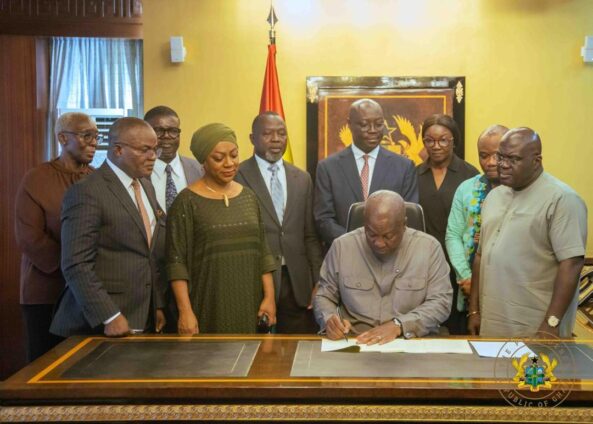

- Mahama Signs Value for Money Office Act to Curb Inflated Public Contracts
President John Dramani Mahama has signed the Value for Money Office Act, 2026 into law, paving the way for the establishment of a new oversight body intended to curb inflated government contracts, cost overruns and wasteful public spending.
The law, assented to on Monday, May 11, marks a major institutional step in the government’s public financial management reform agenda, as Ghana seeks to tighten scrutiny over procurement decisions and ensure that public expenditure delivers measurable benefits to citizens.
Finance Minister Dr Cassiel Ato Forson, who announced the development after the President signed the bill into law, described the move as a significant milestone in efforts to contain expenditure pressures linked to overinflated public sector contracts.
“Today is a good day. His Excellency, the President, this morning signed into law the Value for Money Office Bill,” Dr Forson said.
He explained that under the new regime, all single-source procurement arrangements will be required to pass through the Value for Money Office for assessment before approval.
“What we seek to do going into the future will be that we will set up the office, and all single-source procurements will have to go through the office for value for money,” he said.
The new law establishes a specialised institution to embed efficiency, transparency and accountability in government expenditure. It is expected to address long-standing weaknesses in public financial management, including inflated contract sums, abandoned projects, cost overruns and wasteful spending across the public sector.
According to Dr Forson, responsibility for conducting value-for-money reviews had previously rested with the Legal Division of the Ministry of Finance, which he said did not have the specialised technical expertise required for such assessments. The new office is therefore expected to institutionalise the process through a dedicated body with the capacity to independently assess government contracts.
Once operational, the Value for Money Office will conduct value-for-money assessments, issue mandatory Value for Money Certificates before major contracts are awarded, monitor compliance across public entities and enforce sanctions where violations occur.
Dr Forson said the law will ensure that every cedi spent by government delivers maximum benefit to citizens in terms of economy, efficiency, effectiveness, equity and sustainability.
The establishment of the office also fulfils one of President Mahama’s campaign promises to improve transparency and discipline in public contracting.
Government is now expected to allocate resources to operationalise the office, appoint its leadership and constitute the technical team required to implement the law. The Finance Minister said the Value for Money Office is expected to become fully operational by January 2027.
“I want to use this opportunity to assure the people of Ghana that the manner of public sector contracting and overinflation of contracts will be curtailed by this signature,” Dr Forson stated.
The creation of the office comes at a time of heightened public concern over procurement abuse, inflated contract values and the fiscal burden imposed by stalled or poorly executed public projects.
If effectively implemented, the Value for Money Office could become an important filter in Ghana’s procurement architecture, particularly for single-source contracts and major public investments where cost escalation, weak appraisal and political discretion have historically exposed the state to financial waste.
Its success, however, will depend on whether value-for-money reviews become binding safeguards rather than procedural formalities. In a public finance environment still recovering from debt distress and fiscal consolidation, the new law places renewed pressure on government to prove that every public contract can withstand technical, financial and developmental scrutiny before taxpayer funds are committed.

