

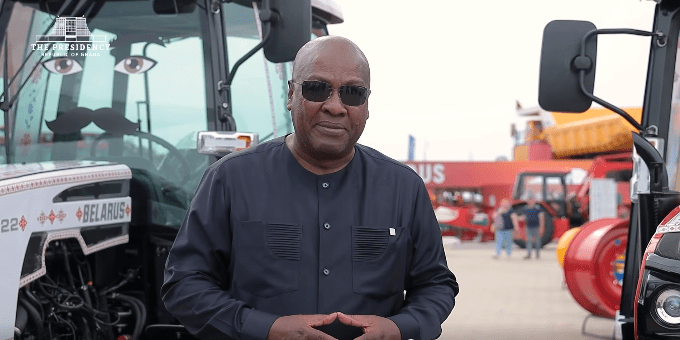

- Mahama Woos Belarusian Mining Equipment Makers to Ghana
Ghana is set to host a delegation of Belarusian mining equipment manufacturers next week as President John Dramani Mahama moves to court fresh industrial investment into the country’s mining and productive sectors.
The planned visit was announced by President Mahama during the maiden Ghana-Belarus Business Forum in Minsk, where he positioned Ghana as a stable and strategic investment destination for Belarusian companies seeking access to West Africa and the wider African market.
According to the report, the engagement is expected to focus on mining equipment manufacturing, industrial engineering, construction machinery, technology transfer and possible local partnerships with Ghanaian firms.
President Mahama said Ghana had reached an agreement with Belarusian manufacturers whose expertise in heavy-duty mining machinery could support the country’s mining, construction and infrastructure sectors.
The expected visit comes at a time when Ghana is seeking to increase local value addition in mining, reduce dependence on imported equipment and deepen industrial activity around one of the country’s most important foreign exchange-earning sectors.
Mining remains central to Ghana’s economy, with gold continuing to dominate export earnings and fiscal receipts. However, much of the industry’s equipment, technology and specialised machinery is still imported, limiting the domestic industrial linkages that could be created from the sector.
A partnership with Belarusian mining equipment firms could therefore support Ghana’s ambition to move beyond mineral extraction into a broader mining services and equipment ecosystem.
Industry analysts say the opportunity lies not only in importing machinery, but in using such partnerships to build local capacity for assembly, servicing, maintenance, spare parts supply and technical training.
If structured well, the collaboration could create skilled jobs, strengthen local engineering capacity and reduce the cost and downtime associated with importing heavy-duty equipment and replacement parts.
The President also used the forum to promote Ghana’s strategic location under the African Continental Free Trade Area, noting that investors establishing operations in Ghana would gain access not only to the domestic market, but also to a continental market of more than 1.4 billion people.
That pitch is important because Ghana is not merely seeking one-off equipment supply arrangements. It is seeking to position itself as a manufacturing and trade hub for companies looking to serve the wider West African and African markets.
The Belarus engagement also aligns with government’s planned US$10 billion five-year “Big Push” Infrastructure Programme, which is expected to create opportunities in roads, railways, ports, logistics, energy, construction and manufacturing.
President Mahama said investments in infrastructure would lower business costs, improve connectivity and strengthen Ghana’s competitiveness.
For Belarusian companies with expertise in mining machinery, road construction equipment and industrial engineering, Ghana’s infrastructure and mining pipeline could provide a market for long-term industrial participation.
The potential collaboration also fits into government’s broader strategy of using foreign partnerships to drive industrialisation, technology transfer and value addition.
For years, Ghana’s mining economy has been criticised for exporting raw minerals while importing most of the capital goods, equipment and specialised services needed to operate the sector.
This has limited the extent to which mining drives domestic manufacturing, engineering and high-value employment.
A successful equipment partnership could begin to change that model by encouraging manufacturers to establish local assembly or service operations rather than merely selling machinery from abroad.
However, the success of the engagement will depend on the details.
Ghana will need to ensure that any agreements go beyond equipment imports and include clear commitments on local participation, skills transfer, after-sales service, financing arrangements and industrial localisation.
Without those conditions, the country risks replacing one import source with another without building meaningful domestic capacity.
Government will also need to align the potential investments with Ghana’s mining policy direction, especially as the country places stronger emphasis on local content, responsible mining, lease renewal scrutiny and improved fiscal returns from mineral resources.
For mining companies operating in Ghana, improved access to equipment and maintenance services could reduce operational bottlenecks, especially for contractors and indigenous firms that often struggle with financing and access to reliable machinery.
For the wider economy, the opportunity is to use mining demand as a base for industrial growth.
Mining equipment assembly, fabrication, repair, component supply and operator training could all become part of a stronger local industrial ecosystem if supported by the right policy incentives.
President Mahama assured investors that Ghana offers political stability, a transparent regulatory environment, investment protection and guarantees for the repatriation of profits.
Those assurances are intended to make Ghana attractive to long-term capital at a time when African economies are competing aggressively for industrial investment.
The planned visit by Belarusian manufacturers is expected to provide an opportunity for engagements with government agencies, mining companies and private sector operators on possible investment projects and partnerships.
For Ghana, the visit is another test of whether international partnerships can be converted into actual industrial assets on the ground.
If the talks lead to local assembly, technology transfer and job creation, the Belarus engagement could strengthen Ghana’s mining value chain and support the country’s ambition to become a regional industrial hub.
If it remains limited to equipment sales, however, the long-term impact will be far more modest.
The real opportunity is not simply that Belarusian companies may sell machinery to Ghana.
It is that Ghana could use the partnership to build a domestic mining equipment and industrial services base capable of serving the country and the wider African market.

