

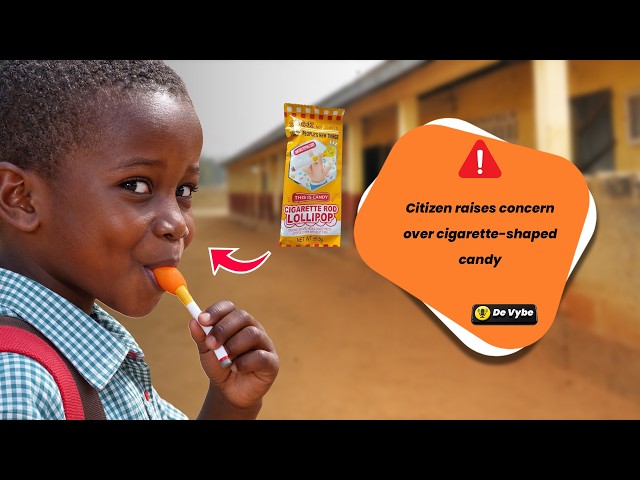

- Cigarette-Shaped Candy Exposes Deeper Battle Over Children and Tobacco Influence
The seizure of an unregistered cigarette-shaped lollipop from traders in Accra has opened a broader debate over how Ghana protects children from products that can normalise tobacco use long before they are old enough to understand its risks.
Vision for Accelerated Sustainable Development Ghana has welcomed the Food and Drugs Authority’s intervention, carried out with support from the Ghana Police Service and National Security, but says the confiscation of products from Makola Market and the Accra Central Business District should be treated as the beginning rather than the conclusion of the regulatory response.
The FDA has said the product, branded “Cigarette Rod Lollipop”, is not registered with the authority and that its composition is therefore unknown. A suspect linked to its sale has been arrested as investigations continue.
For VAST Ghana, however, the issue extends beyond whether the confectionery contains tobacco or nicotine. The organisation argues that a product deliberately designed to resemble a cigarette can itself raise serious public-health concerns if it reaches children without triggering Ghana’s tobacco-control safeguards.
“Ghana’s hard-won gains in tobacco control must not be undermined by products that turn cigarettes into sweets,” said Labram Musah, Executive Director of VAST Ghana. “The FDA’s recent action is welcome; now it must be sustained, expanded and backed by testing, border control and strong public education.”
His call for laboratory testing is significant because an unregistered confectionery presents regulators with two separate questions. The first is whether the product is safe to consume, while the second concerns whether its appearance, packaging or marketing may breach rules intended to prevent the normalisation of tobacco products.
Without chemical analysis, regulators and parents are left without certainty over what children may actually be consuming. Testing would also give the FDA a firmer evidential basis for deciding what further enforcement action, if any, is appropriate.
The legal issue may be just as important. Ghana’s Public Health Act, 2012 (Act 851) contains provisions restricting the sale, display, supply or advertising of non-tobacco products that carry writing, images, graphics or other material associated with tobacco products.
The law also prohibits the packaging, labelling or offering for sale of products that look like, or are likely to be identified or associated with, tobacco. Separate provisions prohibit the sale of tobacco and tobacco products to children.
The significance is that regulators do not necessarily have to wait until a product contains tobacco before considering whether it poses a public-health concern. A product’s design, presentation and association with smoking can themselves become relevant.
VAST Ghana says the cigarette-shaped candy illustrates what public-health researchers describe as the “commercial determinants of health” — the ways in which products, marketing, branding and commercial behaviour can influence health outcomes.
The organisation points to a similar episode in 2010, when Ghana’s then Food and Drugs Board warned against “smoke candies” designed to imitate cigarette brands. The reappearance of a similar product more than a decade later, it argues, raises questions about the durability of enforcement.
The concern also sits within a broader international tobacco-control framework. Article 16 of the World Health Organization Framework Convention on Tobacco Control calls on parties to prohibit the manufacture and sale of sweets, snacks, toys and other objects in the form of tobacco products that appeal to minors.
The economic logic behind such products is what makes the issue difficult. A sweet may technically be sold as confectionery, but its visual identity can still reproduce the shape and symbolism associated with smoking.
That distinction matters because children develop habits and perceptions partly through familiarity. A cigarette-shaped sweet may not create nicotine dependence on its own, but critics argue it can make the imagery and ritual of smoking appear playful, ordinary or socially acceptable.
VAST Ghana says this is particularly concerning at a time when public-health authorities are trying to prevent the initiation of tobacco and nicotine use among young people.
The organisation has also raised concerns about celebrity influence, arguing that public figures who portray cigarette smoking as acceptable can contribute to the broader normalisation of tobacco use. It cited comments attributed to musician Shatta Wale, including the statement: “I don’t do hard drugs, but I smoke cigarettes.”
The wider argument is that tobacco control cannot be reduced to policing the sale of cigarettes. It must also address the commercial and cultural environment in which smoking is presented to children and young people.
That places responsibility beyond the FDA. VAST Ghana is calling for coordinated surveillance involving the Ministry of Health, Ministry of Gender, Children and Social Protection, Ghana Education Service and other institutions, particularly around markets, shops and schools.
It is also calling for stronger border controls. If the product entered Ghana through an import channel, seizing stock already on the market deals only with the downstream effect while leaving the supply route intact.
Tracing the source of the product would therefore be as important as confiscating it. Identifying the importer, distribution network and point of entry could help regulators determine whether similar products are already circulating elsewhere in the country.
VAST Ghana is also urging authorities to maintain consistency in enforcing restrictions surrounding e-cigarettes, vapes and shisha, arguing that young people should not be exposed to multiple pathways through which tobacco or nicotine use can become normalised.
The cigarette-shaped lollipop episode therefore presents Ghana with a test of regulatory consistency. The country already has legislation designed to protect children and restrict products that imitate tobacco, but the effectiveness of those protections ultimately depends on sustained enforcement.
The immediate operation in Makola and the Accra Central Business District may remove one product from circulation. But if similar products remain available in other markets, shops or informal distribution networks, the intervention will have achieved only temporary containment.
For VAST Ghana, the more meaningful measure of success will be whether authorities can establish the product’s composition, trace its source, prevent further imports and apply the law consistently enough to stop similar products from simply reappearing under another brand.
The broader public-health challenge begins long before nicotine dependence. It starts with the commercial images, products and social cues that shape how children perceive smoking.
In that sense, the cigarette-shaped sweet is more than a novelty confectionery item. It is a test of whether Ghana’s public-health system is prepared to regulate not only tobacco itself, but also the subtle ways in which tobacco culture can be made familiar to a new generation.

