


- MIIF Chief Says Partnerships Are Key to Unlocking Ghana’s Mineral Wealth
Ghana’s mineral prospects are substantial. The harder question is whether the country can turn those prospects into processing plants, stronger local businesses and lasting public revenue.
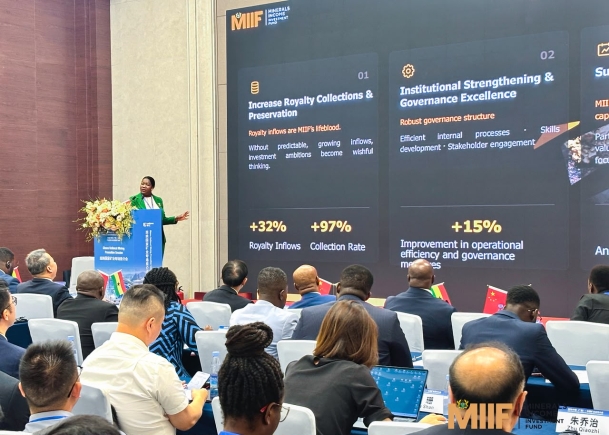
That challenge framed remarks by Minerals Income Investment Fund (MIIF) Chief Executive Officer Justina Nelson at the 2026 China (Guangxi)–ASEAN Mining Cooperation Conference.
She pointed to opportunities for foreign investors to work with Ghanaian companies across new and existing mining projects, joint ventures with contract miners, and the domestic manufacture of mining supplies. Possible processing investments include alumina refining, iron and steel production, smelting and battery-grade manganese.
The pitch reflects a broader ambition: to capture more of the value generated by the country’s mineral endowment before it leaves Ghana in the form of unprocessed or lightly processed commodities.
But the size of a resource estimate does not, by itself, make an investment viable. The commercial case must also account for infrastructure, energy, financing, technology, skilled workers and reliable access to markets.
Nelson cited estimated deposits of about 920 million tonnes of bauxite, more than 1.7 billion tonnes of iron ore at Sheini Hills and around 5.2 million tonnes of manganese.
She also pointed to graphite exploration opportunities and further potential in the Cape Coast lithium belt. These figures indicate the scale of geological interest; they should not be read as proof that all the material can be mined economically or processed profitably.
That distinction matters for prospective investors and the public. Exploration findings and resource estimates are only early stages in the path to production. Projects require further technical and commercial work to establish how much material can be extracted, at what cost, and with what environmental and social consequences.
For large processing facilities, investors must also be confident that power, transport, water and feedstock will be available at the scale and price required.
The potential case for local industry is nevertheless significant. Nelson cited an integrated iron and steel industry as a possible way to replace about US$528 million in annual iron and steel imports, using 2023 data.
The figure points to an import-substitution opportunity, but it is not a forecast of savings or a guarantee that a Ghanaian plant would be competitive. That would depend on the cost and consistency of local ore, reliable energy, transport links, capital costs and the ability to supply buyers at competitive prices.
The same questions apply to the other processing ambitions. Refining bauxite into alumina or producing battery-grade manganese could retain more value locally, but the investment case needs to be assessed against global competition, technology requirements and the size of dependable markets.
A plant built on optimistic demand assumptions could become a costly underused asset. A project that secures long-term customers, suitable infrastructure and clear financing could instead anchor a wider industrial supply chain.
Partnerships may help close that gap, but their design will determine who benefits. Foreign investors can bring capital, technical expertise and access to markets. Ghanaian firms can contribute local knowledge, workforce capacity and links to communities and suppliers.
Joint ventures and supply contracts can connect those strengths. Yet local participation will be limited if domestic firms are confined to low-margin services while the most valuable technical work, procurement and processing take place elsewhere.
The government’s task is therefore not simply to attract capital. It is to create conditions in which investment builds durable domestic capability. That includes helping local suppliers meet the standards required by mining companies, developing technical skills, and making procurement opportunities accessible to Ghanaian businesses.
It also means spelling out how projects will handle environmental obligations, mine closure and community impacts.
MIIF has a potential role in making projects more investable. In earlier remarks on African mining finance, Nelson said: “There is no shortage of capital globally. What Africa needs are de-risked, feasibility-ready projects that investors can confidently support.”
The point is relevant to Ghana’s mineral ambitions: investor interest alone cannot substitute for detailed feasibility work, credible governance and a clear route to commercial returns.
The fund’s mandate to maximise the value of mineral royalty and dividend income and support the long-term monetisation of Ghana’s mineral wealth places it at the intersection of public returns and investment promotion.
That position could allow it to help prepare projects, bring partners together or participate in financing structures. It also makes transparency essential. Public reporting should make clear what the fund invests in, what risks it takes, how returns are measured and how benefits accrue to the state.
The opportunity comes as royalty receipts are becoming an important part of the public revenue picture. MIIF recorded GH¢5.3 billion in mineral royalty receipts in the first half of 2026 and set a full-year target of GH¢9 billion.
Those flows matter, but the larger industrial question is whether mining can generate more than royalties: productive local suppliers, technical jobs, processing capacity and a broader tax base.
There are signs that the value-chain question is being considered beyond the conference circuit. MIIF has been assessing possible local industrial participation in areas of the mining supply chain, including consumables used by mines.
That kind of investment may be less visible than a refinery or steelworks, but it can be a practical route to building manufacturing experience and retaining more procurement spending in Ghana.
The challenge is to connect such initiatives to a coherent industrial strategy. Ghana needs to identify which parts of the mineral value chain can be competitive domestically, what infrastructure they require, and how public and private capital can be combined without shifting excessive risk to taxpayers.
A partnership should be judged by its financing terms, local economic contribution, environmental safeguards and ability to operate commercially—not only by the size of its announced investment.
For Chinese and other international firms, Ghana’s resource base and policy signals may be attractive. Deputy Lands Minister Yusif Sulemana said the country’s laws and policies are open to investment and encouraged companies to explore opportunities.
Turning that invitation into operating projects will require predictable rules, timely approvals and a credible process for resolving disputes.
Ghana’s mineral wealth could support a deeper industrial base, but geological abundance is only a starting point. The test for the partnerships now being promoted is whether they deliver viable projects that expand domestic skills and suppliers, process more material locally, and generate returns that endure beyond commodity-price cycles.
Without those outcomes, the country may attract mining capital while leaving much of the value chain and its economic resilience elsewhere.

