

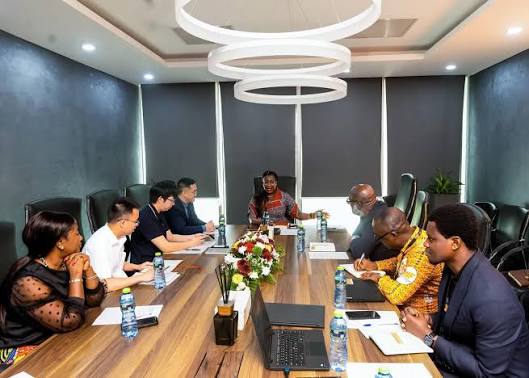

- MIIF, Zijin and Financial Institutions Join Effort to Restore Subri Forest Land
Ghana’s Minerals Income Investment Fund and Forestry Commission have launched a two-year initiative to restore degraded land in the Subri River Forest Reserve, offering an opportunity to demonstrate how mineral wealth can finance environmental recovery rather than merely compensate for damage after extraction.
The project is supported by Zijin Golden Ridge Limited, Ghana International Bank and three other financial institutions, working with the Ministry of Lands and Natural Resources, Forestry Commission and Environmental Protection Authority. It will cover site preparation, seedlings, planting, monitoring, community engagement and environmental, social and governance reporting.
The partnership is important because the Subri reserve is not an empty landscape awaiting trees. It is a complex ecological and economic system affected by illegal mining, illegal logging, farming pressure and earlier extraction. Restoration must therefore address the causes of degradation while rebuilding biodiversity, soil health and community stewardship.
MIIF Chief Executive Justina Nelson framed the initiative as part of the Fund’s responsibility to manage Ghana’s mineral interests sustainably. “Value creation must go hand in hand with environmental responsibility,” she said, arguing that restoration should protect biodiversity and enable communities to benefit from natural resources across generations.
That principle goes to the heart of Ghana’s mining debate. Mineral revenues are finite, while environmental damage can outlive mines and revenue cycles. If even a portion of the income generated from minerals is invested successfully in rehabilitating damaged ecosystems, MIIF can broaden its national value proposition beyond financial returns.
The immediate project is modest relative to the scale of Ghana’s degraded landscapes. The announcement says 50 acres will be rehabilitated, although an earlier MIIF statement reported that the Forestry Commission had allocated 50 hectares. Since 50 hectares equal roughly 124 acres, the partners should reconcile this discrepancy before implementation begins.
Clarity is not a cosmetic requirement. The project’s budget, number of seedlings, planting density, maintenance obligations and eventual cost per hectare depend on the confirmed land area. Inconsistent baseline information will make it difficult for citizens to measure delivery or compare the programme with other restoration investments.
The partners should publish the memorandum of understanding or a project summary setting out the exact boundaries, financing commitments, species mix, survival targets and institutional responsibilities. ESG reporting becomes useful only when commitments can be tested against clear indicators and independently verified results.
Tree planting is the most visible stage of reforestation, but it is rarely the most difficult. Seedlings must survive drought, fire, invasive plants, grazing and renewed encroachment. A successful project should consequently report survival rates after the first and second years rather than merely publicising how many seedlings entered the ground.
Species selection will also determine whether the intervention restores an ecosystem or creates a plantation. Native species can support wildlife, strengthen ecological connectivity and improve resilience. Commercial species may provide economic returns and reduce pressure on natural forests, but an excessive dependence on monocultures can limit biodiversity and expose the site to disease or climate risks.
The Forestry Commission’s technical role is therefore central. Under the memorandum, it will provide expertise and supervise implementation. That responsibility should include ecological assessment, seedling quality control, fire management, replacement planting and long-term monitoring after the two-year project formally ends.
Community participation will be equally important. People living around Subri must have incentives to protect restored areas after external funding and ceremonial attention decline. Nursery work, planting, beekeeping, agroforestry and paid monitoring can turn neighbouring communities into economic partners rather than treating them as threats to conservation.
Land-use arrangements must nevertheless be explicit. Where farmers occupy degraded reserve areas, restoration can create tension if livelihoods are displaced without consultation or alternatives. Genuine engagement should identify affected users, establish permitted activities and provide accessible grievance processes before planting begins.
Zijin’s participation strengthens the mining connection. The company entered Ghana after acquiring Newmont’s Akyem mine for US$1 billion and says it has already reforested 317 acres within the Ajenjua Bepo and Kweikaro reserves as part of its environmental obligations.
Zijin Golden Ridge Chief Executive Leon Zhang described restoration as “a long-term responsibility, not a one-time gesture”. That commitment should be reflected in multi-year financing and disclosed outcomes. Corporate involvement is most credible when support continues through maintenance and verification, rather than ending when seedlings are planted.
The distinction between voluntary corporate social responsibility and mandatory environmental obligations must also remain clear. Mining companies are legally responsible for rehabilitating areas affected by their operations. Contributions to Subri should not substitute for mine-site reclamation, biodiversity offsets or other conditions attached to environmental permits.
Similarly, MIIF must protect its core mandate. The Fund exists to maximise and manage mineral income and state interests for long-term national benefit. Environmental investment can support that purpose, but spending should follow approved criteria, transparent budgets and measurable returns rather than becoming an undefined channel for corporate philanthropy.
Those returns need not be purely financial. Restored forests protect watersheds, store carbon, reduce erosion, support biodiversity and sustain livelihoods. These benefits have economic value even when they do not generate immediate cash flows. Credible measurement could also position future projects for climate or carbon finance, provided claims are conservative and independently verified.
Coordination with existing Subri initiatives is essential. The reserve has already hosted planting programmes involving the Forestry Commission, European Union, civil-society organisations and private companies. More than 100,000 seedlings were planted during a 2026 Tree for Life exercise, while four European Union-supported projects aim to restore degraded landscapes and strengthen livelihoods.
The new partnership should map these interventions to prevent duplication and fragmented monitoring. A common restoration database could record project boundaries, species, funders, planting dates, survival rates and responsible institutions. Satellite imagery and field inspections could then show whether forest cover and ecological quality are genuinely improving.
If reporting focuses mainly on partnerships, ceremonies and seedlings planted, the initiative will add another attractive announcement to Ghana’s reforestation history without changing the landscape. MIIF and its partners have correctly linked mineral value with environmental responsibility. They must now prove that the link can produce a living forest across Ghana’s mining regions nationwide.

