


- Milo Remains Ghana’s Most Chosen Brand but Kivo Records Fastest Growth – Study
Local and regional brands accounted for 84 per cent of consumer choices among Ghana’s 250 leading fast-moving consumer goods brands in 2025, highlighting the advantage of affordability and local relevance in an increasingly competitive household market.
Ghanaian households made an estimated 4.192bn brand choices during the year, according to the Ghana Brand Footprint 2026 report by Worldpanel by Numerator.
Household spending on fast-moving consumer goods increased 12.9 per cent, but the gains were unevenly distributed. While 69 per cent of the top 250 brands recorded higher consumer spending, only 52 per cent increased their Consumer Reach Points.
The divergence suggests that higher prices and changes in the mix of goods purchased may have contributed significantly to spending growth. It also indicates that increased consumer expenditure did not automatically translate into more households buying a brand or purchasing it more frequently.
“Ghanaian shoppers remain highly conscious of the value they get from every purchase,” said Ifedayo Akinyele, Country Manager at Worldpanel by Numerator Ghana.
“For brands, this means growth cannot rely on higher spend alone. The opportunity is to remain relevant to households, reach more shoppers and give them compelling reasons to choose the brand again.”
The report measures brand performance using Consumer Reach Points, or CRPs. The metric combines the number of households purchasing a brand, how frequently those households buy it and the number of households in the market.
It is therefore a measure of how often consumers choose a brand, rather than the value of its sales or its share of industry revenue.
That distinction is important. A brand selling a large quantity of affordable products can generate more Consumer Reach Points than one earning greater revenue from a smaller number of higher-priced purchases.
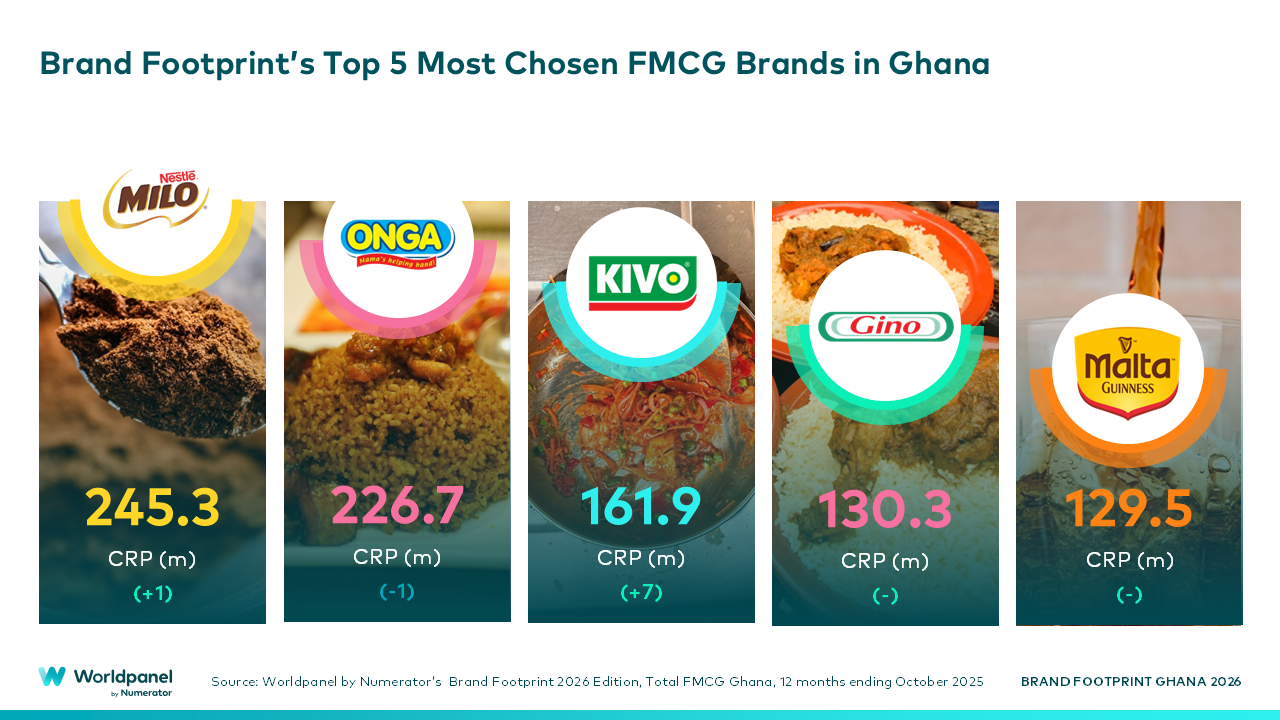
Milo remained Ghana’s most chosen fast-moving consumer goods brand, generating 245.3 million Consumer Reach Points.
Onga placed second with 226.7m, leaving a gap of 18.6m consumer choices between the two leading brands.
Kivo recorded the biggest movement in the ranking, climbing seven positions to third with 161.9 million Consumer Reach Points.
Gino ranked fourth with 130.3m, while Guinness Malta completed the five leading brands with 129.5m.
The presence of Milo at the top demonstrates that local and regional dominance does not exclude multinational products. Brands with a long history, extensive distribution and a strong connection to local consumption habits can remain deeply embedded in household purchasing decisions regardless of their ownership.
But Kivo’s performance was the report’s most striking growth story.
Its Consumer Reach Points increased 112.8 per cent year on year, the fastest growth among Ghana’s 50 leading brands. It reached 85.9 per cent of Ghanaian households, suggesting that its advance was built on mass-market penetration rather than reliance on a narrow consumer segment.
Kivo’s rise reflects the power of combining familiar products with accessible pricing and broad availability.
In a market where many purchases are made in small quantities and through fragmented retail channels, distribution can be as important as advertising. A brand that is known but unavailable at the point of purchase cannot convert awareness into Consumer Reach Points.
Kivo’s expansion therefore provides a wider lesson for manufacturers: growth depends on getting products into more households and ensuring that consumers encounter them frequently enough to buy them again.
The 12.9 per cent increase in household FMCG expenditure appears positive for manufacturers, distributors and retailers. But it should not be read automatically as evidence that households bought 12.9 per cent more goods.
Nominal expenditure can rise because consumers purchase greater volumes, move towards more expensive products or pay higher prices for approximately the same basket.
The difference between the proportion of brands recording spending growth and those increasing their Consumer Reach Points points to a market in which part of the expansion may have been price-led.
About 69 per cent of leading brands attracted more consumer expenditure, but only 52 per cent were chosen more often when household penetration and purchasing frequency were taken into account.
For companies, revenue growth caused mainly by price increases may prove less durable than growth supported by a larger customer base.
Consumers can respond to sustained price pressure by moving to smaller pack sizes, buying less frequently, switching brands or abandoning discretionary products.
The strongest position is therefore held by brands that can increase spending, penetration and repeat purchases simultaneously.
Among brands that grew their Consumer Reach Points by more than 2.5 per cent, roughly 62 per cent increased both household penetration and purchasing frequency.
This means the majority of the stronger performers did not depend exclusively on existing customers buying more. They also recruited new households.
The 84 per cent share captured by local and regional brands reflects their strength in adapting products, packaging and prices to Ghanaian consumption patterns.
Local brands may be better positioned to respond quickly to changing tastes, distribute through informal retail networks and offer pack sizes aligned with household cash flows.
They may also benefit from lower logistical complexity and a more direct understanding of consumers outside Ghana’s largest urban centres.
However, the 84 per cent figure represents a share of Consumer Reach Points among the top 250 brands, not necessarily 84 per cent of FMCG revenue.
A multinational brand may record fewer individual choices but generate more value per transaction, while an affordable domestic product may be selected more frequently.
The report therefore demonstrates the reach of local and regional brands rather than establishing their precise share of industry sales.
It nevertheless challenges the assumption that multinational scale guarantees consumer dominance. Ghana’s market rewards familiarity, availability and price relevance — advantages that local companies can possess even when their advertising budgets are smaller.
Despite the billions of annual brand choices, the Ghanaian FMCG market remains fragmented.
Worldpanel found that 82 per cent of the top 250 brands reached fewer than half of Ghanaian households during the year.
This creates significant room for expansion but also exposes the limits of current distribution and market penetration.
A brand can grow by persuading existing buyers to purchase more frequently, but the larger opportunity for most companies lies in recruiting households that do not currently buy their products.
“Ghana offers considerable room for brands to grow, but that growth depends on understanding how household priorities are changing,” Mr Akinyele said.
“The brands that can combine accessibility, relevance and strong consumer reach will be best positioned to win more choices.”
For manufacturers, achieving that combination will require more than marketing.
It involves setting prices that households can absorb, developing pack sizes suited to different income groups and building distribution networks that extend beyond modern supermarkets into traditional shops, open markets and neighbourhood retailers.
For retailers, the rankings show that household budgets remain contested at the level of individual purchasing decisions. A consumer may recognise several brands but choose the one that is available, affordable and appropriate at that moment.
The Brand Footprint findings ultimately portray a market that is expanding in value but remains unforgiving.
Households spent more in 2025, yet almost half of Ghana’s leading brands failed to increase how often they were chosen.
Milo’s continued leadership shows the value of long-term household familiarity. Kivo’s rapid ascent demonstrates what can happen when reach, pricing and relevance converge.
The deeper message for the rest of the market is that rising expenditure can enlarge the revenue pool, but it cannot guarantee a brand’s share of it.

