

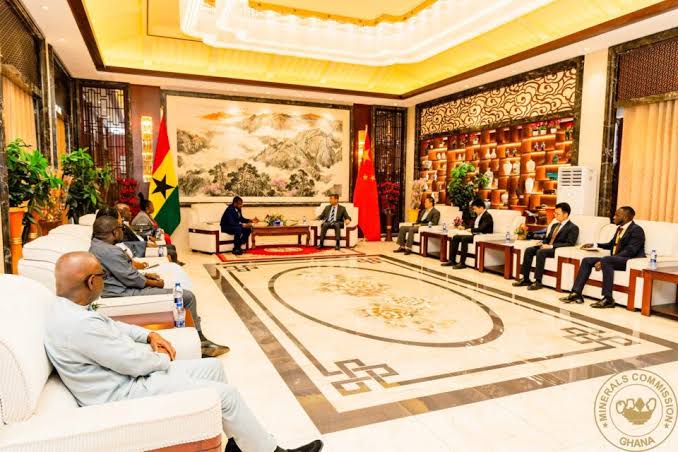

- Minerals Commission, Chinese Embassy Deepen Cooperation on Sustainable Mining
Ghana and China have renewed their commitment to responsible mining cooperation, with both countries placing greater emphasis on regulatory compliance, environmental protection, technical collaboration and long-term investment in the extractive sector.
The commitment followed a meeting between Isaac Andrews Tandoh, chief executive officer of the Minerals Commission, and China’s Ambassador to Ghana, Tong Defa.
Their discussions focused on strengthening cooperation in mineral resource development while ensuring that mining companies operate within Ghana’s legal and environmental framework.
The engagement comes as Ghana intensifies efforts to formalise mining activity, curb illegal operations and improve governance across a sector that remains central to export earnings, employment and public revenue.
Mr Tandoh said the Minerals Commission was committed to maintaining a transparent and predictable regulatory environment capable of attracting responsible investment while protecting the country’s mineral resources.
He argued that stronger institutions and consistent compliance with mining regulations were necessary to ensure that mineral wealth produced broader economic benefits rather than environmental degradation and social conflict.
The meeting also covered technical cooperation, knowledge transfer and capacity-building initiatives intended to raise operational standards within the mining industry.
For Ghana, these areas are important because stronger regulatory oversight alone may not be enough to improve outcomes if institutions lack the technology, data and technical skills required to monitor increasingly complex mining operations.
Modern exploration, production tracking, environmental monitoring and mine-site rehabilitation increasingly depend on specialised technologies and reliable information systems.
Cooperation with international partners could therefore improve the capacity of Ghanaian regulators to verify production, monitor environmental obligations and assess whether operators are meeting licensing conditions.
Ambassador Tong reaffirmed China’s support for Ghana’s sustainable mining objectives and said Chinese authorities continued to encourage companies operating in the country to comply with local laws, environmental requirements and responsible-business standards.
He also indicated that China was prepared to work with Ghana to promote modern mining technologies, improve operational efficiency and increase value creation within the mineral sector.
The renewed partnership is significant because Chinese companies and nationals have played visible roles in Ghana’s mining economy, including in areas where concerns have arisen over illegal mining and environmental damage.
The latest engagement therefore places a premium on translating diplomatic commitments into measurable compliance at the operational level.
For the partnership to strengthen public confidence, regulatory agencies will need to demonstrate that companies are being held to the same standards regardless of ownership or nationality.
This will require effective licensing, inspections, environmental enforcement and sanctions where violations occur.
The cooperation also provides an opportunity to deepen value addition.
Ghana has long sought to move beyond the export of raw minerals towards refining, processing and manufacturing activities that retain more economic value domestically.
Chinese investment could support this transition through capital, technology and industrial expertise, particularly where projects are linked to local supply chains, skills development and employment.
However, the quality of investment will matter as much as its volume.
Projects that merely expand extraction without strengthening local capabilities may increase output without significantly transforming the economy.
A more developmental partnership would include technology transfer, local procurement, training and support for Ghanaian firms to participate in higher-value parts of the mining supply chain.
Mining activity has contributed to the pollution of water bodies, land degradation and disruption of farming communities in parts of Ghana.
Responsible mining therefore requires more than compliance with production and tax obligations. It must include effective reclamation, protection of water resources and meaningful engagement with host communities.
The Minerals Commission’s emphasis on predictable regulation could help investors plan with greater certainty, but predictability must be matched by enforcement.
Weak application of existing laws could undermine the credibility of the governance drive and create an uneven playing field for companies that comply fully with environmental and operational standards.
The Ghana–China engagement also reflects a broader shift in global mining partnerships.
Governments are increasingly expected to assess foreign investment not only by the capital it brings but also by its environmental, technological and social impact.
For Ghana, the renewed cooperation offers a chance to align Chinese participation in mining with national objectives involving formalisation, industrialisation and sustainable development.
Statements of support will need to be followed by stronger monitoring, transparent reporting and clear evidence that mining companies are complying with Ghanaian law.
If those commitments are enforced, the partnership could strengthen investor confidence and support a more productive relationship between mineral development, environmental protection and economic growth.

