

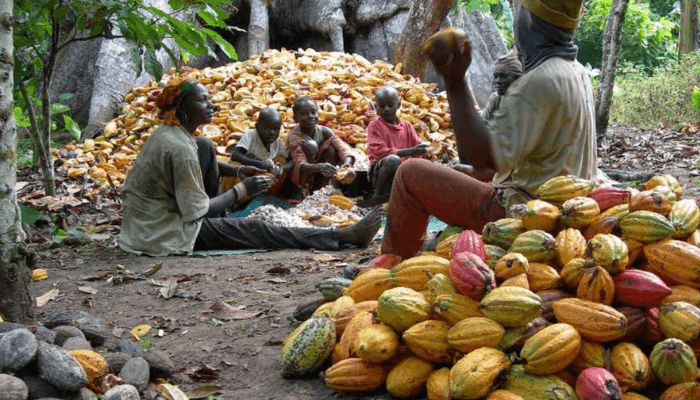

- Ivory Coast Freezes Cocoa Price at CFA1,200 as Farmers Absorb Global Market Reversal
Ivory Coast has kept its cocoa farmgate price at CFA1,200 per kilogramme for the 2026/27 main crop, leaving farmers facing a dramatic reversal from last year’s record producer price and exposing the difficult economics of protecting growers when international commodity markets turn sharply.
Agriculture Minister Bruno Nabagne Kone announced the decision as the world’s largest cocoa-producing country opened its main harvest season, maintaining the same producer price introduced for the mid-crop rather than increasing it in response to the recent recovery in international cocoa prices.
“It has been decided that a kilogram of well-fermented, well-dried, well-sorted cocoa will be purchased at the farm gate price of 1,200 francs per kilo,” Mr Kone said.
The figure is 57.14% below the record CFA2,800 per kilogramme offered at the beginning of the previous main crop, when international cocoa prices were still being driven by an historic supply squeeze. For farmers who adjusted income expectations to those extraordinary prices, the new season represents a severe reset.
“We were expecting the farm-gate price to go back up a bit, either to 2,000 or to 1,800; that was the hope,” cocoa farmer Thibaut Yoro said. “Unfortunately, it’s still stuck at 1,200. Well, they’re the ones who’ve done their calculations. Honestly, it’s a disappointment in a way. But what can we do about it?”
The government’s decision is best understood not as another price cut but as an attempt to prevent a repeat of the distortion that emerged when domestic producer prices became increasingly disconnected from the international market.
Ivory Coast had already reduced the farmgate price sharply for the mid-crop after exporters struggled to commercialise cocoa purchased at elevated domestic prices once global prices fell. That episode exposed the vulnerability of a system in which the state guarantees farmers a producer price while international cocoa values remain highly volatile.
When the guaranteed price is supported by export values, the system can work relatively smoothly. But when the producer price rises substantially above what exporters can recover from international buyers, stocks can accumulate, purchases can slow and the state may eventually be forced to absorb part of the adjustment.
That appears to be the economic logic behind the CFA1,200 decision. The government is prioritising a price that can be reconciled more easily with forward sales and international market conditions rather than attempting to recreate last year’s exceptional farmgate returns.
For farmers, however, the arithmetic is painful. The difference between CFA2,800 and CFA1,200 is CFA1,600 for every kilogramme sold, meaning a grower marketing one tonne receives CFA1.60 million less in nominal revenue than under last year’s peak producer price.
That reduction matters because cocoa farming is not a costless activity. Labour, pesticides, fertiliser, pruning, disease management and farm rehabilitation all require cash, while ageing trees and increasingly variable weather conditions add to production risks.
A lower farmgate price may therefore solve a marketing problem while creating a production problem. If farmers cannot generate enough income to maintain their plantations or finance inputs, the resulting underinvestment could weaken future yields and recreate the supply constraints that previously pushed global prices higher.
That is the central tension in Ivory Coast’s cocoa economy: the farmgate price must remain low enough for the marketing system to function, but high enough to preserve the economic incentive for farmers to keep producing.
The stakes are national. Cocoa supports millions of livelihoods, remains central to export earnings and plays a major role in rural incomes, meaning a sharp fall in producer prices can feed through into household consumption and local economic activity far beyond cocoa farms themselves.
At the same time, artificially maintaining a producer price above international market economics can create fiscal and commercial costs. The government is therefore balancing farmer welfare against the sustainability of the country’s export system.
The situation will be watched closely in neighbouring Ghana. The two countries together account for a dominant share of world cocoa production and both operate state-influenced producer-pricing systems, meaning large differences in farmgate prices can create incentives for informal cross-border movement of beans.
That makes producer pricing a regional as well as national policy issue. Ghana and Ivory Coast must both find ways to protect farmers without setting prices so far above market fundamentals that official purchasing and export channels become financially unstable.
The wider lesson is that a commodity boom can be politically seductive. When international prices surge, governments face intense pressure to pass as much of the windfall as possible to farmers.
But cocoa is largely sold forward, and the price available to exporters at any moment may reflect contracts signed months earlier rather than current futures-market quotations. A recovery in spot or futures prices therefore does not automatically mean authorities can immediately raise the producer price without creating mismatches elsewhere in the system.
That explains why farmers can watch international cocoa prices recover while their own guaranteed price remains unchanged. The farmgate price reflects not only today’s market but also forward sales, exchange rates, marketing costs, stabilisation mechanisms and the distribution of risk between government, exporters and producers.
The longer-term solution is consequently bigger than repeated adjustments to the farmgate price. Producing countries need to capture more value beyond the raw bean.
Ivory Coast has been expanding domestic processing and is targeting a higher share of locally processed cocoa by 2030. Turning beans into liquor, butter, powder and other intermediate products can retain more industrial activity, employment and export value within the country.
But processing is not an immediate substitute for farmer income. A stronger domestic cocoa-processing industry can improve national value capture, but it will not automatically guarantee farmers a sustainable return unless purchasing arrangements and productivity also improve.
The more durable answer therefore requires higher yields, lower production costs, better farm rehabilitation, stronger access to finance and pricing mechanisms capable of smoothing extreme market cycles without creating unsustainable obligations for the state.
That is why Ivory Coast’s CFA1,200 decision represents a fragile equilibrium rather than a victory for either side.
Exporters gain a more commercially manageable producer price. Government reduces the risk of sustaining a price disconnected from market realities. Farmers absorb much of the downside after having briefly participated in one of cocoa’s most extraordinary global price booms.
The policy question is whether the new equilibrium can preserve production.
A cocoa economy cannot be considered stable merely because beans can once again be sold profitably abroad. It must also generate enough income at the farm gate to finance the next harvest and keep farmers investing in the trees on which the entire industry depends.
Ivory Coast has chosen market stability over another attempt to shield growers from the commodity cycle. The harder question is whether CFA1,200 per kilogramme is sustainable not only for the cocoa market, but for the farmer who keeps that market supplied.

