


- MTN Ghana Bets on Fibre and AI as Data Consumption Hits 19.30GB Per User
MTN Ghana is stepping up investment in fibre infrastructure and artificial intelligence-powered network management as surging data consumption reshapes the economics of the country’s telecommunications industry and pushes the operator further away from its traditional dependence on voice services.
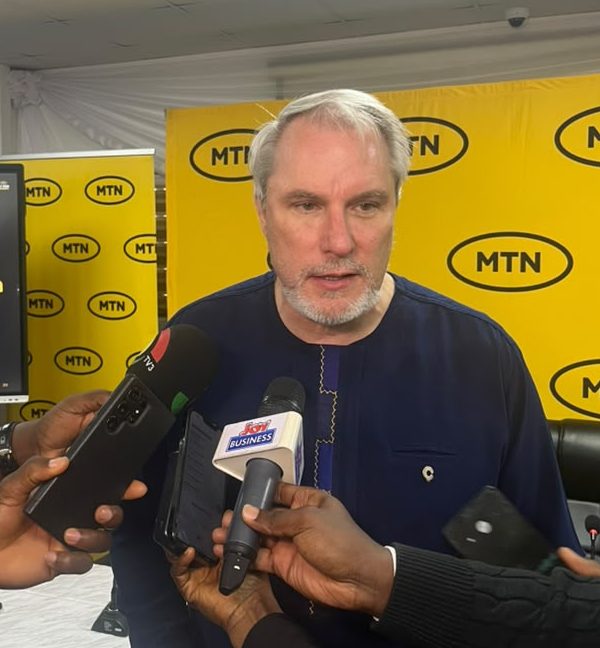
Stephen Blewett, Chief Executive Officer of MTN Ghana, said customers on the company’s network now consume an average of 19.30GB of data each month, reflecting what he described as strong demand for connectivity driven increasingly by business activity as well as entertainment.
Speaking at MTN Ghana’s “Facts Behind the Figures” engagement at the Ghana Stock Exchange in Accra, Mr Blewett said the company’s response would involve deeper fibre deployment, stronger mobile coverage and greater use of artificial intelligence to optimise network performance.
“I think in terms of data, our focus is how do we give people the best possible experience? Because that’s the number one question I get from people — how do I get the best experience?” he said. “So we’re investing heavily in fibre. We dropped the price of fibre, as you know, so we’re giving people more access to fibre.”
The strategy points to an important transformation in MTN Ghana’s business model. Data is no longer simply an additional telecommunications product; it is increasingly the infrastructure through which consumers communicate, businesses transact and a growing range of digital services are delivered.
Fibre is central to that transition because it can support significantly heavier data consumption while delivering more reliable fixed broadband. Lower prices could help MTN expand access beyond large companies and higher-income households as demand grows for cloud services, streaming, online commerce, digital education and remote work.
“Why fibre? Because it gives you a very rich experience with high data usage. You’re always going to have that with fibre,” Mr Blewett said.
For businesses, the economic significance extends well beyond faster internet. Connectivity is increasingly tied to payments, banking, inventory management, customer acquisition, advertising and communication, making broadband reliability an important component of productivity.
Mr Blewett said the growth in consumption was not being driven solely by entertainment. “People in Ghana are using an average 19.3 gigabytes per month. So it means there’s an appetite for this,” he said. “And people are not only using it for entertainment, they’re using it for business, etc. So we’re going to support people to grow that.”
MTN is simultaneously turning to artificial intelligence to manage increasing traffic on its mobile network. “When it comes to the rest of mobile data, [it is about] giving more coverage and improving our network, using AI to ensure that we look after our network in a way that gives people the best possible experience,” Mr Blewett said.
The technology could help the operator analyse network traffic, anticipate congestion, identify faults and determine where capacity should be expanded. That becomes increasingly important as rising data usage places greater pressure on infrastructure and forces operators to extract more efficiency from capital-intensive networks.
The investment push comes as voice becomes less central to MTN Ghana’s revenue mix. Voice revenue declined 1.40% year-on-year to GH¢1.90 billion in the first half of 2026, reflecting the continued migration of communication towards internet-based applications such as WhatsApp.
That decline does not necessarily indicate weakening customer engagement. MTN Ghana’s subscriber base increased 8.50% to 32.80 million, suggesting consumers remain deeply connected to the network but are changing how they communicate and consume services.
Digital services are benefiting from that shift. Revenue from the segment increased 98.00% to GH¢377 million, supported by gaming, video and other digital content products.
Mobile Money provides another major growth pillar. Revenue increased 23.30% to GH¢3.50 billion, while active users reached 18.30 million. Transaction volumes rose 23.30%, with transaction values increasing 44.40%, underscoring the growing role of digital payments in Ghana’s economy.
“The continued expansion of our fintech ecosystem, together with the successful structural separation completed in the first quarter, positions the business well to capture future opportunities arising from increasing financial inclusion and the digitisation of payments across the market,” Mr Blewett said.
The combination of connectivity and financial services gives MTN a powerful position within Ghana’s digital economy. Its network provides the infrastructure, smartphones provide the interface, data enables access and Mobile Money allows customers to transact within the same expanding ecosystem.
But greater consumption also creates an infrastructure challenge. Average usage of 19.30GB per customer means MTN must continually expand capacity simply to maintain service quality as customer behaviour becomes more data intensive.
That leaves the company balancing three competing demands: affordability, investment and monetisation. Lower fibre prices can accelerate adoption, but fibre deployment, mobile-network expansion and technology upgrades require significant capital.
The broader macroeconomic environment therefore matters because telecommunications equipment is highly capital intensive and much of it is exposed to foreign-exchange movements.
Still, the strategic direction is increasingly clear. Ghanaian consumers are using more data, businesses are becoming more dependent on digital connectivity and telecommunications operators are evolving from sellers of airtime into providers of digital infrastructure.
For MTN Ghana, fibre and AI therefore sit at the centre of its next phase of growth. The question is no longer simply how many subscribers the company can connect, but how much economic activity those connections can support and whether network investment can keep pace with a customer base consuming data faster than ever before.

