


- President Mahama Proposes New Compact with Global Philanthropy as Aid Landscape Shifts
President John Dramani Mahama has proposed a new compact between Ghana and global philanthropic organisations, calling for a shift from fragmented, short-term projects towards partnerships that strengthen national institutions and leave behind lasting development capacity.
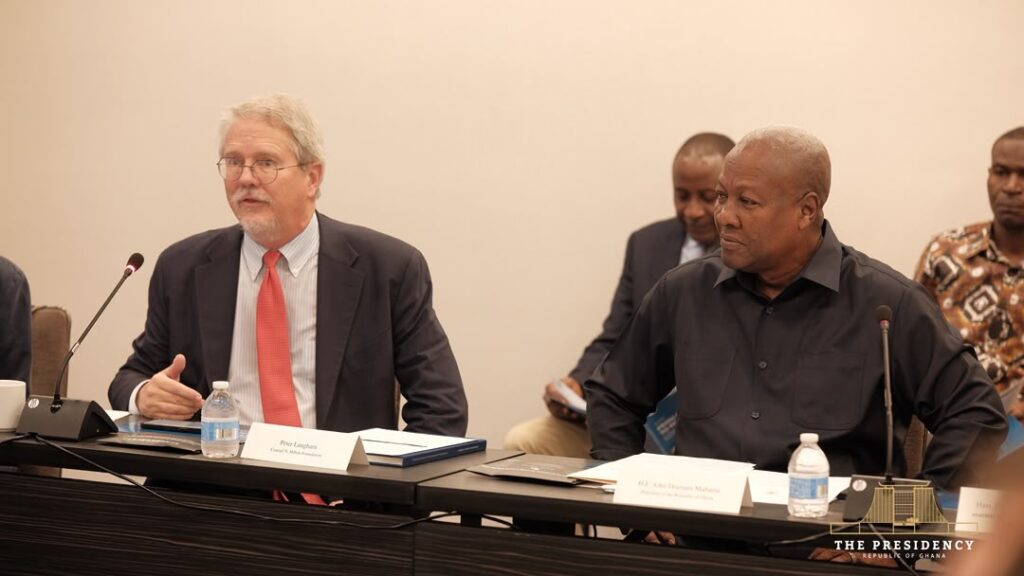
Speaking at a presidential funders’ roundtable in New York, Mr Mahama said changing political priorities and uncertainty surrounding traditional development finance required countries in the Global South to exercise greater control over their development agendas.
The meeting brought together representatives of about 20 United States-based philanthropic organisations, including the Gates Foundation, Open Society Foundations, Rockefeller Foundation, Hilton Foundation and Ford Foundation.
The roundtable was organised by the Open Society Foundations on the sidelines of the 81st United Nations General Assembly and focused on developing a new model of engagement between Ghana and global foundations.
“Development finance can change quickly,” Mr Mahama said. “Funding priorities shift, and political decisions taken thousands of miles away can have immediate consequences for programmes, institutions and communities in our countries.”
His proposal reflects a wider reordering of international development finance, as governments confront tighter aid budgets, competing geopolitical demands and pressure to demonstrate that external assistance produces durable results.
For Ghana, the central question is whether philanthropy can do more than temporarily fill gaps left by declining or unpredictable development assistance.
Mr Mahama’s proposition is that foundations should help countries build the institutions, evidence and programme pipelines required to mobilise larger pools of public, private and multilateral finance.
The approach is not presented simply as a search for new money. It is an attempt to redefine the relationship between external funders and national governments by shifting attention from isolated projects to the capabilities required to implement development policy at scale.
The President said Africa already had a long-term development vision through the African Union’s Agenda 2063, but translating continental ambition into practical outcomes remained the greater challenge.
“That requires institutions that can execute, the ability to mobilise and manage resources well, stronger negotiating capability, programmes that can attract the right forms of finance, and systems that allow us to account properly for results and learn from them,” he said.
The argument addresses one of the persistent weaknesses of development assistance.
Externally funded projects can deliver important services, but they often operate through separate implementation structures, procurement arrangements, reporting systems and funding cycles. When the funding ends, the specialist personnel, institutional knowledge and delivery systems created for the programme may disappear with it.
Such fragmentation can also impose significant administrative costs on governments. Ministries and agencies may be required to satisfy multiple reporting and due-diligence requirements for relatively small grants, diverting limited technical staff from their core responsibilities.
Mr Mahama warned that the multiplication of separate funding arrangements could burden national institutions rather than strengthen them.
Under his proposed model, philanthropic organisations would align their interventions more closely with Ghana’s priorities and collaborate on larger, more coherent programmes.
“The value of an intervention may lie in the institution that becomes stronger, the evidence that leads to a better public decision, the programme that becomes ready for larger-scale financing, or an approach that proves itself and can then be taken further,” he said.
Philanthropic capital can occupy a space that governments, commercial investors and conventional development lenders may be reluctant to enter. Foundations can support policy experimentation, research, public goods, early-stage programme preparation and social interventions that may not generate an immediate financial return.
This flexibility gives philanthropy the potential to absorb the initial risk of developing projects before they become suitable for multilateral, public or private financing.
But the success of such an approach will depend on whether philanthropic resources genuinely build national capabilities or merely create another layer of externally driven programmes.
At the centre of the proposed framework is the Millennium Development Authority, which the President has designated as Ghana’s focal institution for international philanthropic partnerships and grant co-ordination.
MiDA was established to manage Ghana’s programmes under the United States Millennium Challenge Corporation and has experience operating under demanding international standards for procurement, financial management and project implementation.
“MiDA gives us an institution with experience of working to demanding international standards of procurement, financial management, delivery and accountability,” Mr Mahama said.
Under the new arrangement, MiDA would serve as a central entry point for global foundations seeking to work with the Ghanaian government. It would connect funders with the relevant ministries and agencies while involving the Accra Reset team, civil society organisations and other delivery partners.
The decision could help Ghana reduce duplication and provide foundations with a more predictable route for initiating and managing partnerships.
A central gateway could also give the government a clearer view of philanthropic flows, enabling it to identify funding gaps, prevent overlapping projects and measure how external grants contribute to national priorities.
Yet centralisation also carries risks. If the new system becomes bureaucratic or politically controlled, it could slow project approval and marginalise organisations with specialised knowledge or strong community relationships.
MiDA will therefore have to balance co-ordination with flexibility. Its credibility will depend on transparent project selection, clear reporting, professional independence and its ability to connect funders with the institutions best equipped to deliver results.
Mr Mahama linked the proposal to the “Accra Reset”, an initiative built around greater country ownership of development policy.
He argued that sovereignty in development could not be reduced to governments demanding fewer external conditions. Greater national control must be accompanied by the institutional discipline to manage funds, implement programmes and account for results.
“We cannot ask our partners to give us greater room to lead while avoiding the difficult work that leadership requires,” he said.
The President said country leadership demanded clearer priorities, improved policy co-ordination, stronger financial management and institutions capable of delivering measurable outcomes.
At the same time, he challenged philanthropic organisations to consider whether their funding models strengthened national institutions or unintentionally weakened them through parallel systems.
Country ownership, he stressed, should not be interpreted as a request for international partners to lower their standards.
“Our responsibility is to build institutions capable of meeting those standards and to give partners confidence that resources can be traced, results can be demonstrated and lessons from implementation can inform what happens next,” Mr Mahama said.
That commitment will be central to the credibility of the initiative.
Ghana’s development institutions must demonstrate that greater national control will produce stronger accountability rather than less scrutiny. Foundations, particularly those accountable to boards and donors, are unlikely to commit substantial resources without credible safeguards covering procurement, financial management and impact measurement.
Although global foundations command significant resources, philanthropy cannot fully replace bilateral assistance, concessional finance or domestic public revenue.
The largest foundations may manage billions of dollars, but their resources remain small compared with the funding required for national infrastructure, universal healthcare, education systems and climate adaptation.
The more realistic opportunity lies in using philanthropic funds strategically: strengthening public institutions, supporting programme design, generating reliable evidence and reducing the risks that prevent larger investors from participating.
Some development challenges may require grants. Others may benefit more from technical expertise, research, institutional support or philanthropic capital structured to attract additional private and development finance.
Mr Mahama invited the foundations at the roundtable to move beyond conventional donor-recipient relationships and contribute their expertise, networks and institutional capabilities to Ghana’s development agenda.
“Ghana, for its part, must be prepared to lead, coordinate and account for what follows,” he said.
The success of the proposition will ultimately be measured by whether it changes the way development programmes are designed and delivered.
If MiDA becomes merely another administrative layer, the initiative could reproduce the fragmentation it seeks to overcome. If it provides credible co-ordination and protects professional delivery standards, Ghana could offer a model for how countries in the Global South engage philanthropy on more equal terms.
The deeper test will be whether the partnerships create institutions capable of continuing their work after individual grants have ended.
For Ghana, the new deal with global philanthropy is therefore not principally about how much money foundations are prepared to provide. It is about whether external resources can help construct a development system that becomes progressively less dependent on them.

